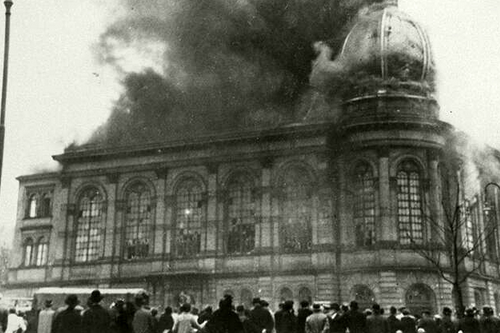
When the Foundations Are Not Even Close to Being What They Claim
Iran labels Argentina’s Navy and Air Force as terrorist organisations in a political retaliation that raises questions about reciprocity, international law, the AMI and israeli embassy a attacks, and Tehran’s foreign policy.
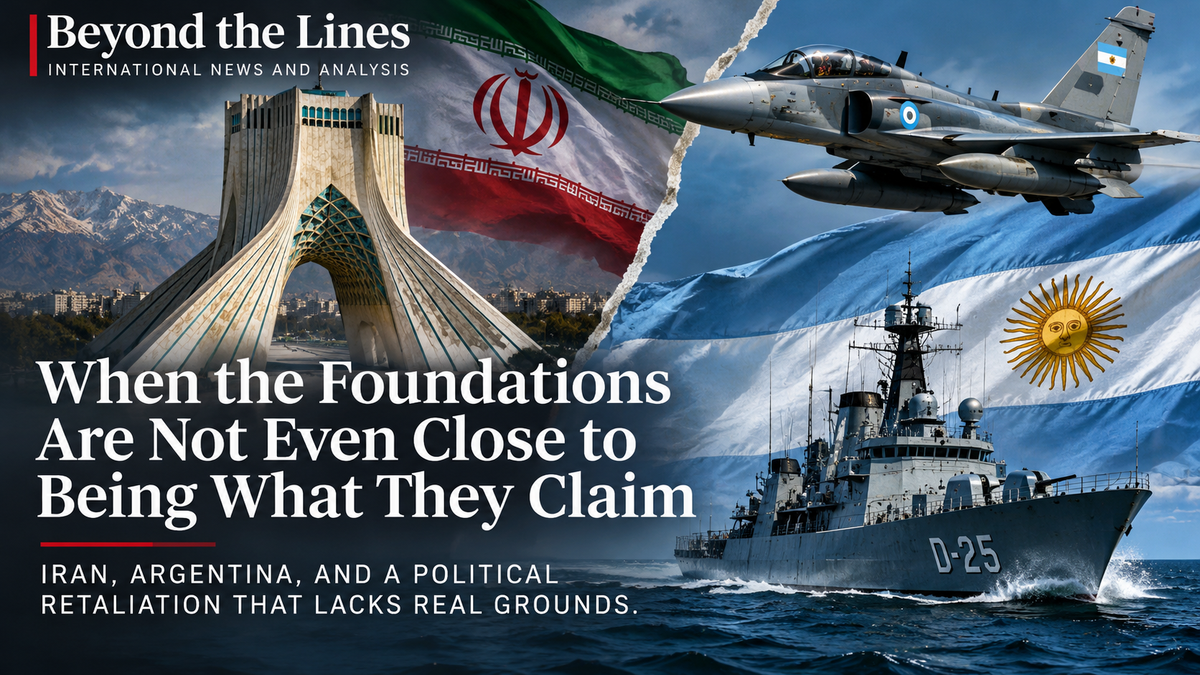
Iran has designated the Argentine Armed Forces, as well as the Argentine Air Force, as terrorist organisations
When despotic thinking, absurdity, and the misuse of religious ideology or some form of pseudo-populist manifesto become instruments for generating hatred, the objective often appears to be the same: to remain in power, concentrate a country's wealth, and act under the conviction of being above every limit, almost as if those in government considered themselves superior to any authority, even God.
Over the past decades, Iran has demonstrated that it has not always been willing — nor does it appear willing today — to pursue a path of understanding with those states with which it maintains political, religious, or strategic disagreements. Its confrontation with the West and its persistent use of religion as an instrument of political power have shaped much of its foreign policy since the final decades of the twentieth century.
Against this background, Iran has designated the Argentine Armed Forces, as well as the Argentine Air Force, as terrorist organisations.
Although Tehran has already adopted similar measures against the United States, the United Kingdom, and other countries, extending this logic to Argentina is as absurd as trying to hang a painting on a cloud.
It lacks solid foundations and, above all, any genuine equivalence between the institutions involved.
What Are Iran's Grounds for This Decision?
The decision announced by the Iranian government on 11 November 2026 is based primarily on political, legal, and diplomatic considerations: the principle of reciprocity.
Tehran is responding to the decision by Javier Milei government to include the Islamic Revolutionary Guard Corps (IRGC) in Argentina's register of individuals and entities linked to terrorism and its financing.
Iran bases its position on three main arguments:
1. The principle of reciprocity
Tehran argues that if Argentina designates an institution belonging to Iran's official military structure as terrorist, it has the right to adopt an equivalent measure against Argentine military institutions.
2. Iranian legislation of 2019
The Iranian government invokes its legislation on reciprocal action in response to the United States' designation of the Revolutionary Guard as a terrorist organisation. On the basis of this domestic legal framework, Tehran seeks to justify measures against states that support or endorse such a designation.
3. The alleged violation of international law
Iran's Ministry of Foreign Affairs maintains that Argentina's decision constitutes a hostile act and violates fundamental principles of international law, arguing that the Revolutionary Guard is part of Iran's official Armed Forces.
However, the fact that domestic legislation allows a government to adopt retaliatory measures does not automatically mean that those decisions enjoy recognition or legitimacy under international law.
Ultimately, we are dealing with a unilateral political and legal designation that, in itself, does not demonstrate that Argentina's military institutions have engaged in terrorist activities.
Reciprocity is not evidence. Nor does it turn two institutionally different situations into equivalent ones.
Why Did Argentina Designate the Iranian Revolutionary Guard as a Terrorist Organisation?
This is a fundamental question if we are to understand the origins of the current confrontation.
Argentina's decision is based on judicial and intelligence-related findings concerning two of the most serious terrorist attacks in its contemporary history:

The attack on the Israeli Embassy
17 March 1992.
- 29 people murdered.
- More than 200 injured.
The AMIA bombing
18 July 1994.
- 85 people murdered.
- More than 300 injured.

Argentina has attributed responsibility for these attacks to Iran and Hezbollah, maintaining that senior Iranian officials and individuals linked to the Revolutionary Guard were involved. Iran, for its part, has historically rejected these accusations.
We are not talking about an ideological disagreement between two governments or a simple diplomatic dispute. We are talking about two terrorist attacks that left victims, devastated families, and an entire society still waiting for answers.
From this perspective, Argentina's decision has a historical and judicial context that cannot be separated from the country's collective memory.
The Memorandum of Understanding: A Wound That Continues to Haunt Argentina
The Memorandum of Understanding between Argentina and Iran, signed in January 2013 under the government of Cristina Fernández de Kirchner, cannot be analysed solely as a diplomatic attempt to break the deadlock in the investigation into the AMIA bombing.
Its economic, commercial, and geopolitical context requires us to consider other interests that may have influenced that decision.
Argentina was facing economic difficulties, foreign exchange restrictions, pressure on its reserves, and an increasing need for foreign currency and international markets. In that context, Iran represented a relevant trading partner and an opportunity to deepen economic and diplomatic relations.
The controversy arose because, while the Argentine government presented the memorandum as a tool to advance the search for truth and justice, its critics, including prosecutor Alberto Nisman, argued that the agreement concealed negotiations intended to serve commercial and political interests, potentially at the expense of the judicial investigation.
Those accusations should not be presented as definitively proven facts. However, it would be equally irresponsible to ignore the circumstances surrounding that rapprochement or the unanswered questions left by the agreement.
From our perspective, the memorandum represents an episode that deserves to be examined within a much broader issue: the use of foreign policy, commercial relations, and a government's domestic needs as instruments of international negotiation.
The central question remains: to what extent can a government compromise matters of justice, sovereignty, and collective memory in the name of an economic or diplomatic opportunity?
The history of the AMIA bombing, relations between Argentina and Iran, and Tehran's recent retaliatory measures against Argentine military institutions demonstrate that foreign policy decisions do not end with the signing of a document. Their consequences can extend for decades.
The Broader Implications of a Decision That Goes Beyond Diplomacy
Iran's decision has several dimensions that deserve attention:
- Diplomatic: It deepens the confrontation between Buenos Aires and Tehran.
- Political: Iran seeks to establish a precedent for retaliating against countries that designate its Revolutionary Guard as a terrorist organisation.
- Military: It introduces a hostile designation against fundamental institutions of Argentina's Armed Forces.
- International: It may complicate bilateral relations and increase tensions in matters of security.
This does not, in itself, mean that Iran has declared war on Argentina, nor does it automatically authorize military action against Argentine forces.
There is also a fundamental issue that cannot be overlooked.
The Iranian Revolutionary Guard and the Argentine Armed Forces have different institutional structures and functions. The former has its own political and ideological structure, directly linked to Iran's system of power, and a record of supporting armed organisations abroad.
Argentina's Navy and Air Force are conventional state military institutions, subject to the Constitution and the country's democratic legal framework.
Therefore, the reciprocity invoked by Tehran does not establish equivalence between these institutions or demonstrate terrorist conduct by Argentina's military forces.
What appears to be taking place is the use of a terrorism designation as an instrument of diplomatic retaliation. Rather than helping to resolve differences, this response deepens a confrontation that offers no constructive prospects.
It is particularly contradictory for a government that claims to defend certain religious and legal principles to maintain practices of repression against its own population. A state in which citizens can be persecuted, detained, or punished for expressing opinions contrary to those in power, questioning religious impositions, or simply disagreeing with the authorities.
The use of terrorism as a political argument loses credibility when those invoking it fail to provide their own citizens with basic guarantees of freedom, justice, and respect for human life.
Iran: Between the Greatness of Its Culture and the Intellectual Poverty of Its Rulers
There is something particularly sad about all of this.
Iran is an extraordinary country. A land of ancient history, thought, poetry, and literature. A society that has given the world great writers, philosophers, and poets — authors capable of making us reflect for hours after reading just a few pages of their work.
A culture that invites critical thought, contemplation, and questioning the very nature of existence.
And yet, today, there seems to be an enormous distance between that cultural richness and those who lead its political institutions.
It is difficult to find intellectual depth in decisions that appear to stem more from pride, resentment, and the need to preserve power than from any genuine willingness to build constructive international relations.
A society cannot be governed through fear, nor can an ideology be defended by turning it into an instrument of persecution. Neither can international legitimacy be achieved through declarations that lack demonstrable legal and factual equivalence.
Iran's greatness does not belong to its rulers. It belongs to its people, its history, its culture, and those who, both within and beyond its borders, continue to defend thought, freedom, and human dignity.
And perhaps that is the greatest contradiction of all: a country with such an extraordinary intellectual heritage, governed by power structures that seem to fear precisely what its own culture has cultivated for centuries — the freedom to think.
Because when power needs to silence thought in order to sustain itself, its foundations cease to be principles and become nothing more than mechanisms of domination.