Kristallnacht: The Night Germany Turned Against Its Jewish Neighbours
Eighty-eight years after Kristallnacht, the November Pogrom remains a warning about antisemitism, state violence and the dangers of silence.

Eighty-eight years after the November Pogrom of 1938, the destruction of Jewish communities remains a powerful reminder of how discrimination, propaganda and institutional failure can lead to organised violence.
HISTORY | IN-DEPTH | 9 NOVEMBER 2026
Estimated reading time: 14–16 minutes
The Story in Brief
On 9 and 10 November 1938, synagogues burned across Nazi Germany, Austria and the Sudetenland. Jewish businesses were destroyed, homes were invaded and tens of thousands of Jewish men were arrested and transported to concentration camps.
The violence became known as Kristallnacht, or the Night of Broken Glass, although historians increasingly use the term November Pogrom to reflect the full extent of the attacks.
The destruction was not spontaneous. Nazi leaders instigated the violence, while police authorities were instructed to permit much of it to continue.
Eighty-eight years later, Kristallnacht remains a defining warning about the dangers of antisemitism, state-sponsored persecution and the erosion of civil rights. Its history demonstrates how discrimination can become normalised long before violence reaches its most extreme form.
Introduction — The Night the World Could No Longer Look Away
On the morning of 10 November 1938, streets across Germany and Austria were covered in shattered glass.
Jewish shop windows had been smashed. Synagogues stood burning or lay in ruins. Homes had been ransacked, religious objects destroyed and thousands of Jewish men taken away by police and Nazi paramilitary organisations.
Families who had lived in Germany for generations suddenly faced a terrifying reality: the government responsible for protecting them had become an organiser of their persecution.
Yet the violence did not begin that night.
For more than five years, Adolf Hitler's National Socialist government had systematically stripped Jewish citizens of their rights, livelihoods and place in German society.
Antisemitic propaganda had portrayed Jews as enemies of the nation. Discriminatory legislation had excluded them from professions, education and public life. Jewish-owned businesses faced boycotts, intimidation and forced transfers of ownership.
By November 1938, the foundations for organised violence had already been established.
Kristallnacht marked a decisive escalation.
What had begun with discrimination, political propaganda and legal exclusion developed into coordinated attacks against Jewish communities across Nazi-controlled territory.
The November Pogrom was not the Holocaust itself. The systematic mass murder of European Jews would develop during the Second World War.
Nevertheless, Kristallnacht exposed the direction in which Nazi persecution was moving.
The events raise questions that remain relevant today.
How does a society reach the point where neighbours turn against one another? What happens when governments encourage hatred rather than restrain it? And how much responsibility lies with those who witness persecution but remain silent?
To understand Kristallnacht, it is necessary to examine not only the violence of those two days, but also the years of political decisions that made it possible.
Chapter 1 — Before Kristallnacht: How Antisemitism Became Government Policy
When Adolf Hitler became Chancellor of Germany on 30 January 1933, antisemitism was already a central element of Nazi ideology.
The Nazi movement portrayed Jewish people not simply as a religious minority, but as a supposed racial threat to German society.
This ideology was promoted through political speeches, newspapers, schools, propaganda films and public campaigns.
Shortly after taking power, the Nazi government began introducing discriminatory measures.
On 1 April 1933, Nazi organisations organised a nationwide boycott of Jewish-owned businesses.
Members of the Sturmabteilung, commonly known as the SA, stood outside shops, medical practices and legal offices, discouraging Germans from entering.
Although the official boycott lasted one day, its significance extended far beyond that date.
It demonstrated that hostility towards Jewish citizens now had government support.
During the following years, Jewish professionals were increasingly excluded from public employment and numerous areas of economic life.
The most important legal turning point came in September 1935, when the Nazi government introduced the Nuremberg Laws.
These laws deprived German Jews of full citizenship rights and prohibited marriages and sexual relations between Jews and people classified by the regime as being of German or related blood.
Discrimination was no longer simply encouraged through propaganda.
It had become enforceable law.
Jewish families who had lived in Germany for generations increasingly found themselves treated as outsiders in their own country.
Children experienced exclusion at school. Professionals lost their livelihoods. Businesses faced growing pressure to transfer ownership to non-Jewish Germans.
The persecution also changed relationships between ordinary people.
Neighbours, colleagues and classmates were increasingly separated by government-imposed racial categories.
Not every German supported Nazi antisemitism, and individual reactions varied. Some people helped Jewish acquaintances or opposed particular measures. Others supported, participated in or benefited from the persecution.
What mattered was that the Nazi government had created an environment in which discrimination became increasingly normalised.
By 1938, Jewish citizens had lost much of their legal, economic and social protection.
The events of November would expose the consequences.
Chapter 2 — The Assassination Used to Justify a Pogrom
On 7 November 1938, a 17-year-old Polish Jewish teenager named Herschel Grynszpan entered the German embassy in Paris and shot the diplomat Ernst vom Rath.
Vom Rath died from his injuries two days later.
The shooting occurred against the background of the forced expulsion of thousands of Polish Jews from Germany in late October 1938.
Grynszpan's own family had been among those expelled and stranded near the Polish border.
Nazi propaganda immediately exploited the assassination.
Rather than treating the shooting as an individual criminal act, the regime presented it as evidence of an alleged wider Jewish conspiracy against Germany.
On 9 November, Nazi leaders gathered in Munich to commemorate Hitler's failed Beer Hall Putsch of 1923.
That evening, Propaganda Minister Joseph Goebbels addressed senior Nazi officials following the announcement of vom Rath's death.
His speech helped initiate the violence that followed.
Party officials communicated instructions to regional organisations. Nazi paramilitary groups mobilised, and police authorities received orders governing their response.
The regime portrayed the attacks as spontaneous expressions of public anger.
Historical documentation establishes otherwise.
The violence was instigated from within the Nazi leadership, with the involvement of party organisations and the deliberate non-intervention of much of the police apparatus.
The assassination provided a pretext for persecution that was already deeply rooted in Nazi policy.
Jewish communities across Germany were collectively punished for an act for which they bore no responsibility.

Chapter 3 — 9–10 November 1938: Synagogues Burned, Homes Destroyed, Families Terrorised
Across Germany, Austria and the Sudetenland, Jewish communities became targets of widespread attacks.
Synagogues were set on fire. Religious texts were desecrated. Jewish cemeteries and community institutions were vandalised.
Shop windows were smashed, merchandise destroyed or stolen, and private homes invaded.
The attackers included members of the SA, SS and Hitler Youth, alongside civilians who joined the violence.
In smaller towns, perpetrators and victims sometimes knew one another personally.
This was not violence committed exclusively by strangers.
It could involve people who had lived on the same streets, attended the same schools or conducted business with one another for years.
Historical estimates vary according to the definitions and records used. More than 1,000 synagogues and Jewish prayer houses were destroyed or damaged, with some historical assessments placing the number above 1,400.
Thousands of Jewish businesses and other properties were attacked.
Approximately 30,000 Jewish men were arrested and sent to concentration camps, although some archival accounts record lower totals.
The death toll is more complex than the frequently repeated figure of 91, which derives from contemporary Nazi reporting.
Later historical research has documented hundreds of deaths connected to the violence and its aftermath, including deaths in concentration camps and suicides.
The human consequences extended far beyond the numerical record.
Families lost their homes and livelihoods. Children witnessed attacks on their parents. Religious communities saw places of worship destroyed.
For many German Jews, Kristallnacht ended any remaining belief that their position might improve under Nazi rule.
The state was no longer merely restricting their rights.
It was facilitating violence against them.
Chapter 4 — When the Police Stood Aside
One of the most disturbing aspects of Kristallnacht was the role played by institutions that were supposed to protect the population.
Police officers were not simply overwhelmed by unexpected violence.
Senior Nazi officials had issued instructions that effectively permitted attacks on Jewish property and religious institutions.
Reinhard Heydrich, head of the Security Police and Security Service, directed police authorities to ensure that the violence did not endanger non-Jewish property or lives.
Jewish synagogues could be destroyed, provided surrounding buildings were protected.
Firefighters in several locations were instructed to prevent flames from spreading to neighbouring properties rather than extinguishing the burning synagogues themselves.
The distinction was revealing.
The authorities were capable of protecting buildings and maintaining public order.
Their instructions determined whose property deserved protection.
For Jewish citizens, the consequences were devastating.
The organisations responsible for enforcing the law were allowing serious crimes to take place.
The events illustrate a fundamental danger in any society: when institutions cease to apply the law equally, vulnerable communities can lose the protections on which their safety depends.
Chapter 5 — From German Streets to Concentration Camps
The destruction of property was only one part of the November Pogrom.
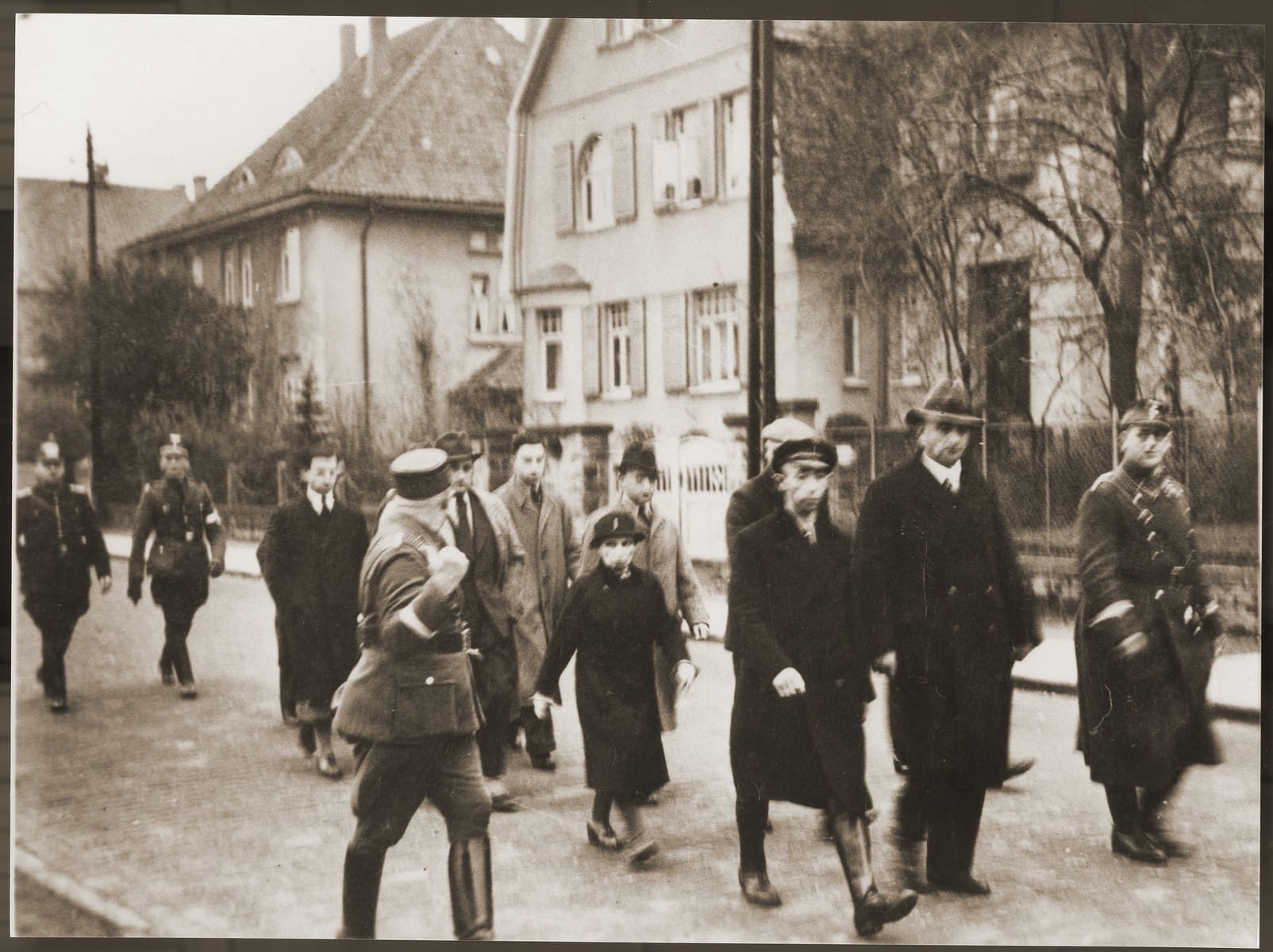
During and immediately after the attacks, tens of thousands of Jewish men were arrested.
Many were transported to Dachau, Buchenwald and Sachsenhausen concentration camps.
These arrests were not based on criminal convictions.
The men were detained because they were Jewish.
Inside the camps, prisoners faced humiliation, physical abuse, harsh conditions and the threat of death.
Some died during imprisonment.
Others were eventually released, often after demonstrating that they intended to leave Germany.
For families, the arrests created a new form of terror.
A husband, father, brother or son could disappear into the concentration camp system without having committed a crime.
The Nazi regime was using imprisonment to accelerate Jewish emigration and intensify pressure on the remaining Jewish population.
Kristallnacht therefore marked an important escalation in the use of concentration camps as instruments of mass persecution.
Although concentration camps had existed since 1933, the November arrests represented the first mass incarceration of Jewish men simply on the grounds of their Jewish identity.
Chapter 6 — The Victims Were Forced to Pay for Their Own Destruction
Following the pogrom, Nazi authorities introduced further economic measures against Jewish citizens.
On 12 November 1938, senior Nazi officials met to discuss the consequences of the violence.
Rather than compensating the victims, the regime imposed a collective financial penalty on Germany's Jewish population.
The amount was one billion Reichsmarks.
Jewish property owners were also made responsible for repairing damage caused by the attackers.
Insurance payments for destroyed property were confiscated or redirected by the state.
Additional measures accelerated the exclusion of Jews from German economic life.
Jewish-owned businesses faced compulsory closure or transfer, and restrictions on employment and commercial activity increased.
The regime was not only persecuting Jewish citizens physically and socially.
It was systematically stripping them of their economic independence.
The violence of November 1938 and the subsequent economic measures reinforced one another.
Jewish families were losing the resources they needed to survive, rebuild or escape.
Chapter 7 — The World Watched: International Reactions and Missed Opportunities
News of Kristallnacht spread internationally.
Newspapers reported the burning of synagogues, attacks on Jewish businesses and arrests of Jewish citizens.
Governments and religious leaders condemned the violence.
The United States recalled its ambassador to Germany for consultations, while international criticism placed the Nazi regime under increased diplomatic scrutiny.
However, condemnation did not produce a coordinated international rescue effort capable of accommodating the large numbers of Jewish refugees seeking safety.
Many countries maintained restrictive immigration policies.
The difficulties facing Jewish refugees had already become apparent during the Evian Conference in July 1938, when representatives of numerous countries discussed the refugee crisis without establishing a comprehensive solution.
Following Kristallnacht, the urgency of emigration increased dramatically.
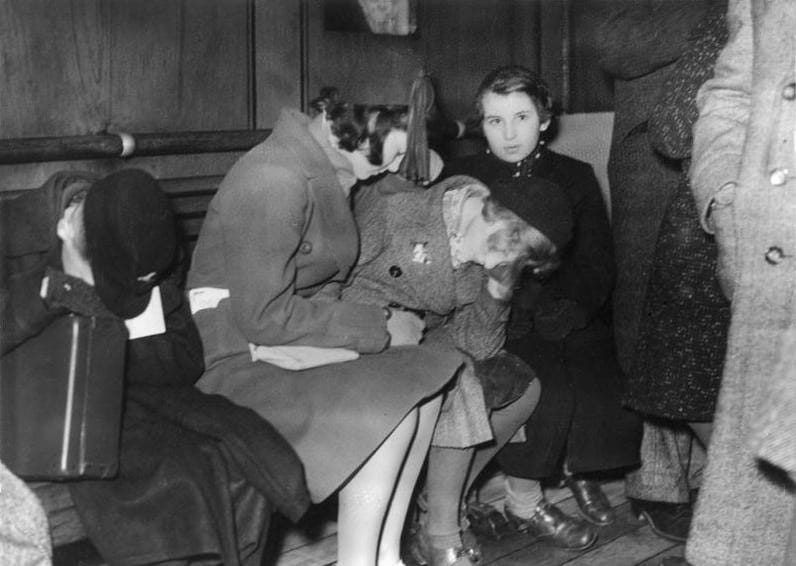
Britain subsequently agreed to admit thousands of predominantly Jewish refugee children through the Kindertransport programme.
Approximately 10,000 children, most of them Jewish, reached Britain before the outbreak of the Second World War.
For many, leaving meant separation from parents they would never see again.
International responses were therefore mixed.
There were acts of humanitarian assistance, diplomatic condemnation and individual courage.
But there were also restrictive immigration systems, political hesitation and failures to provide sufficient refuge.
The history of Kristallnacht demonstrates that recognising persecution and responding effectively to it are not the same thing.
Chapter 8 — Ordinary People: Participation, Silence and Resistance
Kristallnacht raises difficult questions about the behaviour of ordinary people during periods of state-sponsored persecution.
The violence was organised by Nazi authorities, but it also involved civilians.
Some participated in attacks, looting or public humiliation.
Others watched without intervening.
Some expressed disapproval of the destruction, particularly the damage to property, without necessarily opposing the persecution of Jewish citizens.
There were also Germans who assisted Jewish neighbours or refused to participate.
The historical record does not support treating the entire German population as having responded identically.
Nevertheless, the events demonstrate how political propaganda, fear, opportunism and social pressure can shape behaviour.
When a government repeatedly portrays a minority as dangerous, disloyal or responsible for national problems, discrimination can become socially acceptable to increasing numbers of people.
The gradual erosion of empathy can make further persecution easier.
Kristallnacht also demonstrates the importance of individual decisions.
Whether to participate, remain silent, object or help someone in danger could have profound consequences.
Those decisions were made within a dictatorship, where opposition could carry serious risks.
That context matters when examining the behaviour of witnesses and bystanders.
Understanding those circumstances does not diminish the responsibility of the perpetrators.
It helps explain how organised persecution became possible.

Chapter 9 — From Kristallnacht to the Holocaust
Kristallnacht was not the beginning of Nazi antisemitism, nor was it the beginning of the Holocaust's systematic mass murder.
It was, however, a major turning point.
The events revealed that the Nazi leadership was prepared to organise widespread physical violence against Jewish communities and use state institutions to facilitate persecution.
In September 1939, Germany invaded Poland, beginning the Second World War in Europe.
The Nazi occupation of large territories brought millions more Jews under German control.
Persecution intensified through forced relocation, ghettos, mass shootings and deportations.
Following Germany's invasion of the Soviet Union in June 1941, mobile killing units and other German forces murdered Jewish civilians on an enormous scale.
The Nazi regime subsequently developed and implemented a systematic programme of mass murder across occupied Europe.
By the end of the Holocaust, approximately six million European Jews had been murdered.
The progression from discriminatory legislation to organised violence and ultimately genocide was not inevitable in every historical detail.
It resulted from decisions made by political leaders, institutions and perpetrators over time.
Kristallnacht remains significant because it exposes an earlier stage in that progression, when the destruction of Jewish communities was publicly visible and the Nazi state demonstrated its willingness to facilitate it.
Chapter 10 — Eighty-Eight Years Later: Why Kristallnacht Still Matters
Eighty-eight years after the November Pogrom, the historical circumstances of 1938 remain distinct from those of contemporary Europe.
Modern European states operate under different legal, political and institutional frameworks.
Comparisons with Nazi Germany therefore require care.
Not every instance of prejudice, political extremism or public disorder represents a repetition of the events that preceded the Holocaust.
Nevertheless, the history of Kristallnacht offers important lessons about the mechanisms through which hatred can spread.
Antisemitism did not begin with burning synagogues.
It developed through years of propaganda, discriminatory legislation, exclusion and the portrayal of Jewish citizens as a collective threat.
Today, antisemitism can appear through harassment, threats, conspiracy theories, attacks on Jewish institutions and the targeting of individuals because of their Jewish identity.
Political disagreements about Israel, including criticism of its government and military policies, must remain open to legitimate debate.
Such criticism is not automatically antisemitic.
However, holding Jewish people collectively responsible for the actions of the Israeli government, threatening Jewish communities or attacking synagogues because of events in the Middle East crosses a fundamental boundary.
Jewish citizens should never have to answer for decisions made by a foreign government simply because they are Jewish.
The same principle of individual dignity and protection applies to Muslims, Christians and members of every other religious or ethnic community.
Remembering Kristallnacht should not become an exercise in comparing suffering or assigning collective guilt.
Its historical importance lies partly in recognising what happens when society abandons the principle that every person deserves equal protection under the law.
What This Means — Remembrance Requires More Than Words
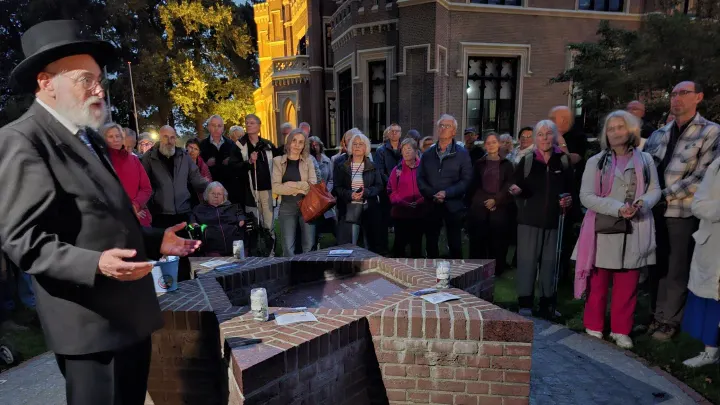
Every year, commemorations of Kristallnacht bring together survivors, descendants, political leaders, religious communities and members of the public.
Candles are lit. Names are remembered. Speeches are delivered.
These acts of remembrance have genuine importance.
But historical remembrance also requires an understanding of how persecution developed and why institutions failed to stop it.
Kristallnacht was preceded by years of political radicalisation and discriminatory government policy.
It was made possible by the decisions of Nazi leaders, the participation of organised groups and civilians, and the deliberate failure of authorities to protect Jewish citizens.
The lessons extend beyond the protection of any one community.
They concern the responsibility of governments to uphold equal rights, the obligation of law enforcement to protect people without discrimination and the importance of independent journalism in exposing hatred and abuses of power.
They also concern the choices made in everyday life.
A society's commitment to human dignity is tested not only when persecution becomes extreme, but when discrimination first begins to appear acceptable.
Conclusion — Never Again Must Be More Than a Promise
On 9 November 1938, Jewish families across Nazi Germany watched their homes, businesses and places of worship come under attack.
For many, the violence destroyed any remaining sense of security in the country they called home.
Eighty-eight years later, the photographs of shattered shop windows and burning synagogues remain among the most recognisable images of Nazi persecution before the Second World War.
Yet the true significance of Kristallnacht lies beyond the destruction captured in those photographs.
It is found in the people who were attacked, the families torn apart, the institutions that failed them and the political system that organised their persecution.
The Holocaust would later demonstrate the catastrophic consequences of Nazi racial ideology and the systematic dehumanisation of millions of people.
Remembering Kristallnacht means understanding that such crimes did not emerge without warning.
They were preceded by choices, policies and actions that progressively stripped Jewish citizens of their rights and protection.
The responsibility of remembrance belongs not only to historians or the descendants of survivors.
It belongs to societies that wish to prevent persecution from taking root again.
Never Again must remain more than a phrase spoken at memorial ceremonies. It must be reflected in the protection of human dignity, the rejection of antisemitism and the defence of equal rights — wherever people are threatened because of who they are.
Sources & References
- United States Holocaust Memorial Museum — Kristallnacht: https://encyclopedia.ushmm.org/content/en/article/kristallnacht
- United States Holocaust Memorial Museum — The Holocaust Encyclopedia: https://encyclopedia.ushmm.org/
- Jewish Museum Berlin — 9 November 1938: https://www.jmberlin.de/en
- Yad Vashem — The November Pogrom: https://www.yadvashem.org/
- USC Shoah Foundation — Survivor Testimonies and Kristallnacht: https://sfi.usc.edu/
- Holocaust Memorial Day Trust — Kristallnacht: https://hmd.org.uk/
- Norwegian Centre for Holocaust and Minority Studies: https://www.hlsenteret.no/
Editorial Note
Historical estimates of the destruction and deaths associated with Kristallnacht vary according to the records and definitions used. The frequently cited figure of 91 deaths originates from contemporary Nazi reporting and does not capture the full number of deaths connected with the pogrom and its aftermath.
This article distinguishes the historical events of 1938 from contemporary developments. Its discussion of modern antisemitism is intended to explain the continuing relevance of historical remembrance, not to equate present-day Europe with Nazi Germany.
Beyond the Lines — Independent Journalism. Beyond the Headlines.