Walking Against Antisemitism: How Solidarity Walk Became a Growing Movement Across the Netherlands
From two walkers to 25 Dutch locations: how Solidarity Walk is building a grassroots movement against antisemitism.
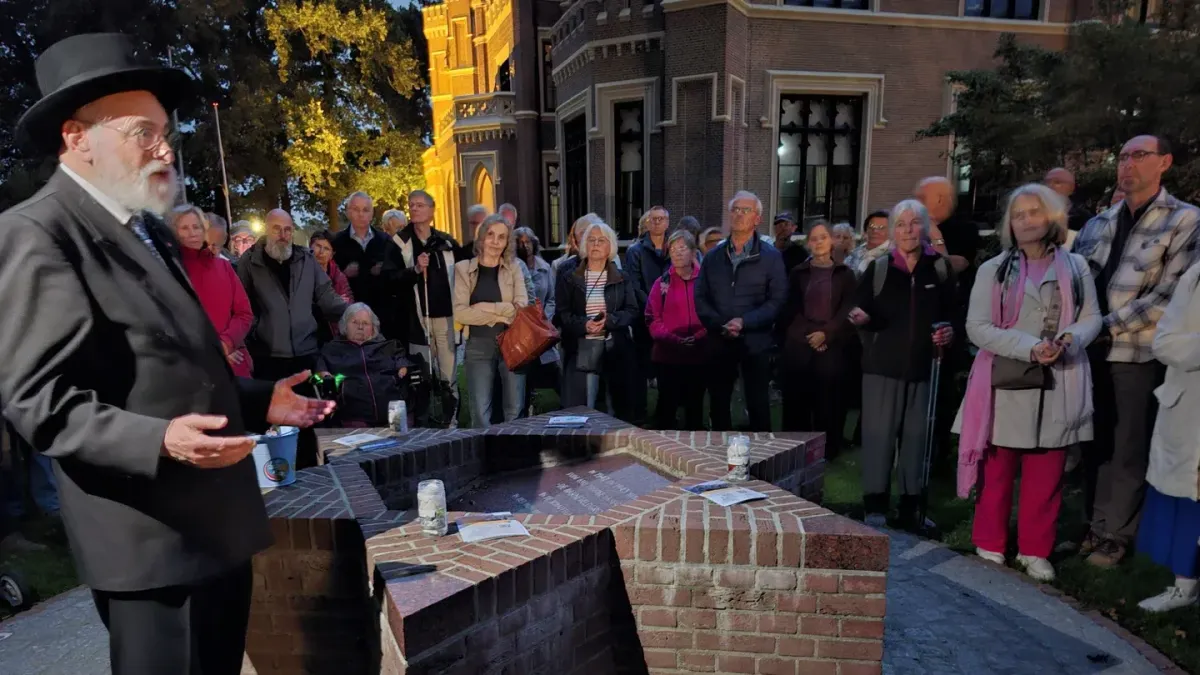
From two people walking through Amersfoort to a network spanning 25 Dutch locations, Solidarity Walk is turning concern about antisemitism into visible public action.
Estimated reading time: 10–12 minutes
The Story in Brief
What began in November 2023 as a simple walk through the Dutch city of Amersfoort has developed into a growing grassroots movement supporting Jewish communities and opposing antisemitism.
Founded by Jacob Schermers and his wife following the Hamas-led attacks on Israel on 7 October 2023, Solidarity Walk encourages people to demonstrate solidarity through peaceful, recurring walks in their own communities.
By November 2026, the initiative reported activities in 25 Dutch locations, alongside a group in Spain. The movement has also established Stichting Solidarity Walk, reportedly obtaining recognised public-benefit status in the Netherlands.
Against a background of persistent antisemitic incidents, the initiative raises a broader question: can ordinary citizens help strengthen community relationships through small but consistent acts of solidarity?
For Solidarity Walk, the answer begins with walking together.
Introduction — When Solidarity Becomes Action
Across Europe, the consequences of international conflicts are increasingly visible in local communities.
Political disagreements surrounding Israel and the Palestinians have become part of public demonstrations, university debates, social media discussions and everyday conversations.
For Jewish communities, these tensions have also coincided with serious concerns about antisemitism, intimidation and personal safety.
In the Netherlands, official figures show that police recorded hundreds of antisemitic incidents in both 2024 and 2025. Jewish organisations have repeatedly expressed concern about the ability of Jewish citizens to live openly and safely.
It was within this environment that a small initiative began in Amersfoort in November 2023.
There were no elaborate campaigns or major demonstrations. Two people simply decided to walk through their city to express support for the Jewish community.
Three years later, that initiative has developed into Solidarity Walk, a growing network bringing together people from different towns, churches and backgrounds.
Its central message is straightforward: solidarity should be more than words.
But the movement's development also raises questions about the role of faith, public responsibility and community engagement in societies experiencing growing polarisation.
1. The Beginning: Two People Walking Through Amersfoort
The origins of Solidarity Walk can be traced to November 2023, shortly after the Hamas-led attacks on southern Israel on 7 October.
The attacks killed approximately 1,200 people in Israel, according to Israeli authorities, and resulted in around 250 people being taken hostage.
The subsequent war in Gaza caused widespread civilian suffering and intensified political and social tensions far beyond the Middle East.
In the Netherlands, these developments contributed to an increasingly difficult public atmosphere surrounding Israel, Jewish identity and antisemitism.
Jacob Schermers and his wife wanted to demonstrate that Jewish people in their community were not alone.
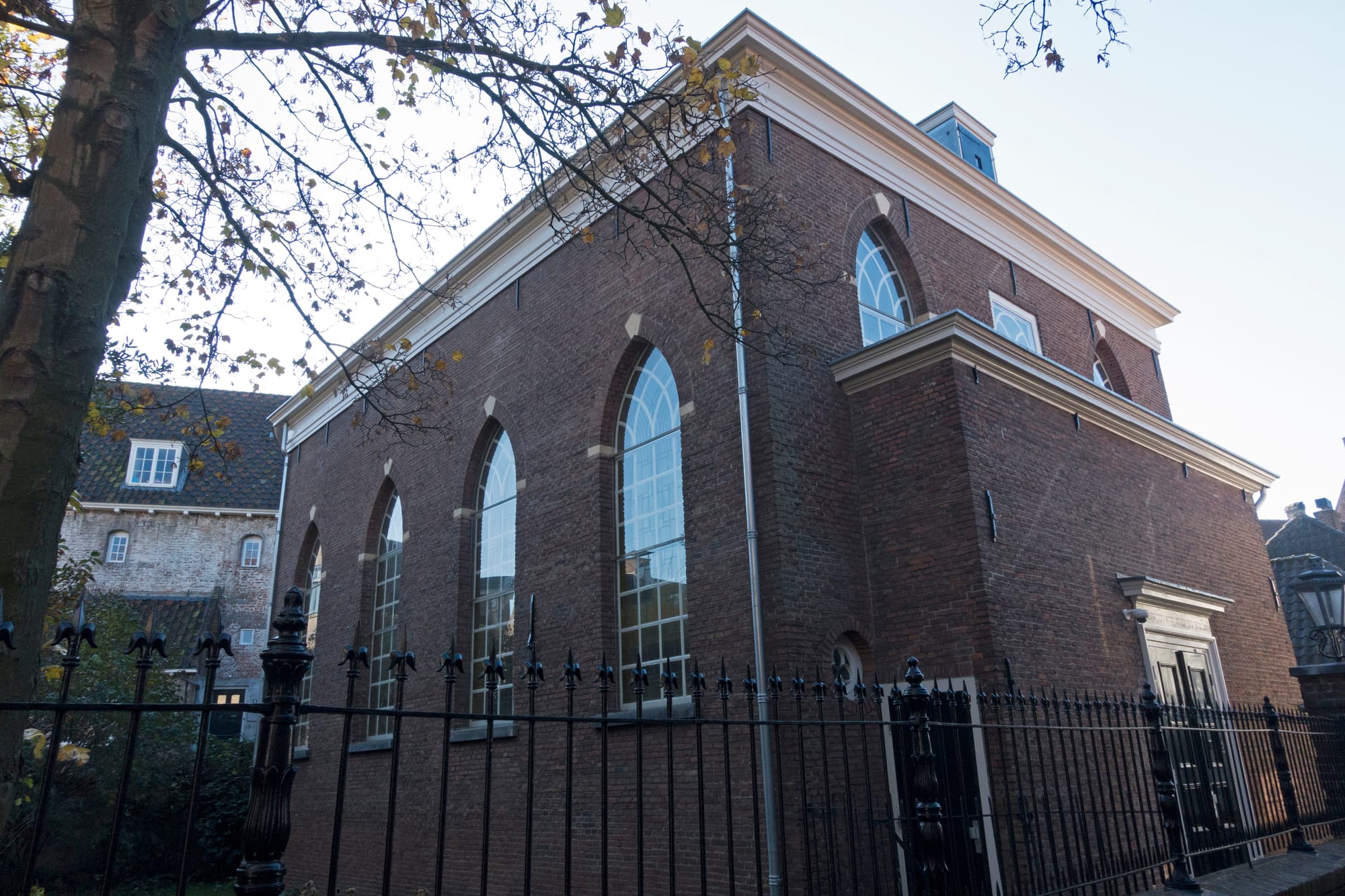
They began walking from Amersfoort's town hall towards the synagogue, passing a church along the route.
The locations were symbolic.
The town hall represented civic society and public responsibility. The church reflected the Christian background of the organisers. The synagogue represented the Jewish community they wished to support.
Their action was intentionally simple.
There were no large crowds, political speeches or elaborate organisational structures.
Instead, the couple demonstrated their support through their physical presence in the city.
Over time, others joined them.
The idea began spreading beyond Amersfoort, inspiring similar walks in other Dutch communities.
What started as a personal response to international events gradually developed into a wider grassroots initiative.
2. Why Walking? The Meaning Behind the Movement
At first glance, walking through a town may appear to be a modest response to a problem as serious as antisemitism.
Solidarity Walk's organisers, however, believe that visible public participation has meaning.
Their approach is based on the principle that support should not remain confined to private conversations, statements on social media or declarations issued by institutions.
Instead, individuals can demonstrate solidarity by being present in their own communities.
Participants gather at agreed locations and walk together, sometimes passing synagogues, churches, municipal buildings or Jewish memorial sites.
The routes frequently reflect the history and identity of the communities in which they take place.
Some gatherings include prayer or reflection. Others provide opportunities for conversations between participants.
The movement's Christian origins remain important, but the organisers invite participation from people with different backgrounds and beliefs.
A person may join because of religious conviction, concern about antisemitism or a broader commitment to freedom of religion and equal rights.
These motivations are not necessarily identical, but they can coexist within a shared public activity.
The walks are also intended to be recurring rather than isolated events.
According to the organisers, regular participation helps demonstrate that support for Jewish communities is not limited to moments of crisis.
The objective is to establish a continuing presence that encourages awareness, conversation and community relationships.
3. Antisemitism in the Netherlands: What the Figures Reveal
Solidarity Walk emerged against a background of growing concern about antisemitism in Dutch society.
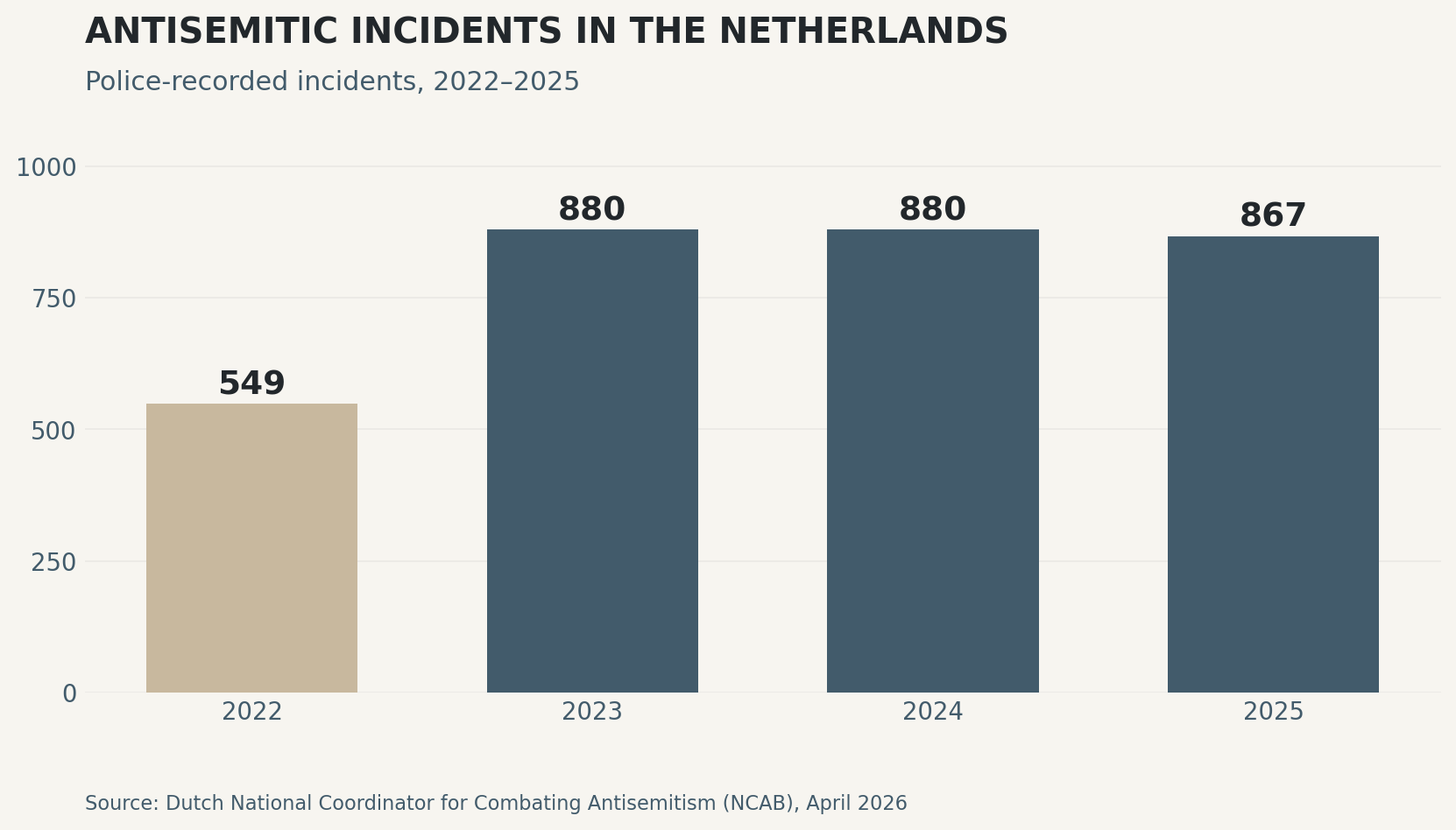
Figures published by the Dutch National Coordinator for Combating Antisemitism in April 2026 show that police registered 867 antisemitic incidents in 2025, compared with 880 in 2024.
Although the total decreased slightly, it remained substantially above the 549 incidents recorded in 2022.
The figures also reveal differences between categories of incidents.
Police registered 34 cases involving antisemitic violence in 2025, compared with 42 in 2024.
However, antisemitic threats increased from 88 to 93 over the same period.
The authorities reported that more than 400 incidents in 2025 concerned Jewish people or institutions, including incidents in residential areas, public spaces and near Jewish buildings or cemeteries.
These figures represent recorded incidents rather than a complete measurement of every antisemitic experience in Dutch society.
Different organisations also use different reporting methods.
For example, the Centre for Information and Documentation on Israel (CIDI) registered 281 antisemitic incidents in 2025, compared with 421 in 2024.
The figures should not be directly compared with police totals because the organisations use different definitions, reporting channels and methodologies.
Nevertheless, both datasets demonstrate that antisemitism remains a significant concern.
Beyond statistics, the issue affects everyday decisions.
Some Jewish people report being reluctant to display recognisable religious symbols, discuss their identity openly or attend Jewish events without considering security concerns.
The question is therefore not only how many incidents occur, but also how insecurity influences the ability of Jewish citizens to participate freely in society.
Solidarity Walk seeks to address part of that social dimension through visible community support.
Its activities cannot replace law enforcement, education or government policy. However, the organisers believe that public solidarity can help counter feelings of isolation.

4. From Amersfoort to 25 Dutch Locations
By November 2026, Solidarity Walk had developed far beyond its original location.
According to a report published by Christelijk Nieuws on 8 November, the movement now organises walks in 25 locations across the Netherlands.
The initiative has also expanded internationally, with a walking group established in Albir, Spain.
Dutch locations associated with the movement include Amersfoort, Zwolle, Groningen and Rotterdam.
Participation varies between communities.
Some gatherings reportedly attract more than one hundred people, while others bring together smaller groups of several dozen participants.
For the organisers, the importance of a walk is not determined exclusively by attendance.
A small group in a local neighbourhood can express the same message of solidarity as a larger gathering in a major city.
This approach is central to the movement's organisational model.
Rather than relying on one national demonstration, Solidarity Walk encourages residents to establish activities in their own towns.
The organisation's website provides information about existing walks and practical guidance for people interested in starting a local initiative.
The aim is to make participation accessible and sustainable.
Regular local gatherings may also provide opportunities to establish relationships between residents, religious communities and local organisations.
However, expansion creates new challenges.
As the network grows, organisers must consider coordination, communication, volunteer support and relationships with the Jewish communities they seek to support.
The reported presence in 25 Dutch locations represents an important stage in Solidarity Walk's development, although the number of participants and the longer-term impact of the walks have not been independently assessed.
5. A New Foundation: Building for the Future
In November 2026, Solidarity Walk reached another organisational milestone.
The initiative formally established Stichting Solidarity Walk, providing a foundation through which its activities can be coordinated and developed.
According to Christelijk Nieuws, the foundation has also obtained ANBI status.
In the Netherlands, ANBI stands for Algemeen Nut Beogende Instelling, a designation for organisations recognised by the Dutch tax authorities as serving the public benefit.
Under applicable Dutch regulations, donations to qualifying organisations may be eligible for tax deductions.
For Solidarity Walk, establishing a foundation represents an important transition.
The initiative began as a personal act of solidarity, supported by individuals who volunteered their time and energy.
A formal organisational structure may help the movement develop a more coordinated approach to fundraising, administration, local activities and future planning.
It may also support relationships with churches, community organisations and other institutions interested in its objectives.
At the same time, the movement faces the challenge of maintaining its original grassroots character.
One of its defining features has been the simplicity of participation.
People do not need extensive resources or organisational experience to join a walk.
As the foundation develops, balancing that accessibility with the responsibilities of a growing organisation will be important.
The reported ANBI recognition is a significant development, although its registration details should be checked directly against the Dutch tax authorities' public register.
6. Beyond the News: A Personal Journey to Israel
Solidarity Walk's activities are not limited to gatherings in Dutch streets.
A report published in November 2026 highlights the experience of Leonie Hurink, whose involvement with the movement provided an opportunity to travel to Israel.
Since 7 October 2023, Hurink had followed developments in Israel closely.
She read news reports, followed personal accounts and tried to understand the experiences of people living through a period of conflict and uncertainty.
However, she increasingly recognised the limitations of observing events from a distance.
Through Solidarity Walk, she was able to visit Israel and meet people whose experiences had previously reached her primarily through news coverage.
During the journey, she listened to personal stories, asked questions and gained impressions of everyday life.
According to the published account, those encounters deepened her understanding of the human experiences behind international events.
Her journey illustrates a broader point about public engagement.
News reports often focus on governments, military developments and diplomatic negotiations.
Yet international conflicts also affect individual families, communities and personal relationships.
Meeting people directly can provide additional perspectives that are difficult to communicate through statistics or political statements alone.
Such encounters do not replace independent journalism or provide a complete understanding of a complex conflict.
They can, however, encourage participants to consider the experiences of individuals beyond the political headlines.
For Solidarity Walk, this reflects an important part of its wider approach: moving from expressions of concern towards personal engagement.
7. Faith, Responsibility and the Meaning of Solidarity
Christian faith has played a central role in Solidarity Walk since its beginnings.
The movement emerged from a combination of religious conviction, concern about antisemitism and a desire to demonstrate practical support for Jewish communities.
Its activities frequently include prayer, reflection and references to biblical teachings.
During a gathering at De Kandelaar in Voorthuizen, a representative of the initiative presented its message through three Dutch expressions:
Wandelen, wachters en wakker worden.
Translated into English, these mean walking, watchmen and awakening.
Walking represents the decision to act rather than remain a passive observer.
Watchmen refers to the biblical image of people remaining alert and accepting responsibility when others face danger or injustice.
Awakening represents a call to recognise social problems and respond rather than remain indifferent.
For Christian participants, these ideas connect religious belief with public responsibility.
Yet the wider questions extend beyond religion.
What responsibility do neighbours have when members of their community experience discrimination?
How can concern be translated into practical action?
And can people with different religious and political convictions work together around shared principles?
Solidarity Walk offers one possible response through peaceful and recurring community gatherings.
Its religious identity remains an important part of the movement, but its public invitation extends beyond those who share the organisers' faith.
That openness may become increasingly important as the initiative expands into more diverse communities.
8. Jewish Identity, Israel and the Importance of Distinction
One of the challenges facing initiatives such as Solidarity Walk is the relationship between solidarity with Jewish communities and political support for Israel.
The movement's organisers openly express support for both the Jewish community and Israel.
For some participants, these commitments are closely connected through religious belief, historical understanding or personal relationships.
However, Jewish identity and Israeli government policy are not interchangeable.
Jewish communities include people with different nationalities, religious traditions and political opinions.
They also hold a wide range of views about Israel and its government.
Holding Jewish citizens collectively responsible for the decisions of the Israeli government is discriminatory.
At the same time, criticism of Israeli government policies, including military operations or settlement policies, does not automatically constitute antisemitism.
The distinction matters particularly during periods of intense international conflict.
People should be able to express political opinions, demonstrate peacefully and criticise governments without intimidating or discriminating against others because of their religion or identity.
For Solidarity Walk, maintaining a peaceful and inclusive environment will remain important as its activities reach more communities.
The movement's public expression of support for Israel may be welcomed by some participants and questioned by others.
Understanding these different perspectives, while keeping opposition to antisemitism at the centre of the discussion, will be an important part of its future development.
9. Can Small Civic Actions Make a Difference?
A public walk cannot, by itself, eliminate antisemitism.
Nor can participation numbers establish whether Jewish communities feel safer or whether discriminatory attitudes have declined.
Those outcomes would require independent research and longer-term assessment.
Nevertheless, civic initiatives can have significance beyond measurable short-term results.
They can create opportunities for conversations between people who might otherwise never meet.
They can demonstrate that concerns about discrimination are shared beyond the communities directly affected.
They can also encourage residents to consider their own responsibilities within society.
Solidarity Walk's approach is based on consistency rather than confrontation.
Its organisers believe that regular participation sends a message that extends beyond a single public event.
The movement also illustrates how grassroots initiatives can develop without initially relying on major institutions or extensive financial resources.
Its growth from two walkers to a network of local groups demonstrates the potential for individual action to inspire wider participation.
However, the question of impact remains important.
As Solidarity Walk develops, hearing directly from Jewish communities about their experiences of the initiative would provide valuable insight.
Such perspectives could help establish whether the walks contribute to feelings of support, stronger community relationships or greater public awareness.
The movement's continued development offers an opportunity to examine how local solidarity operates in practice.
10. What This Means for Europe
The concerns that prompted Solidarity Walk are not limited to the Netherlands.
Across Europe, Jewish communities have reported experiences of harassment, threats and discrimination.
European institutions have recognised antisemitism as a continuing challenge requiring coordinated action involving governments, law enforcement, education and civil society.
The European Union's strategy for combating antisemitism and fostering Jewish life emphasises both the protection of Jewish communities and the importance of allowing Jewish life to flourish openly.
Solidarity Walk represents one form of civic participation within this broader challenge.
Its approach is local, recurring and relatively simple to organise.
The initiative does not provide a complete solution to antisemitism, but it raises questions that are relevant across European societies.
How can communities respond when international conflicts intensify tensions at home?
How can citizens support neighbours experiencing discrimination without increasing political polarisation?
And how can religious organisations, secular groups and local institutions cooperate around fundamental rights?
These questions are particularly important in societies where political disagreements increasingly influence personal relationships.
Opposition to antisemitism should not require agreement on every aspect of Middle Eastern politics.
It should rest on the principle that people must be able to live safely and openly, regardless of their religion, ethnicity or political beliefs.
The same principle applies to the protection of Muslim communities, Christians and other groups facing discrimination.
The challenge for European societies is to defend these rights consistently, even when public debate becomes deeply divided.
11. The Future of Solidarity Walk
The establishment of Stichting Solidarity Walk and the reported expansion to 25 Dutch locations mark a new phase in the movement's development.
Its organisers hope to reach additional communities, encourage more local groups and strengthen the network of people willing to participate.
The foundation may provide greater organisational stability and opportunities for cooperation with other institutions.
Yet future growth will depend on more than numbers.
Maintaining relationships with local communities, supporting volunteers and ensuring that gatherings remain peaceful and accessible will be important.
The movement will also need to consider how its activities are experienced by the Jewish people it intends to support.
Direct engagement, listening and dialogue could help strengthen those relationships.
For founder Jacob Schermers, the journey from a personal act of solidarity to a national initiative represents a significant development.
The story is still unfolding.
Beyond the Lines has established contact with Solidarity Walk and intends to explore the movement's origins, experiences and future ambitions through a separate interview.
That conversation will provide an opportunity to examine the personal motivations behind the initiative and the challenges involved in building a growing network of solidarity.
Conclusion — Solidarity Begins Close to Home
In November 2023, two people began walking through Amersfoort to demonstrate that Jewish members of their community were not alone.
Three years later, Solidarity Walk reports activities in 25 Dutch locations, a group in Spain and a newly established foundation.
The movement has developed from a personal gesture into a more structured grassroots initiative.
Yet its central message remains largely unchanged.
Its organisers believe that solidarity should be demonstrated through visible participation, personal involvement and a willingness to stand alongside others.
At a time when antisemitism remains a serious concern across Europe, Solidarity Walk raises an important question about the role ordinary citizens can play in strengthening their communities.
Its long-term impact remains to be assessed.
But its development illustrates how a small act of public solidarity can encourage others to participate.
For a movement that began with two people walking through their own city, that is a significant journey.
And for societies struggling with division, it offers a subject worthy of continued attention, critical examination and dialogue.
Sources & References
- Solidarity Walk — Official Website. Organisational mission, local activities and information about the initiative.
https://www.solidaritywalk.com/ - Christelijk Nieuws (8 November 2026). Solidarity Walk groeit uit tot landelijke beweging: solidariteit met de Joodse gemeenschap. Reporting on the movement's expansion, foundation, ANBI status and community activities.
https://christelijknieuws.nl/2026/11/08/solidarity-walk-groeit-uit-tot-landelijke-beweging-solidariteit-met-de-joodse-gemeenschap/ - Christelijk Nieuws (4 November 2026). Christelijke organisaties in Nederland komen op voor Israël en het Joodse volk. Background on the origins of Solidarity Walk and its founder.
https://christelijknieuws.nl/2026/11/04/christelijke-organisaties-in-nederland-komen-op-voor-israel-en-het-joodse-volk/ - National Coordinator for Combating Antisemitism, Netherlands (15 April 2026). Antisemitismecijfers 2025: opnieuw zorgwekkend hoog. Official police-recorded antisemitism statistics.
https://www.ncab.nl/actueel/nieuws/2026/04/15/antisemitismecijfers-2025-opnieuw-zorgwekkend-hoog - National Coordinator for Combating Antisemitism (28 May 2026). Nieuwe CIDI-cijfers: antisemitisme daalt, maar blijft structureel hoog. CIDI monitoring results and methodological context.
https://www.ncab.nl/actueel/nieuws/2026/05/28/nieuwe-cidi-cijfers-antisemitisme-daalt-maar-blijft-structureel-hoog - Government of the Netherlands. National Strategy to Combat Antisemitism 2024–2030. Government priorities concerning security, education and antisemitism prevention.
https://www.ncab.nl/ - European Commission. EU Strategy on Combating Antisemitism and Fostering Jewish Life 2021–2030. European policy framework.
https://commission.europa.eu/ - Dutch Tax Administration (Belastingdienst). ANBI regulations and public register. Information on public-benefit organisations and donation rules.
https://www.belastingdienst.nl/
Editorial Note
This article draws on public information published by Solidarity Walk, Christelijk Nieuws and official Dutch and European institutions. The movement's reported geographical expansion and ANBI recognition have been attributed to published accounts; the underlying registration and participation figures have not been independently audited. Beyond the Lines is in contact with Solidarity Walk, but no unpublished interview statements have been used. A separate interview is planned.