ARGENTINA AND THE LEVANT
Since the late 19th century, immigrants from Syria, Lebanon, and the Levant have shaped Argentina’s cultural and social identity, building lasting ties between the Eastern Mediterranean and South America through family networks, commerce, and community institutions.

A Shared History of Migration, Identity, and Diplomacy
An Investigative Journalistic Report
From the Nineteenth Century to the Present
INTRODUCTION
Two Regions Connected by People, Not Only by Governments
The relationship between Argentina and the Eastern Mediterranean Levant is far older and more complex than might be assumed by looking only at contemporary diplomatic relations. Before many of the states and borders we recognize today existed, people from territories now associated with Syria, Lebanon, and Palestine began emigrating to South America. At the same time, Jewish communities from Europe and other regions arrived in Argentina and established communal lives that maintained connections with Palestine and, later, the State of Israel.
These migrations formed part of a broader international process shaped by the economic, political, and social transformations of the nineteenth and early twentieth centuries. The crisis of the Ottoman Empire, economic hardship, family networks, commercial opportunities, and political changes all influenced the decisions of people seeking a future beyond their places of origin.
Argentina became one of the destinations for these migration movements. In its cities and towns, newcomers established businesses, associations, religious institutions, and family networks. Over generations, their descendants became active participants in the country's economic, cultural, and political life.
Meanwhile, the transformation of the Levant during the twentieth century gave rise to new states, territorial disputes, and international conflicts. The establishment of Israel in 1948, the displacement of Palestinians during the war that year, and subsequent regional conflicts influenced the diplomatic relations of numerous countries, including Argentina.
This report examines these developments from a historical and journalistic perspective. Its purpose is neither to portray Jewish and Arab communities as uniform blocs nor to reduce the history of the region to contemporary conflicts. Instead, it seeks to understand different migration experiences, the formation of identities, the evolution of diplomatic relations, and the ways events in the Levant have affected Argentine society.
The research is organized around three main dimensions: the history of the region and its populations; the development of ties between Argentina and migrant communities; and the transformation of those relationships within the contemporary diplomatic landscape.
PART I. UNDERSTANDING THE LEVANT
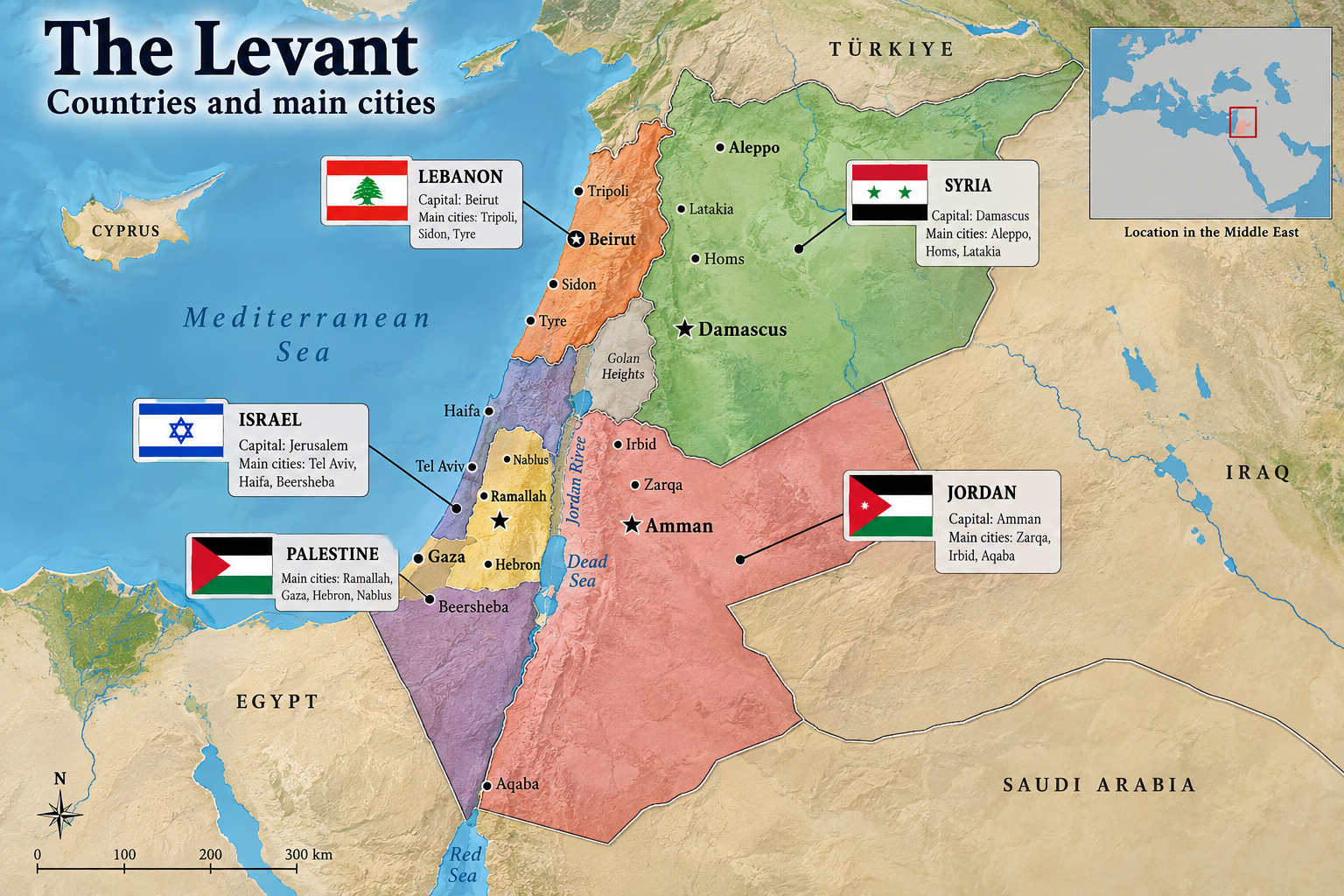
CHAPTER 1. The Levant: The Origin of the Name and Its Geographic Boundaries
The term Levant is used to describe a region of the eastern Mediterranean. Its origin is associated with the French word levant, derived from lever, meaning “to rise,” referring to the direction from which the sun rises. A similar idea appears in the Arabic term Mashriq, associated with the east and the place of sunrise.
However, the Levant does not have universally accepted geographic boundaries. Its definition varies according to historical period, political context, and academic usage. In common usage, it includes territories such as Lebanon, Syria, Israel, Palestine, and Jordan. Some definitions also incorporate parts of Turkey, Cyprus, or other areas near the eastern Mediterranean.
It is important to distinguish the Levant from broader concepts. The term Middle East may also include countries such as Iraq, Iran, and the states of the Arabian Peninsula. The term Arab world, meanwhile, encompasses countries in both Asia and North Africa that share, despite significant internal differences, linguistic and cultural connections associated with the Arabic language.
These categories are not interchangeable. Israel is geographically part of the Levant, but it is not an Arab state. Iran is generally included in definitions of the Middle East, although it is not usually considered part of the Levant's geographic core. Likewise, not all Arab people are Muslim: Christian communities and other religious traditions have a long history in the region.
Understanding these distinctions is essential when studying migration to Argentina. The people who arrived from the Levant did not necessarily come from nation-states with the borders that exist today. Many emigrated from localities that were then part of the Ottoman Empire.
For this reason, the history of these communities requires distinctions between birthplace, family identity, language, religion, political affiliation, and the nationality recorded in contemporary documents.
CHAPTER 2. Before Argentina: The Ottoman Levant and the Origins of Migration
Throughout much of the nineteenth century, numerous territories in the Levant were under the rule of the Ottoman Empire. The empire's administrative divisions did not correspond to the borders of the states that emerged after the First World War.
The population of the region was diverse. It included Sunni and Shia Muslims, Maronite, Orthodox, Melkite, and other Christian communities, as well as Jewish and Druze populations. The distribution of these groups varied according to locality and historical period.
A person's identity could simultaneously be connected to religion, local community, family, language, and membership in the empire. Contemporary national identities developed within a different historical context and should not automatically be projected onto every nineteenth-century experience.
The reasons for emigration were varied. Commercial opportunities, the search for land and employment, military obligations, economic difficulties, and political transformations influenced individual and family decisions. Maritime routes and commercial networks connected Mediterranean ports with the Americas, facilitating overseas migration.
Once some emigrants had settled in Argentina, their letters, recommendations, and commercial contacts helped guide relatives and acquaintances toward the same destination. In this way, migration networks developed and sometimes continued across generations.
An important documentary detail is that some immigrants from Ottoman territories were registered in Argentina as “Turks.” This designation could refer to the nationality or travel document issued by Ottoman authorities rather than to a Turkish ethnic identity.
The history of these migrations cannot be explained by a single cause or attributed to a homogeneous community. Understanding it requires reconstructing the circumstances of each period and the individual experiences of those who chose to emigrate.
PART II. ARGENTINA: A COUNTRY SHAPED BY MIGRATION
CHAPTER 3. The Arrival of Levantine Communities in Argentina
From the late nineteenth century through the first decades of the twentieth, Argentina received immigrants from different parts of the Levant. Among them were people from territories now identified with Syria, Lebanon, and Palestine.
Many arrived in Buenos Aires, while some subsequently moved to other provinces. Communities settled in places including Córdoba, Mendoza, Tucumán, and Santiago del Estero. Their experiences varied according to available resources, family connections, employment opportunities, and individual circumstances.
A significant number of newcomers entered retail trade. Some began as itinerant vendors and later established permanent businesses. Others became involved in agriculture, industry, professional occupations, or different forms of entrepreneurship.
Community associations, religious institutions, mutual-aid societies, and family networks facilitated integration. These institutions helped preserve languages, customs, and connections with places of origin while supporting adaptation to Argentine society.
Over successive generations, identities changed. Some families maintained specific national or regional affiliations; others identified primarily through religion, family connections, or their membership in Argentine society.
For this reason, Syrian, Lebanese, Palestinian, and Arab identities should not be used interchangeably. They may share historical and cultural connections, but each has its own trajectory. Nor is it accurate to assume that all descendants of these migrations share the same political views or maintain identical relationships with the Middle East.
The research of Lily Pearl Balloffet helps illuminate these transnational connections and the participation of people of Levantine origin in Argentine history. Her work provides a framework for understanding how connections between Argentina and the Middle East developed through individuals, families, and social networks, beyond official diplomacy.
The history of these communities demonstrates that integration does not necessarily require the disappearance of identities of origin. In many cases, the two dimensions coexisted: families became part of Argentine life while preserving traditions and memories connected to their ancestors.
CHAPTER 4. Jewish Immigration and the Connections with Palestine
Jewish immigration to Argentina developed through different waves and from a variety of places of origin. Its causes included persecution, antisemitism, political and economic restrictions, and the search for better living conditions.
In the late nineteenth and early twentieth centuries, some Jewish immigrants participated in agricultural colonization projects, particularly in Entre Ríos and other provinces. Others settled in cities, where they developed commercial, industrial, professional, and cultural activities.
The establishment of religious, educational, cultural, and mutual-aid institutions helped consolidate communities with organized communal lives. These institutions reflected different traditions, geographic backgrounds, and ideological positions.
The relationship with Palestine had a particular dimension through Zionism, a modern political movement that advocated the establishment of a Jewish national home in that territory. However, Judaism and Zionism are not identical concepts, and Argentine Jews held diverse political positions. Not all shared the same views about the future of Palestine, the creation of Israel, or relations with Arab countries.
The establishment of the State of Israel in 1948 opened a new chapter. For some people, Israel represented a national project, an opportunity to emigrate, or a refuge from persecution. For others, remaining in Argentina was a decision shaped by family, professional, cultural, or political considerations.
The emigration of Argentine Jews to Israel is also an important part of this history. Sebastian Klor's research on the period from 1948 to 1967 provides a basis for examining the motivations, debates, and experiences of those who left Argentina to settle in the new state.
The Argentine Jewish community, like any other community, should not be understood as a uniform group. Its members have held different positions regarding Israel, Zionism, Argentine politics, and regional conflicts.
Studying this diversity is essential to understanding the relationship between Argentina and the Levant without reducing the history to a simple opposition between communities.
PART III. THE TRANSFORMATION OF THE LEVANT AND ARGENTINE DIPLOMACY
CHAPTER 5. The Dissolution of the Ottoman Empire and the Emergence of New Borders
The First World War profoundly altered the political map of the Levant. The defeat and subsequent dissolution of the Ottoman Empire opened a period of territorial reorganization that affected millions of people.
After the war, France and the United Kingdom assumed international mandates over different territories in the region. France administered Syria and Lebanon, while the United Kingdom took responsibility for Palestine and Transjordan. These administrations formed part of the international mandate system that shaped the political development of local societies.
Greater Lebanon was proclaimed in 1920 under French administration. Syria experienced political and military conflicts before achieving independence in 1946. Transjordan developed its own institutional trajectory and became independent in 1946.
Palestine followed a different and particularly contentious path. Competing Arab and Jewish national aspirations, British policies, immigration, territorial disputes, and intercommunal violence created an increasingly difficult situation.
In 1947, the United Nations General Assembly adopted Resolution 181, recommending the partition of the territory under British Mandate into a Jewish state and an Arab state, with a special international regime for Jerusalem. The proposal was not accepted by all the parties involved and was accompanied by escalating violence.
In May 1948, the State of Israel was proclaimed. The war that followed caused the mass displacement of Palestinians. Palestinians refer to the experience of expulsion, flight, and loss of homes that affected much of their society during this period as the Nakba, or catastrophe.
The war and subsequent developments transformed population patterns and regional relations. The Palestinian refugee question, borders, Jerusalem, and political recognition remain part of ongoing international disputes.
These transformations also affected diaspora communities, including those living in Argentina. Events in the Levant became more than distant developments: they began to influence family discussions, communal life, and political debate within Argentina.

CHAPTER 6. Argentina and the Creation of Israel: Diplomacy and International Balance
The creation of Israel coincided with the reorganization of the international system after the Second World War. The question of Palestine was debated at the United Nations, and countries had to define their positions regarding partition proposals, the proclamation of the new state, and the conflict that followed.
Argentina participated in this diplomatic environment. The 1947 United Nations General Assembly Resolution 181 is an essential reference for understanding the international context in which the future of Palestine was debated. Argentina's position must be examined through official records, diplomatic statements, and contemporary documentation, without confusing a vote or statement concerning a resolution with subsequent recognition of a state.
Argentina and Israel established diplomatic relations in 1949. This relationship opened an official channel for political exchange and enabled the development of commercial, cultural, educational, and consular ties.
The bilateral relationship evolved in response to changes of government in both countries, Argentine foreign policy, regional developments, and transformations in the international system. Diplomatic relations did not eliminate political differences, nor did they automatically determine every subsequent decision.
Argentine Law No. 14,025, enacted in 1951, forms part of the legal documentation relevant to the establishment of relations with Israel. Its text should be examined alongside Foreign Ministry documents and other official records to reconstruct the institutional stages of the relationship accurately.
Argentina's relationship with Israel must also be considered within the broader context of its policy toward the Middle East. Relations with Israel coexisted with ties to Arab countries and with diplomatic positions on regional and international questions.
Diplomatic history, therefore, cannot be reduced to an isolated bilateral relationship. It must also consider commercial interests, cooperation, positions in multilateral organizations, community connections, and domestic political debate.
CHAPTER 7. Argentina's Jewish and Arab Communities: A Relationship with the Middle East
Jewish and Arab communities are part of Argentina's social history and have maintained relationships with their regions of origin in different ways. These connections have taken shape through associations, religious institutions, cultural activities, family exchanges, travel, and participation in public debate.
In some cases, community organizations have developed solidarity campaigns, cultural activities, or initiatives connected with events in the Middle East. These activities have helped bring conflicts and transformations occurring thousands of kilometers away into Argentine public discussion.
However, organizations do not necessarily represent every member of a community. Each group contains differences in generation, religion, origin, identity, ideology, and political opinion. Individual positions may change over time and should not be inferred solely from family background or religious affiliation.
Norberto Raúl Méndez's work on Argentina's Arab and Jewish communities and the country's relations with the Middle East between 1947 and 2007 provides a useful reference for studying the interaction between foreign policy and communal life.
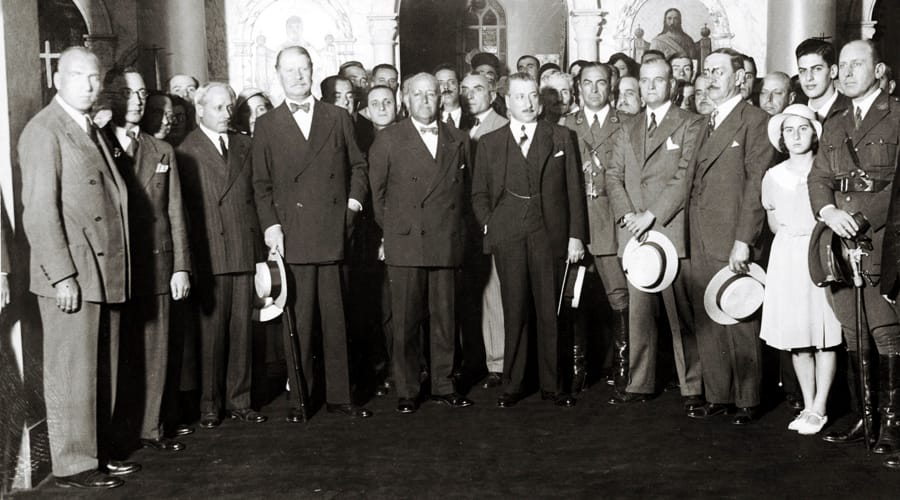
Argentine communities have also developed identities of their own. For many people, connections with their ancestors' countries coexist with a strong sense of belonging to Argentina. For others, relationships with Israel, Palestine, Lebanon, or Syria have different family, cultural, religious, or political meanings.
These experiences should not be interpreted exclusively through conflict. Relations between communities also include social cooperation, cultural exchange, friendships, professional connections, and shared experiences as Argentine citizens.
Journalistic research must distinguish between statements made by leaders, institutional positions, and the opinions of individual community members. This distinction helps avoid generalizations and provides a more accurate understanding of internal diversity.
CHAPTER 8. Trade and Cultural Relations Beyond Israel
Argentina's relationship with the Levant is not limited to its ties with Israel. Lebanon, Syria, Jordan, and Palestine have their own histories and distinct forms of engagement with Argentina.
Relations with Lebanon and Syria developed through official diplomacy as well as through communities of Levantine origin established in Argentina. Family and commercial networks helped maintain contacts across the Atlantic and encouraged cultural and economic exchanges.
Jordan is another regional partner, with a distinct political and institutional history. Bilateral relations should be examined through diplomatic documentation, current agreements, and recorded exchanges.
In the Palestinian case, it is important to distinguish social and cultural contacts, diaspora connections, institutional relations, and international debates over recognition and self-determination. Palestinian history cannot be reduced solely to the conflict with Israel, although that conflict remains central to the region's contemporary situation.
Economic analysis requires a specific methodology. Establishing the importance of trade requires consulting official statistics, identifying the periods being compared, distinguishing exports from imports, and specifying which goods or services are included. It is not enough to claim that a significant commercial relationship exists without presenting verifiable data.
Cultural and academic relations, community associations, educational exchanges, and institutional contacts must also be considered.
The purpose of this chapter is to broaden the perspective and demonstrate that Argentina's relationship with the Levant consists of multiple connections. Diplomacy is an important dimension, but it does not encompass the entire history of relations between the societies.
CHAPTER 9. The Wounds of the Twentieth Century: The Buenos Aires Bombings
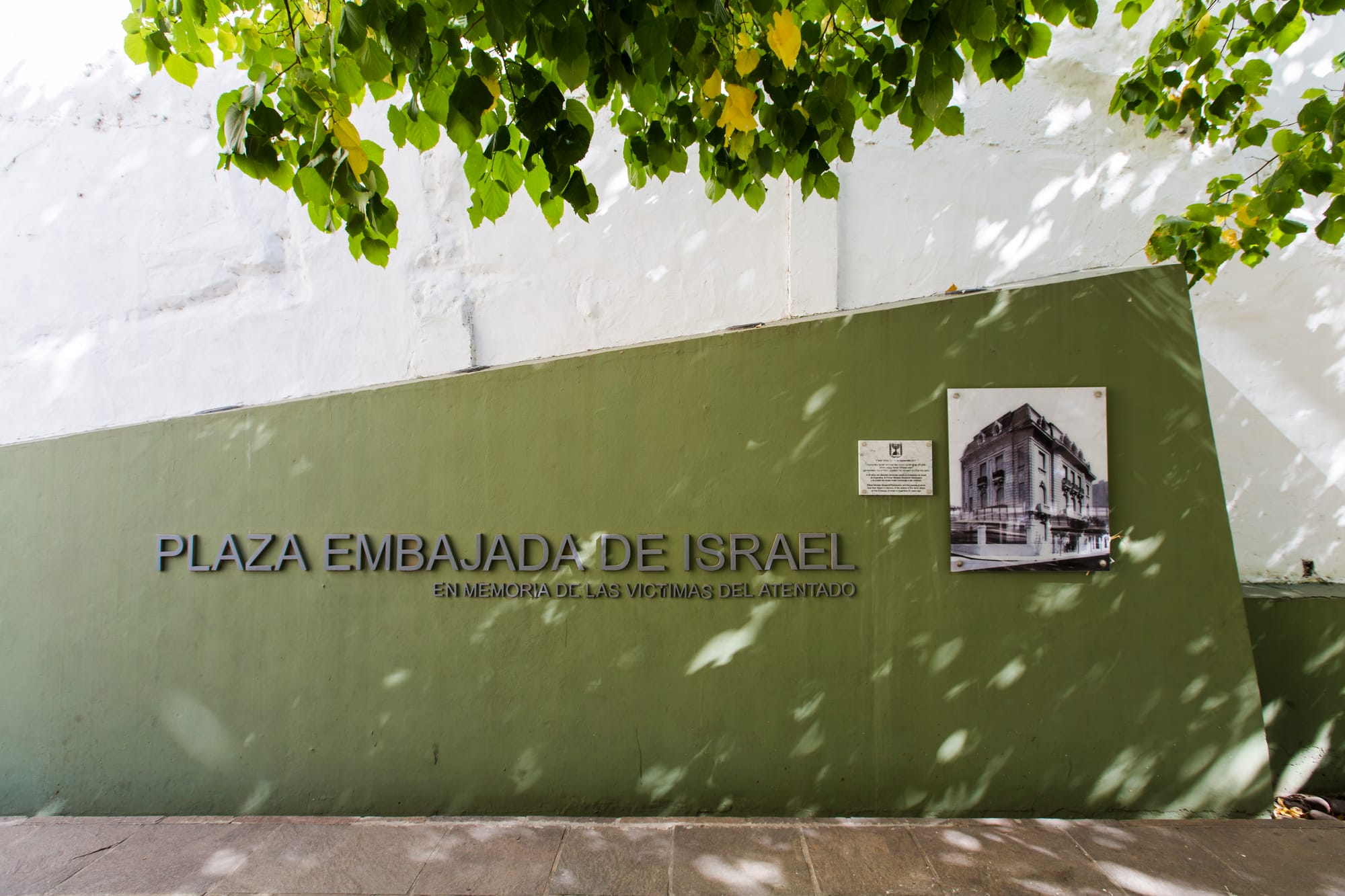
The contemporary history of Argentina's relations with the Middle East is marked by two terrorist attacks in Buenos Aires: the bombing of the Israeli Embassy on March 17, 1992, and the attack on the headquarters of the Argentine Israelite Mutual Association (AMIA) on July 18, 1994.
Both attacks caused numerous casualties and had profound consequences for Argentine society. They also had a particular impact on Jewish communities and institutions, although their consequences extended across the country.
The attacks led to complex judicial investigations, public debate, and prolonged controversies over authorship, responsibility, and institutional failures. Any examination of these events must clearly distinguish documented facts, judicial findings, allegations, hypotheses, and issues that remain disputed.
In the AMIA case, investigations and judicial proceedings extended over decades and were marked by evidentiary problems, institutional controversies, and questions about the performance of the bodies responsible for clarifying the attack. Judicial documentation is essential for establishing precisely what has been determined and which aspects remain subject to debate.
The attack on the Israeli Embassy must likewise be examined through relevant judicial records and available official documentation, avoiding the presentation of unsupported claims as established facts.
These events had political and diplomatic consequences. They influenced public debate on international terrorism, security, judicial cooperation, and foreign policy. They also helped place developments in the Middle East at the center of certain Argentine political discussions.
Responsibility for terrorist acts must be attributed to individuals and organizations identified through substantiated investigations and judicial findings. It should never be transferred to entire populations, religions, or communities.
Given the gravity of the attacks and the complexity of the investigations, both events also warrant a separate investigative article. That work should reconstruct a documented chronology, examine judicial decisions, incorporate corroborated testimony, and explain which facts are established, which remain contested, and which questions are still unresolved.
PART IV. IDENTITY AND IMMIGRATION
CHAPTER 10. Argentina as a Country of Immigration: A Constitutional Tradition
Immigration occupies a central place in the history of modern Argentina. During the nineteenth and twentieth centuries, millions of people arrived from different parts of the world and helped shape the country's economic, social, and cultural development.
The Argentine Constitution expresses an inclusive vision of society in its Preamble, which includes the aim of promoting the general welfare and securing the benefits of liberty for all inhabitants, as well as for “all the men of the world who wish to dwell on Argentine soil.”
Article 20 recognizes fundamental civil rights for foreigners, including the ability to engage in industry and commerce, own property, and freely practice their religion, in accordance with the constitutional text. These provisions form part of a legal tradition that encouraged immigration and the incorporation of people from different backgrounds.
Nevertheless, Argentina's history was not one of uninterrupted openness. The reception of immigrants coexisted with periods of discrimination, restrictions, social conflict, and exclusionary policies. Each community's experience depended on its historical period, origin, economic circumstances, and the political conditions of the country.
Levantine communities and different Jewish communities became part of this broader process. They contributed to the economy, culture, education, religious life, and the development of social institutions. Their descendants participated in many areas of Argentine society without necessarily abandoning all their traditions or connections with their places of origin.
Argentine identity developed through the interaction of diverse populations. Immigration does not explain the entirety of national history, but it is one of its fundamental dimensions. Recognizing this reality makes it possible to better understand the country's cultural plurality.
It also invites us to distinguish between the integration of a community and the uniformity of its members. A society can share institutions and citizenship while preserving religious, cultural, linguistic, and political differences.
Within the context of this report, the history of immigration provides a key to understanding why Argentina maintains connections with the Levant that extend beyond relations between governments. These ties are found in families, associations, memories, cultural exchanges, and the experiences of successive generations.
The constitutional tradition of immigration should be understood as a historical and legal principle, not as proof that every immigrant was received under conditions of equality. The complete history includes both opportunities and contradictions.
CONCLUSION
A History That Is Also Our Own
When we look at Argentina's history, we understand that our country was not built only by those who were here from the beginning, but also by millions of people who arrived from different parts of the world seeking an opportunity, a better future, or simply a place where they could live in peace.
Among them were families who arrived from Syria, Lebanon, and Palestine; Jewish communities that found a home in Argentina; and countless others who, through their customs, work, culture, and personal stories, helped shape our identity.
That is why I believe we cannot understand the relationship between Argentina, Israel, and the Middle East solely through wars, conflicts, or government decisions. Behind all of these events are people, families, generations, and connections that often began long before today's borders existed.
The history of the Levant shows us how borders can change, how new states emerge, and how political conflicts can transform the lives of millions. Argentina's history, in turn, shows how people who emigrated from those territories built new lives and participated in a society that was also transformed by their presence.
Argentina has maintained, despite its contradictions and difficulties, a tradition of receiving people from different backgrounds. This openness is part of our history and of the values expressed in our Constitution.
Understanding the past does not mean agreeing with every idea, belief, or political position held by those who shaped it. It means understanding where we come from, recognizing differences, and trying to look at history honestly. It also means remembering the victims of violence without turning grief into a justification for collective blame or further hostility.
I believe this is the real value of this research: discovering that although we live in different places and have different histories, many of our societies are more connected than we imagine. Understanding these connections helps us better understand not only others, but also our own identity as Argentinians.
BIBLIOGRAPHY AND DOCUMENTARY SOURCES
Academic Studies
Balloffet, Lily Pearl. Argentina in the Global Middle East. Research on transnational connections between Argentina and the Middle East.
National Library of Israel catalog:
https://www.nli.org.il/en/books/NNL_ALEPH997010707252405171/NLI
Klor, Sebastian. Between Exile and Exodus: Argentinian Jewish Immigration to Israel, 1948–1967. A study of the emigration of Argentine Jews to Israel during the state's first decades.
University of Haifa:
https://cris.haifa.ac.il/en/publications/between-exile-and-exodus-argentinian-jewish-immigration-to-israel/
Klich, Ignacio. “Argentine-Ottoman Relations and Their Impact on Immigrants from the Middle East, 1910–1915.” A study of Argentine-Ottoman relations and their effects on immigrants from the Middle East.
Méndez, Norberto Raúl. “Las colectividades árabe y judía de la Argentina y las relaciones Argentina-Medio Oriente (1947–2007).” Research on the interaction between Arab and Jewish communities and Argentine foreign relations.
National University of La Plata institutional repository:
https://sedici.unlp.edu.ar/
Official Argentine Sources
Constitution of the Argentine Nation. Preamble and Article 20.
Official text:
https://www.argentina.gob.ar/normativa/nacional/ley-24430-804
Law No. 14,025. Legal text relating to relations between Argentina and Israel.
National legislation:
https://www.argentina.gob.ar/normativa/nacional/ley-14025-193284
Ministry of Foreign Affairs, International Trade and Worship of Argentina. Institutional material on the seventieth anniversary of diplomatic relations between Argentina and Israel.
Additional Documentary Sources Required for the Investigation
- United Nations General Assembly Resolution 181 of 1947 concerning the future government of Palestine.
- Argentine diplomatic documentation on the recognition of Israel and the establishment of bilateral relations.
- Official Argentine foreign trade statistics for trade with Israel, Lebanon, Syria, and Jordan.
- Judicial records and relevant rulings concerning the bombings of the Israeli Embassy and AMIA.
- Census data, migration records, community archives, and historical studies on Levantine and Jewish immigration to Argentina.