The Holocaust: Understanding the History, Persecution and Murder of Six Million Jews
An in-depth examination of the Holocaust, from Jewish life before Nazi rule to persecution, mass murder, resistance, liberation and the lasting importance of historical remembrance.
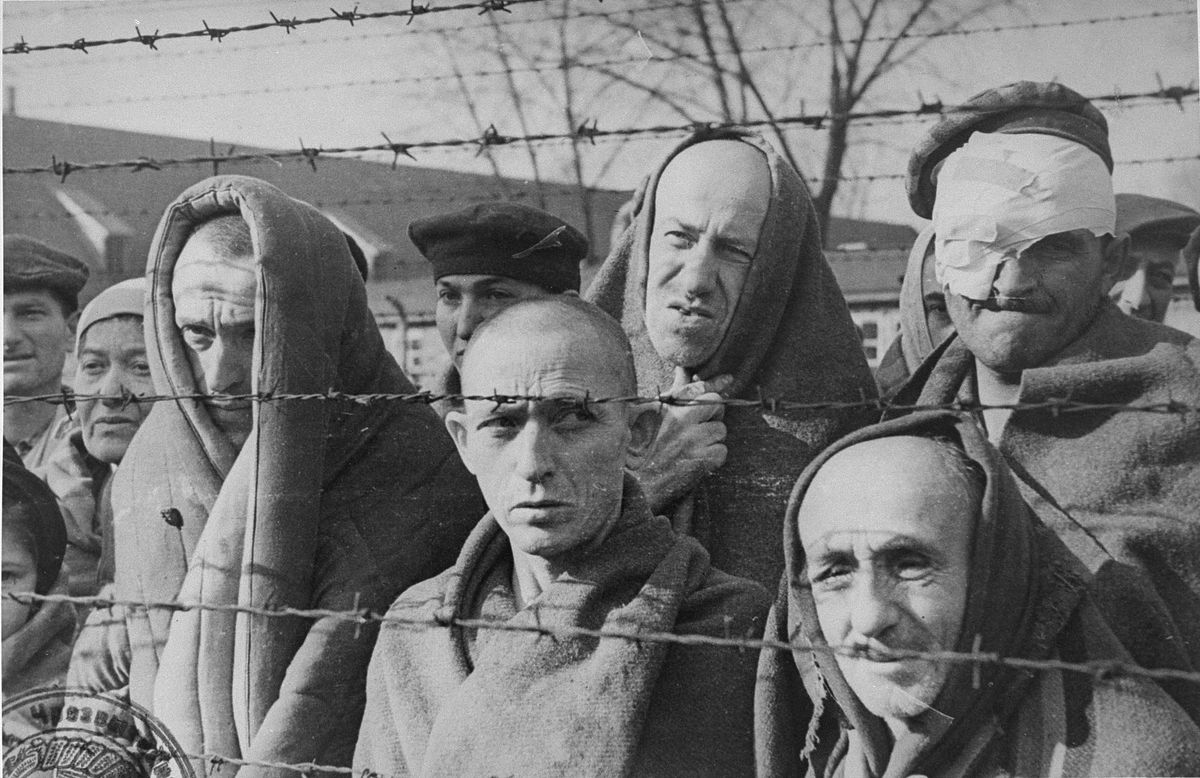
An examination of one of history's most devastating genocides, the destruction of European Jewish communities, and the responsibility to preserve historical memory.
Introduction — Understanding the Holocaust
Between 1933 and 1945, Nazi Germany, together with its allies and collaborators, carried out the systematic persecution and murder of approximately six million European Jews. This genocide, known as the Holocaust or Shoah, became one of the defining atrocities of the twentieth century.
The victims were men, women and children from communities across Europe. They came from different countries, spoke different languages and belonged to different religious, cultural and political traditions. Their lives were destroyed by a regime that transformed antisemitic ideology into state policy and, ultimately, organised mass murder.
The Holocaust did not begin with gas chambers or extermination camps. It developed through a process of discrimination, exclusion, persecution, dispossession and escalating violence. Laws stripped Jewish citizens of their rights. Propaganda portrayed them as enemies. Families were forced from their homes, communities were isolated, and millions were eventually deported or murdered.
During the Second World War, Nazi Germany expanded its campaign of persecution across occupied Europe. Mass shootings, ghettos, forced labour, starvation, deportations and purpose-built killing centres became instruments of genocide.
The Nazi regime also persecuted and murdered millions of other people, including Roma and Sinti, people with disabilities, Polish and Soviet civilians, Soviet prisoners of war and political opponents. Understanding these crimes is essential to understanding the wider system of Nazi terror, while recognising the Holocaust as the genocide specifically directed against Europe's Jews.
Yet the history of the Holocaust is not only a history of death. It is also the history of communities that existed before the war, of people who resisted persecution, of individuals who risked their lives to help others, and of survivors who struggled to rebuild their lives after unimaginable loss.
To understand the Holocaust, it is necessary to examine not only what happened, but how it became possible, how institutions and societies responded, and why its history continues to matter.
Chapter 1 — Jewish Life in Europe Before the Holocaust
Before the rise of Nazi Germany, Jewish communities had been part of European history for more than two thousand years.
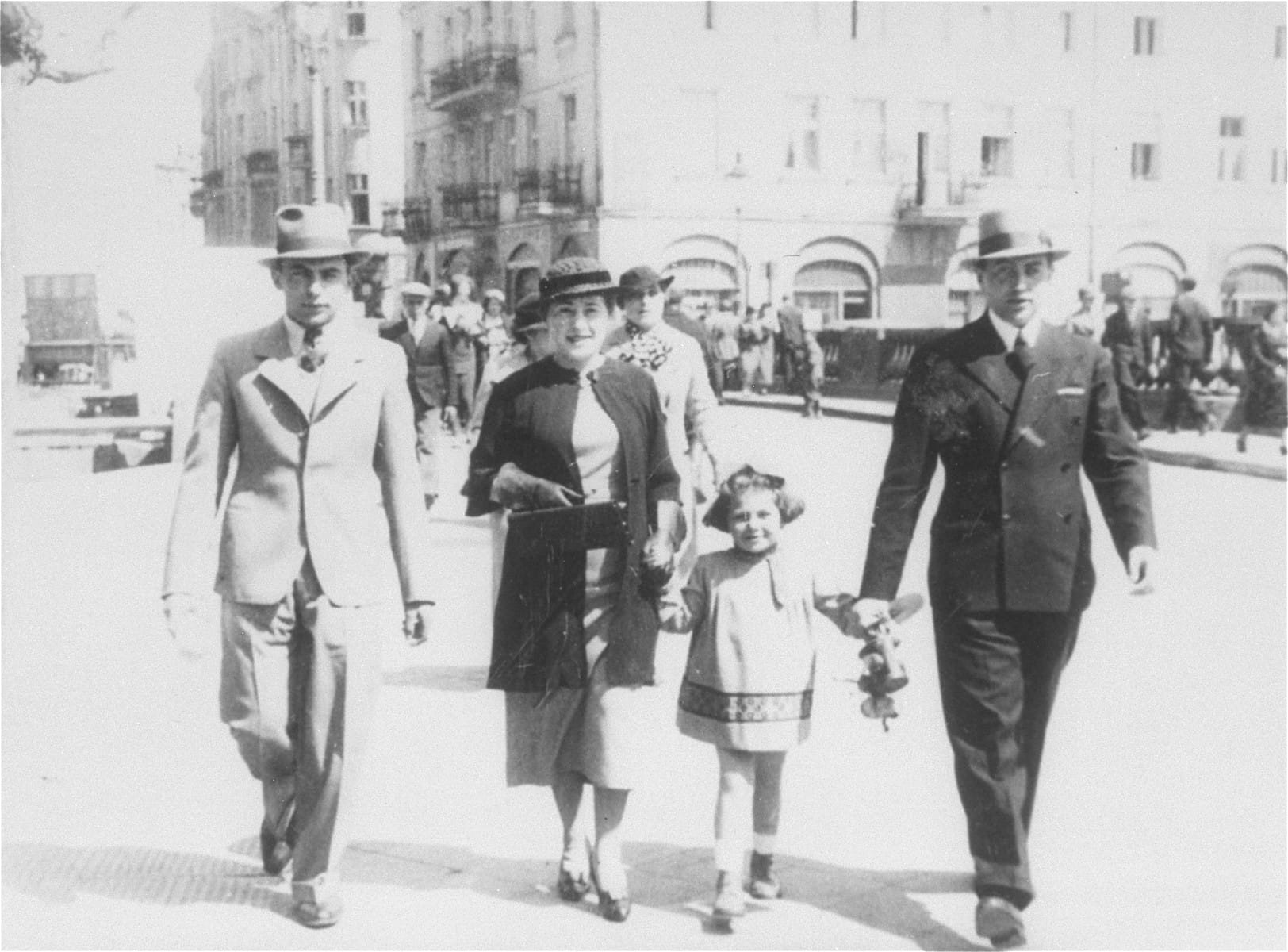
By 1933, approximately 9.5 million Jews lived in Europe, representing more than 60 percent of the world's Jewish population. Jewish communities existed across the continent, from small villages in Eastern Europe to major cities such as Warsaw, Berlin, Amsterdam, Vienna, Budapest and Paris.
These communities were far from uniform.
Some Jewish families maintained deeply religious traditions, while others lived secular lives. Some spoke Yiddish or Hebrew alongside local languages, while others identified strongly with the national cultures of the countries in which they lived.
Jewish Europeans worked as teachers, doctors, merchants, farmers, factory workers, writers, musicians, lawyers and craftsmen. They contributed to European intellectual life, scientific research, literature, business and the arts.
In Poland, home to approximately three million Jews before the war, Jewish communities formed an important part of urban and rural society. Warsaw was a major centre of Jewish religious, political and cultural activity.
In Germany, many Jews considered themselves fully integrated German citizens. Jewish families had served in the German armed forces during the First World War, participated in public life and contributed to the country's economy and culture.
In the Netherlands, Jewish communities had developed over centuries, particularly in Amsterdam, where religious traditions, commerce and cultural life formed part of the city's identity.
Despite these contributions, antisemitism remained a persistent feature of European society.
Religious prejudice against Jews had existed for centuries. During the nineteenth and early twentieth centuries, older prejudices increasingly combined with racial theories, conspiracy narratives and political movements that portrayed Jews as outsiders or threats to national identity.
Even in countries where Jewish citizens enjoyed legal equality, discrimination and social hostility continued.
The consequences of these prejudices would become catastrophic when the Nazi Party gained political power in Germany in 1933.
The destruction that followed was not simply the loss of millions of individual lives. It also devastated families, neighbourhoods, institutions, languages, traditions and cultural networks built over generations.
Understanding the Holocaust therefore begins with recognising what existed before the persecution: diverse communities, ordinary daily lives, and a rich European Jewish heritage that Nazi Germany sought to destroy.
Chapter 2 — The Rise of Nazi Germany and Antisemitism
Germany After the First World War
When the First World War ended in November 1918, Germany entered a period of profound political, economic and social uncertainty.
The German Empire collapsed, Emperor Wilhelm II abdicated, and a new democratic government was established. This government, known as the Weimar Republic, faced enormous challenges from its beginning.
The Treaty of Versailles, signed in June 1919, imposed territorial losses, military restrictions and financial obligations on Germany. Many Germans regarded the treaty as humiliating, and nationalist movements used resentment over its terms to undermine confidence in the new republic.
The country also experienced severe economic instability. Hyperinflation in 1923 devastated savings and disrupted everyday life. Although economic conditions improved during the middle of the decade, the Great Depression beginning in 1929 brought widespread unemployment, poverty and renewed political unrest.
These crises did not make dictatorship inevitable. Germany had democratic institutions, political parties, independent newspapers and citizens who opposed extremism. Nevertheless, instability created opportunities for movements promising national revival, strong leadership and simple explanations for complex problems.
One of those movements was the National Socialist German Workers' Party, commonly known as the Nazi Party.
Adolf Hitler and the Nazi Movement
Adolf Hitler became a prominent figure in the Nazi Party during the early 1920s.
The party promoted an ideology based on extreme nationalism, racial hierarchy, authoritarian leadership, territorial expansion and antisemitism.
Hitler and other Nazi leaders rejected democratic government and portrayed political opponents, especially communists and social democrats, as enemies of Germany.
Central to Nazi ideology was the false belief that humanity could be divided into biologically defined races with different values and abilities.
The Nazis claimed that Germans belonging to what they called the “Aryan race” were superior to other populations. Jews were falsely presented not simply as followers of a religion, but as members of a supposedly dangerous and inferior race.
These ideas had no scientific foundation. They drew upon older European antisemitic traditions, racial pseudoscience and conspiracy theories that had circulated long before the Nazis came to power.
In his political manifesto Mein Kampf, published in two volumes in 1925 and 1926, Hitler outlined many of his ideological beliefs, including his antisemitism and expansionist ambitions.
The Nazi movement increasingly used these beliefs to explain Germany's problems and to identify groups it claimed should be excluded from national life.
Antisemitism as a Political Weapon
Antisemitism was not invented by the Nazis.
For centuries, Jewish communities across Europe had experienced discrimination, expulsions, restrictions on employment and residence, and episodes of violence.
In the nineteenth century, modern political antisemitism increasingly presented Jews as a racial or national threat rather than solely as a religious minority.
Antisemitic conspiracy theories falsely accused Jews of controlling banks, newspapers, governments and revolutionary movements.
One particularly influential fabrication was The Protocols of the Elders of Zion, a fraudulent text that claimed to reveal a Jewish conspiracy for world domination. Although exposed as a forgery, it continued to circulate and influence antisemitic movements.
The Nazis incorporated these false narratives into their political messaging.
They blamed Jews for Germany's defeat in the First World War, economic difficulties, communism and other developments that had entirely different and complex causes.
These accusations were contradictory. Nazi propaganda portrayed Jews as responsible for both international capitalism and communist revolution.
The contradictions mattered less to Nazi propagandists than the political usefulness of creating a common enemy.
By repeatedly presenting Jewish citizens as outsiders and threats, the movement sought to make discrimination appear acceptable and eventually necessary.
Propaganda and the Manipulation of Public Opinion
Nazi propaganda played a central role in spreading the party's ideology.
Through speeches, posters, newspapers, public demonstrations and carefully organised political events, the Nazi movement sought to shape how Germans understood their country's problems.
Hitler was presented as a leader who could restore national pride, economic stability and political order.
At the same time, Jewish people and political opponents were depicted through stereotypes, distortions and dehumanising imagery.
The Nazi newspaper Der Stürmer, published by Julius Streicher, became notorious for its vicious antisemitic cartoons and accusations.
Propaganda did more than communicate political ideas. It attempted to normalise prejudice, encourage conformity and weaken public sympathy for those targeted by the regime.
However, German society was not politically uniform. Many people rejected Nazism, supported other parties or resisted aspects of Nazi rule. Others actively supported the movement, tolerated its policies or adapted to the changing political environment.
Understanding these different responses is essential. The rise of Nazi Germany cannot be explained as though every German citizen held identical beliefs or behaved in the same way.
How Hitler Came to Power
The Nazi Party's electoral support increased dramatically during the Great Depression.
In the Reichstag election of July 1932, the Nazis became the largest party in Germany's parliament, winning approximately 37 percent of the vote. Their support fell to around 33 percent in the November 1932 election, but they remained the largest parliamentary party.
Despite their electoral success, the Nazis never won an outright majority in a free national parliamentary election.
On 30 January 1933, President Paul von Hindenburg appointed Adolf Hitler as German chancellor.
The appointment followed political negotiations involving conservative elites who believed they could use Hitler's popularity while controlling his government.
That calculation proved disastrous.
After the Reichstag fire in February 1933, the government used emergency powers to suspend fundamental civil liberties and intensify repression of political opponents.
In March 1933, the Enabling Act allowed Hitler's government to enact laws without normal parliamentary approval. The vote took place in an atmosphere of intimidation and repression, with Communist deputies prevented from participating and many Social Democrats opposing the measure.
The Nazi regime rapidly dismantled democratic institutions, suppressed opposition parties, restricted independent organisations and consolidated political power.
By the summer of 1933, Germany had effectively become a one-party dictatorship.
From Political Ideology to State Persecution
Hitler's appointment as chancellor marked a decisive turning point for Germany's Jewish population.
Antisemitism was no longer simply a feature of extremist political speeches or publications. It increasingly became official government policy.
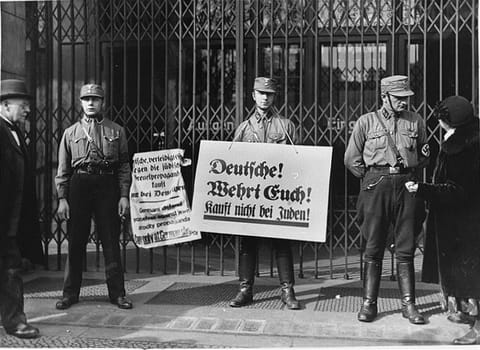
On 1 April 1933, the Nazi regime organised a nationwide boycott of Jewish-owned businesses.
Members of the SA, the Nazi Party's paramilitary organisation, stood outside shops, offices and other businesses, attempting to discourage customers from entering.
Although the boycott lasted only one day as a centrally organised action, it demonstrated the regime's willingness to use state-supported intimidation against Jewish citizens.
Within days, new legislation began excluding Jews from parts of the civil service and professional life.
The regime gradually expanded restrictions affecting education, employment, economic activity and participation in public institutions.
At the same time, Nazi authorities persecuted political opponents and other groups considered undesirable by the regime.
In March 1933, the first prisoners arrived at Dachau, one of the earliest Nazi concentration camps. Initially, the camp primarily held political prisoners, although the categories of people imprisoned in the Nazi camp system expanded over time.
These early developments reveal how quickly a democratic society could be transformed when political power, propaganda, state institutions and organised violence were brought under authoritarian control.
The Danger of Gradual Normalisation
The persecution of European Jews did not begin with a single decision to murder millions of people.
It developed through successive policies that stripped individuals of legal protections, economic security, social acceptance and personal freedom.
Each new restriction created conditions in which further measures could be introduced.
Public propaganda encouraged hostility. Government institutions enforced discrimination. Businesses, professional organisations and individuals faced choices about whether to participate, accommodate, oppose or attempt to evade the regime's policies.
The Holocaust would eventually become a continent-wide genocide during the Second World War, but its foundations were established earlier through the destruction of democracy, the institutionalisation of antisemitism and the systematic exclusion of Jewish people from German society.
The next chapter examines how these policies intensified between 1933 and 1939, transforming discrimination into increasingly open persecution and violence.
Chapter 3 — From Discrimination to Persecution: 1933–1939
The Systematic Exclusion of Jewish Citizens
When Adolf Hitler became chancellor of Germany in January 1933, approximately 500,000 Jews lived in the country. Many had been born and raised in Germany, considered themselves German citizens, and participated fully in its cultural, economic and social life.
Within a few years, their position in society would change dramatically.
The Nazi regime introduced a growing number of laws and regulations designed to remove Jews from public institutions, professional occupations and everyday social life.
Jewish civil servants were dismissed from government positions. Jewish lawyers, doctors, teachers and academics faced restrictions on their ability to work. Jewish-owned businesses experienced boycotts, intimidation and increasing economic pressure.
The Law for the Restoration of the Professional Civil Service, introduced on 7 April 1933, was among the earliest measures used to exclude Jews and political opponents from government employment. Initially, certain exemptions applied, including for some First World War veterans, but these protections were progressively eliminated.
The persecution extended beyond employment.
Jewish students faced increasing restrictions in schools and universities. Cultural organisations excluded Jewish members, while public institutions gradually adopted policies separating Jewish citizens from the wider population.
These measures did not happen simultaneously. They developed over several years, creating an environment in which discrimination became increasingly embedded in German law and society.
For Jewish families, the consequences were deeply personal.
Parents lost employment, children encountered hostility in classrooms, and families who had lived in the same communities for generations increasingly found themselves treated as outsiders.
The Nuremberg Laws of 1935
A decisive turning point came on 15 September 1935, when the Nazi regime introduced the Nuremberg Laws.
These laws provided a legal framework for the racial ideology that had become central to Nazi policy.
Two laws were particularly significant.
The Reich Citizenship Law distinguished between German citizens with full political rights and those who were denied that status under Nazi racial definitions.
The Law for the Protection of German Blood and German Honour prohibited marriages and certain sexual relationships between Jews and people classified by the regime as being of “German or related blood.”
Subsequent regulations defined who would be classified as Jewish according to ancestry, rather than personal religious belief or cultural identity.
This meant that individuals who did not practise Judaism, or whose families had converted to Christianity, could still be classified as Jewish by the Nazi state.
The laws also created discriminatory categories for people with both Jewish and non-Jewish ancestry, whom the regime labelled Mischlinge.
These classifications demonstrated the extent to which Nazi racial ideology was being transformed into an administrative system.
The Nuremberg Laws did not immediately result in mass murder, but they fundamentally changed the legal status of Jewish people in Germany.
They established a framework for systematic exclusion and made racial discrimination an official principle of government.
Education, Childhood and the Loss of Belonging
For Jewish children, persecution was often experienced through everyday events.
School, friendships and participation in community activities became increasingly difficult.
Nazi ideology was incorporated into education, and textbooks promoted antisemitic stereotypes and racial theories.
Jewish pupils could encounter discrimination from teachers, hostility from classmates and exclusion from school activities.
Some families attempted to protect their children by transferring them to Jewish schools, where these remained available.
In November 1938, the Nazi government formally excluded Jewish children from German public schools.
The consequences extended beyond education.
Children experienced the gradual disappearance of friendships, the loss of familiar routines and growing uncertainty about their futures.
For many, the country they had always regarded as home was becoming a place where they were no longer permitted to belong.
Economic Persecution and the Loss of Jewish Property
The Nazi regime also sought to remove Jewish people from economic life.
Jewish-owned shops, businesses and professional practices faced organised boycotts, discriminatory regulations and intimidation.
As persecution intensified, Jewish business owners were increasingly pressured or forced to sell their property, frequently at prices far below its actual value.
This process became known as Aryanisation.
The transfer of Jewish businesses and assets into non-Jewish ownership benefited private individuals, companies and the Nazi state.
Economic persecution was therefore not only a matter of ideology. It also involved the redistribution and theft of property.
In 1938, new regulations accelerated the identification, registration and seizure of Jewish assets.
Jewish families who attempted to emigrate often faced substantial financial barriers, including discriminatory taxes and restrictions on transferring money abroad.
By depriving Jewish citizens of their livelihoods and possessions, the regime made it increasingly difficult for them to remain in Germany while simultaneously limiting their ability to escape.
Forced Emigration and the Search for Refuge
During the 1930s, many German and Austrian Jews recognised that their future in Nazi-controlled territory was becoming increasingly dangerous.
Thousands sought refuge abroad.
Some travelled to neighbouring European countries, while others attempted to reach the United States, the United Kingdom, British Mandatory Palestine or destinations elsewhere in the world.
Leaving was rarely straightforward.
Families needed passports, visas, financial resources and permission to enter another country.
Many governments maintained restrictive immigration policies, particularly during the economic difficulties of the 1930s.
In July 1938, representatives from 32 countries met in Évian-les-Bains, France, to discuss the growing refugee crisis.
Although delegates expressed sympathy for refugees, most participating countries did not significantly expand their immigration opportunities.
The conference exposed the gap between international expressions of concern and the willingness of governments to accept large numbers of people fleeing persecution.
For many Jewish families, the difficulty of finding refuge became a matter of life and death.
Austria and the Expansion of Nazi Persecution
In March 1938, Nazi Germany annexed Austria in an event known as the Anschluss.
The annexation brought approximately 185,000 Austrian Jews under Nazi rule.
Anti-Jewish violence and humiliation escalated rapidly, particularly in Vienna.
Jewish residents were subjected to public harassment, physical attacks, forced cleaning of streets and other forms of degradation.
Businesses were seized, and many families attempted to flee.
The persecution in Austria demonstrated how quickly Nazi antisemitic policies could be extended to newly controlled territories.
It also foreshadowed the broader expansion of persecution that would follow Germany's military conquests during the Second World War.
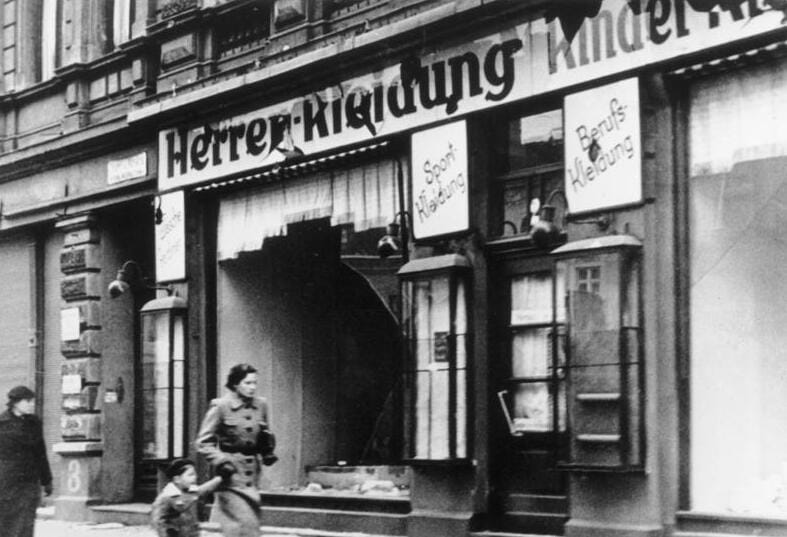
Kristallnacht: The November Pogrom of 1938
On 9–10 November 1938, Nazi-organised violence erupted across Germany, Austria and the Sudetenland.
The attacks became known as Kristallnacht, or the “Night of Broken Glass,” a reference to the shattered windows of Jewish-owned shops, homes and synagogues.
The term, however, does not fully convey the scale and brutality of the violence. Historians also refer to the events as the November Pogrom.
The immediate pretext was the assassination of German diplomat Ernst vom Rath in Paris by Herschel Grynszpan, a young Polish Jew whose family had been affected by Nazi expulsions.
Nazi leaders exploited the incident to organise and encourage attacks against Jewish communities.
During the pogrom, synagogues were burned, Jewish-owned businesses were destroyed, homes were attacked and Jewish people were assaulted and murdered.
At least 91 Jews were reported killed in contemporary official figures, although historical research indicates that the total death toll associated with the violence and its aftermath was substantially higher.
Approximately 30,000 Jewish men were arrested and sent to concentration camps, including Dachau, Buchenwald and Sachsenhausen.
Many were released in the following weeks or months, often under pressure to leave Germany.
The Nazi regime then imposed a collective financial penalty of one billion Reichsmarks on the Jewish population and accelerated the removal of Jews from economic life.
Kristallnacht marked a major escalation in Nazi persecution.
Violence that had previously occurred through a combination of discriminatory laws, intimidation and local attacks now took the form of a large-scale, state-directed pogrom.
The destruction of synagogues also represented an assault on Jewish religious and communal life.
Places of worship, historical records and institutions that had served communities for generations were deliberately targeted.
The Kindertransport: Children Escaping Persecution
Following the November Pogrom, international pressure to assist Jewish refugees increased.
One significant humanitarian response was the Kindertransport.
Beginning in December 1938, the United Kingdom admitted thousands of mostly Jewish children from Nazi-controlled territories without their parents.
By the outbreak of the Second World War in September 1939, approximately 10,000 children had arrived through the programme.
For many, the journey meant separation from their families, uncertainty about the future and the challenge of adapting to life in an unfamiliar country.
Some children were eventually reunited with surviving relatives.
Others never saw their parents again.
The Kindertransport saved thousands of young lives, but it also reflected the limitations of international refugee policies.
Children were offered protection while many of their parents remained trapped in increasingly dangerous circumstances.
Europe on the Brink of War
By the summer of 1939, Nazi persecution had fundamentally transformed Jewish life in Germany and Austria.
Jewish citizens had been stripped of essential rights, excluded from public institutions, deprived of property and subjected to increasingly open violence.
Many had fled abroad, but large numbers remained unable to find refuge.
On 1 September 1939, Germany invaded Poland.
Two days later, Britain and France declared war on Germany, marking the beginning of the Second World War in Europe.
The invasion brought millions more Jews under German occupation and initiated a new phase of persecution.
In occupied Poland, Nazi authorities would establish ghettos, impose forced labour and subject Jewish communities to severe restrictions, starvation and violence.
As the war expanded, Nazi policy would become increasingly radical and murderous.
The systematic genocide of European Jews was not yet fully developed in 1939, but the foundations had been established through years of discriminatory legislation, propaganda, dispossession and escalating persecution.
The transition from exclusion to mass murder would unfold during the war, with devastating consequences for Jewish communities across Europe.
The next chapter examines the establishment of ghettos, the conditions imposed on Jewish populations under German occupation, and the beginning of systematic mass shootings in Eastern Europe.
Chapter 4 — War, Ghettos and Mass Shootings (1939–1942)
The Invasion of Poland: A New Phase of Persecution
On 1 September 1939, Nazi Germany invaded Poland, beginning the Second World War in Europe. On 17 September, the Soviet Union invaded eastern Poland under the arrangements of the German-Soviet pact.
For Poland's Jewish population, numbering approximately 3.3 million before the war, the German invasion marked the beginning of an increasingly devastating period.
Jewish communities that had existed for centuries suddenly found themselves under a regime committed to their exclusion, exploitation and persecution.
German forces and occupation authorities imposed restrictions on movement, confiscated property, demanded forced labour and subjected Jewish residents to public humiliation and violence.
Synagogues were attacked, businesses were seized, and Jewish community leaders were arrested or murdered.
The occupation also brought widespread violence against non-Jewish Polish civilians, particularly members of the political, intellectual and cultural elite whom Nazi authorities considered obstacles to German control.
In German-occupied territories, persecution became increasingly organised through military, police and civilian institutions.
For Jewish families, everyday life changed rapidly. The ability to work, obtain food, travel or maintain contact with relatives became dependent on decisions made by the occupying authorities.
What had begun as discrimination and exclusion within Germany was developing into a system of confinement, forced labour and widespread violence across occupied Europe.
The Establishment of Jewish Ghettos
From late 1939 onward, German authorities began forcing Jewish populations into designated areas known as ghettos, particularly in occupied Poland.
These areas were intended to isolate Jews from the wider population and place them under strict German control.
Ghettos differed considerably in size, structure and conditions. Some were surrounded by walls or fences, while others were initially less physically enclosed but remained subject to severe restrictions.
The largest ghettos included those established in Warsaw and Łódź.
Jewish families were ordered to leave their homes, often with little time to prepare. Many were forced to abandon businesses, possessions and property accumulated over generations.
Several families might be required to share a single apartment or room.
Overcrowding, inadequate sanitation and severe shortages of food and medicine created conditions in which disease spread rapidly.
The German authorities controlled food supplies and movement in and out of the ghettos, making survival increasingly difficult.
Although Nazi officials often described ghettos as temporary administrative measures, they became places of prolonged suffering and, later, important points of departure for deportations to killing centres.
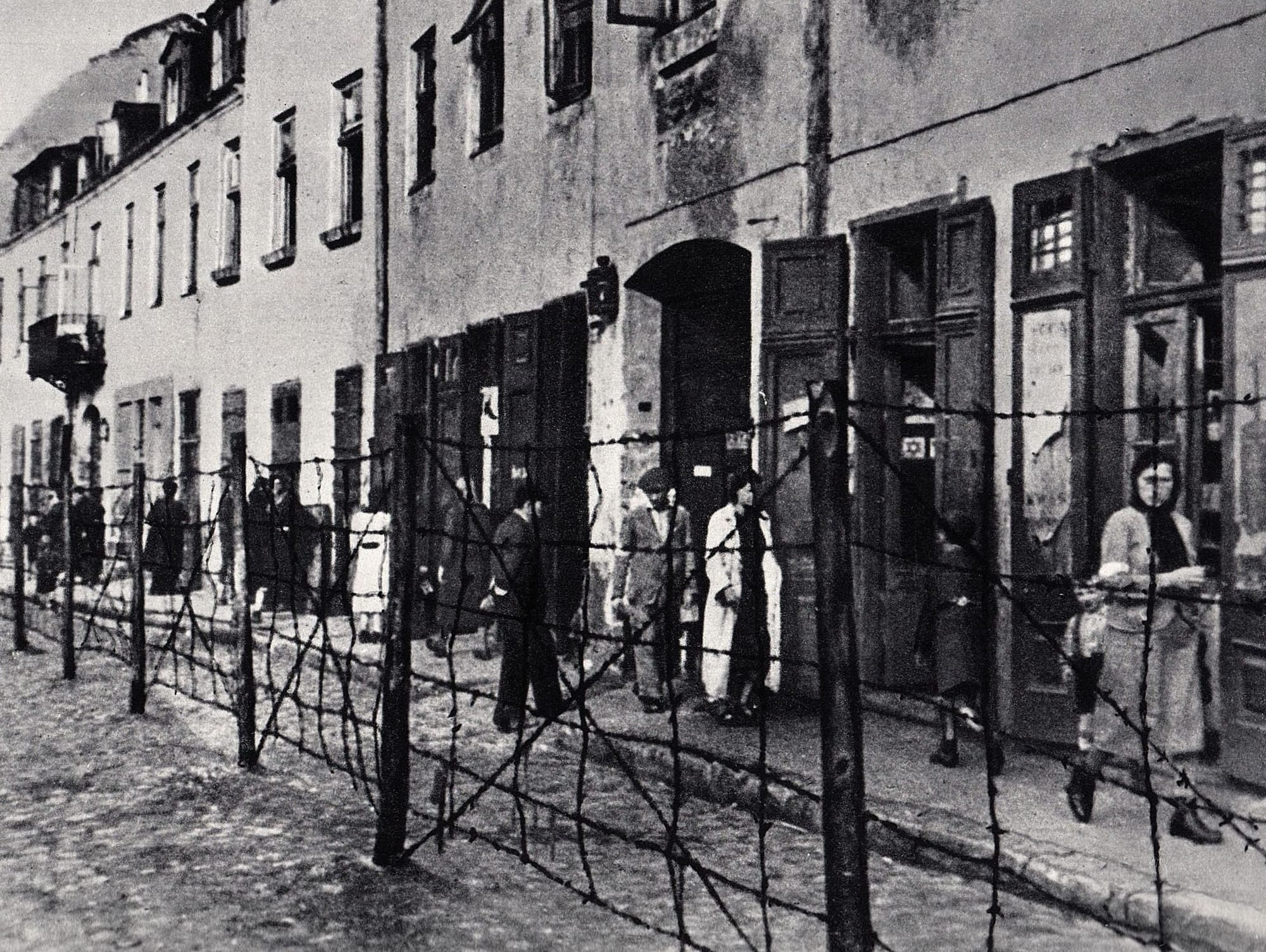
The Warsaw Ghetto: Life Behind the Walls
The Warsaw Ghetto became the largest Jewish ghetto established by Nazi Germany in occupied Europe.
In October 1940, German authorities ordered the creation of the ghetto, and in November its boundaries were sealed.
More than 400,000 Jews were eventually confined within a small section of the city.
Approximately 30 percent of Warsaw's population was forced into an area representing only about 2.4 percent of the city.
The consequences were catastrophic.
Families lived in overcrowded apartments, sometimes with several people sharing a single room. Access to food was severely restricted, and hunger became part of everyday life.
Children searched for scraps of food, while others attempted to smuggle supplies through openings in the walls or across guarded boundaries.
Smuggling was dangerous, but it helped keep many people alive.
Disease spread through the crowded streets and buildings. Typhus and other illnesses caused numerous deaths, particularly among those already weakened by starvation.
Between 1940 and mid-1942, approximately 83,000 Jews died from starvation and disease in the Warsaw Ghetto.
Yet the ghetto was not simply a place of passive suffering.
Jewish residents organised mutual aid, education, religious gatherings and cultural activities under extremely difficult circumstances.
Teachers attempted to continue lessons, doctors cared for patients with limited resources, and community organisations distributed food where possible.
These efforts represented attempts to preserve dignity, identity and human connection in conditions deliberately designed to undermine them.
Documenting Life: The Ringelblum Archive
Among the most remarkable acts of resistance in the Warsaw Ghetto was the effort to document what was happening.
Historian Emanuel Ringelblum organised a clandestine group known as Oneg Shabbat, which collected testimonies, diaries, letters, reports, photographs and other records.
The participants understood that the experiences of Jewish communities under Nazi occupation needed to be preserved.
They documented starvation, forced labour, German policies and the daily struggles of ordinary people.
As the danger increased, parts of the archive were hidden underground in metal containers and milk cans.
After the war, significant portions were recovered.
Today, the Ringelblum Archive provides historians with invaluable evidence about life inside the Warsaw Ghetto.
It also demonstrates that documenting persecution was itself a form of resistance.
At a time when Nazi authorities sought to control information and erase communities, Jewish witnesses worked to preserve their own history.
Jewish Councils and Impossible Decisions
In many ghettos, German authorities established Jewish councils, commonly known as Judenräte.
These councils were ordered to administer certain aspects of daily life, including housing, sanitation, food distribution and the implementation of German directives.
Their members operated under coercion and faced extraordinarily difficult circumstances.
Some attempted to protect residents, organise welfare services or negotiate for food and supplies.
At the same time, German authorities frequently forced councils to participate in measures that harmed the very communities they represented.
As deportations intensified, council members were sometimes ordered to provide lists of residents or assist in organising transports.
Historians have examined these institutions extensively, recognising that the decisions made under Nazi occupation cannot be understood without considering the threats, coercion and limited choices imposed by the perpetrators.
Responsibility for the persecution and genocide rested with Nazi Germany and those who carried out its policies.
Operation Barbarossa: The War Expands Eastward
On 22 June 1941, Nazi Germany launched Operation Barbarossa, the invasion of the Soviet Union.
The invasion opened a new and particularly destructive phase of the war.
German military planning combined territorial conquest with racial ideology and the intended destruction of Soviet political structures.
Nazi leaders viewed the campaign as a war of annihilation.
The invasion brought millions more Jews under German occupation, including communities in present-day Ukraine, Belarus, Lithuania, Latvia, Estonia and parts of Russia.
Unlike the earlier occupation of Poland, the German advance into Soviet territory was accompanied by rapidly escalating mass shootings.
Specialised German security and police units followed the advancing army.
Their operations would become central to the systematic murder of Jewish communities.
The Einsatzgruppen: Mobile Killing Units
The Einsatzgruppen were special units of the German Security Police and Security Service operating behind advancing German military forces.
Their tasks included identifying and eliminating groups designated as enemies of Nazi rule.
Following the invasion of the Soviet Union, these units became major perpetrators of mass murder.
Initially, many shooting operations targeted Jewish men, Soviet officials and other groups. By the summer of 1941, the killings had escalated to include entire Jewish communities, including women, children and elderly people.
Victims were frequently rounded up in their towns or villages and transported or forced to walk to nearby forests, ravines or prepared killing sites.
There, they were shot and buried in mass graves.
The Einsatzgruppen did not operate alone.
German Order Police battalions, Waffen-SS units, elements of the German army, allied forces and local collaborators participated in or supported mass killings.
In many communities, the victims and some of those involved in their persecution had previously lived near one another.
The violence was not confined to distant camps. It frequently took place close to the victims' homes, in familiar landscapes where families had lived for generations.
This phase of the Holocaust is often described as the Holocaust by bullets.
Mass shootings were responsible for the deaths of approximately one-third of the six million Jewish victims of the Holocaust.
Babyn Yar: Two Days of Mass Murder
One of the most extensively documented massacres occurred at Babyn Yar, also known as Babi Yar, a ravine near Kyiv in German-occupied Ukraine.
On 29 and 30 September 1941, German SS and police units, assisted by other forces and auxiliaries, murdered 33,771 Jews.
The figure comes from German reports produced by the perpetrators.
Jewish residents of Kyiv had been ordered to assemble, often believing they were being relocated.
Instead, they were taken to the ravine and murdered.
The massacre included men, women, children and elderly people.
Babyn Yar did not cease to be a killing site after those two days.
Between 1941 and 1943, German forces murdered tens of thousands of additional victims there, including Soviet prisoners of war, Roma and other civilians.
The massacre became one of the most powerful examples of the scale and organisation of mass murder in the occupied Soviet territories.
It also demonstrated that the systematic killing of entire Jewish communities was already taking place before the extermination camp system reached its greatest extent.
Mass Murder Across Eastern Europe
Babyn Yar was not an isolated event.
Mass shootings occurred across Lithuania, Latvia, Belarus, Ukraine and other occupied territories.
In cities, towns and villages, Jewish residents were rounded up and murdered in operations organised by German security forces and their collaborators.
Entire communities disappeared within days.
In some places, victims were forced to dig graves before being killed. Elsewhere, existing pits, forests and ravines were used as execution sites.
The scale of the violence was immense.
By the spring of 1943, Einsatzgruppen and other SS and police units had murdered more than one million Jews in the occupied Soviet territories.
These killings formed a central part of the Holocaust and were closely connected to the wider Nazi programme of genocide.
For surviving relatives, the consequences extended far beyond the immediate loss of life.
Families were separated, local Jewish institutions disappeared, and communities that had existed for centuries were destroyed.
In many locations, mass graves remained unmarked or inadequately documented for decades.
Deportations and the Destruction of the Ghettos
By 1942, Nazi policy had entered a new phase.
Ghettos that had originally been used to isolate and exploit Jewish populations increasingly became collection points for mass deportations.
German authorities organised transports from ghettos to killing centres established in occupied Poland.
In Warsaw, mass deportations began on 22 July 1942.
Over the following two months, approximately 265,000 Jews were deported from the Warsaw Ghetto to the Treblinka killing centre, where the overwhelming majority were murdered shortly after arrival.
Thousands more were killed during the deportation operation inside the ghetto.
The deportations were frequently presented by German authorities as resettlement or transfer for labour.
In reality, many transports were part of the organised murder of Europe's Jewish population.
Families were separated, personal belongings were confiscated, and people were forced into overcrowded railway wagons.
For many, the journey ended at a killing centre.
The Human Consequences of Nazi Occupation
Behind the historical figures were individual lives.
Parents struggled to find food for their children. Doctors attempted to treat patients without adequate medicine. Teachers continued lessons in secret. Religious leaders sought ways to maintain traditions and offer comfort.
Some people attempted to escape, hide or obtain false identity documents.
Others recorded what they witnessed, hoping that the outside world or future generations would learn what had happened.
The history of the ghettos and mass shootings also raises difficult questions about human behaviour under persecution.
Some individuals helped their neighbours at considerable personal risk. Others participated in violence, benefited from stolen property or remained silent.
The circumstances varied across occupied Europe, and historians continue to examine the roles of perpetrators, collaborators, rescuers, bystanders and victims.
What is clear is that the mass murder of European Jews was carried out through deliberate decisions, institutions and organised actions.
By the end of 1942, the Holocaust had developed into a continent-wide programme of genocide.
The ghettos, mass shootings and deportations were interconnected parts of that process.
The next chapter examines the Nazi regime's so-called “Final Solution,” the coordination of deportations across Europe, and the operation of extermination camps designed for systematic mass murder.
Chapter 5 — The Final Solution: Deportations and Extermination Camps
From Persecution to Systematic Genocide
By the end of 1941, Nazi Germany's persecution of European Jews had entered its most murderous phase.
Years of discriminatory legislation, forced displacement, confinement in ghettos and mass shootings had already destroyed countless lives. Across German-occupied Eastern Europe, entire Jewish communities were being murdered by German security forces and their collaborators.
During this period, Nazi leaders developed and coordinated a continent-wide programme to murder Europe's Jewish population.
The perpetrators referred to this programme as the Final Solution to the Jewish Question, using bureaucratic language to conceal the reality of genocide.
The precise sequence of decisions that led to the continent-wide extermination programme remains a subject of historical research. What is clear is that by late 1941, mass murder was already underway, and Nazi authorities were preparing killing centres where large numbers of Jews could be murdered using poison gas.
These facilities became central to the Holocaust.
The genocide was not carried out by a single organisation or in one location. It required the participation of SS and police forces, civilian administrations, railway authorities and numerous other institutions operating across German-controlled Europe.
The machinery of persecution increasingly became a machinery of mass murder.
The Wannsee Conference: Coordinating Genocide
On 20 January 1942, fifteen senior Nazi officials gathered at a villa in the Berlin suburb of Wannsee.
The meeting was chaired by Reinhard Heydrich, head of the Reich Security Main Office.
Its purpose was to coordinate the involvement of different government agencies in implementing the so-called Final Solution.
The conference is sometimes incorrectly described as the moment when the Holocaust was first decided.
In reality, mass shootings of Jewish communities had already been taking place for months, and the first killing centre at Chełmno had begun operating in December 1941.
The Wannsee Conference was therefore not the beginning of genocide. It was a significant stage in organising and coordinating an already developing programme of mass murder.
Officials discussed the deportation of Jews from across Europe, the role of government departments and the categories of people to be included under Nazi racial definitions.
The surviving conference protocol contains a list estimating approximately eleven million Jews across Europe, including populations in countries not yet under German occupation.
The document reveals the geographical scope of Nazi ambitions.
It also demonstrates the disturbing role of ordinary administrative procedures in extraordinary crimes.
Behind the language of transport, labour and population policy was a programme intended to destroy European Jewish life.
The Difference Between Concentration Camps and Extermination Camps
The Nazi camp system consisted of different types of facilities serving different purposes.
Concentration camps were initially established to imprison political opponents and other people targeted by the regime. Over time, the system expanded to include Jews, Roma and Sinti, prisoners of war, people persecuted for their religious beliefs or sexual orientation, and many others.
Prisoners in concentration camps were subjected to brutal treatment, forced labour, starvation, disease, medical abuse and executions.
Large numbers died or were murdered in these camps.
Extermination camps, also known as killing centres, were established specifically for systematic mass murder.
Five principal killing centres were created in German-occupied Poland for the mass murder of Jews using poison gas:
- Chełmno
- Bełżec
- Sobibór
- Treblinka
- Auschwitz-Birkenau
The distinction between concentration camps and killing centres is important, although some facilities performed more than one function.
Auschwitz, for example, operated as a concentration camp complex, a forced-labour centre and a site of systematic mass murder.
Majdanek, near Lublin, is sometimes described in older historical accounts as a sixth extermination camp. More recent scholarship generally classifies it as a concentration camp where prisoners were also murdered through shootings, gas chambers and other methods.
All five principal killing centres were located in territory that was part of Poland before the German invasion in 1939. They were established and operated by Nazi Germany, not by the Polish state.
Deportation Trains: The Journey into the Unknown
The deportation of Jews from occupied and allied European countries required extensive planning.
German authorities organised transports from ghettos, transit camps and cities across the continent.
Railway networks became a central part of the deportation system.
Victims were often told they were being relocated for work or resettlement in the East.
These explanations concealed the true purpose of many transports.
Families were ordered to assemble at designated locations, frequently with restrictions on how much luggage they could carry.
People were separated from their homes, businesses, possessions and communities.
Many believed they would eventually be able to return.
The journeys were often made in overcrowded freight wagons, with inadequate ventilation, sanitation, food or water.
Children, elderly people and those already weakened by hunger or illness faced particularly dangerous conditions.
Some deportees died before reaching their destinations.
The transports involved more than the SS alone. Railway administrators, police, government officials and authorities in collaborating states helped organise or facilitate deportations.
The scale of these operations reveals how genocide depended not only on direct perpetrators, but also on institutions capable of coordinating people, records and transportation across national borders.
Chełmno: The First Killing Centre
Chełmno, known in German as Kulmhof, began operating on 8 December 1941.
Located in German-annexed western Poland, it was the first of the five principal Nazi killing centres to begin mass murder using poison gas.
Victims were brought to the site from surrounding communities and ghettos, including Łódź.
German personnel murdered them using specially adapted gas vans in which carbon monoxide from the vehicles' engines was directed into enclosed compartments.
Bodies were transported to nearby burial sites, where prisoners were forced to dispose of them.
The killing operations continued during two main periods, from December 1941 to April 1943 and again in 1944–1945.
At least 152,000 Jews were murdered at Chełmno, along with thousands of Roma and other victims.
Very few people escaped or survived to describe what happened there.
Chełmno demonstrated the regime's increasing reliance on organised methods of mass murder, alongside the large-scale shootings already underway in Eastern Europe.
Operation Reinhard: Bełżec, Sobibór and Treblinka
Operation Reinhard was the Nazi programme to murder the Jewish population of the General Government, the central area of German-occupied Poland.
Three killing centres became central to this operation: Bełżec, Sobibór and Treblinka.
Their primary purpose was mass murder rather than long-term imprisonment.
Victims were transported from ghettos and other locations, usually by train.
Upon arrival, most were murdered shortly afterward.
German personnel frequently used deception, telling victims that they were entering transit facilities or would undergo washing and disinfection.
The killing centres also contained areas where prisoners were forced to sort stolen belongings and perform other tasks under threat of death.
Bełżec
Bełżec began killing operations in March 1942.
The majority of its victims were Jews deported from ghettos in southern occupied Poland.
Approximately 435,000 Jews were murdered there.
The camp operated for a relatively short period, but its death toll was enormous.
Sobibór
Sobibór began operating in 1942 and received deportation transports from occupied Poland and other European countries, including the Netherlands and France.
At least 167,000 Jews were murdered there.
On 14 October 1943, Jewish prisoners organised an uprising and mass escape.
Although many escapees were subsequently killed, some survived the war and later provided vital testimony.
Treblinka
Treblinka II began operating as a killing centre in July 1942.
It became one of the deadliest sites of the Holocaust.
Approximately 925,000 Jews were murdered there, including hundreds of thousands deported from the Warsaw Ghetto.
On 2 August 1943, prisoners organised an armed revolt and attempted to escape.
Some survived and later described the camp's operations.
Across Operation Reinhard, approximately 1.7 million Jews were murdered in killing centres and related shooting operations.
The destruction of these communities represented one of the most concentrated phases of mass murder during the Holocaust.
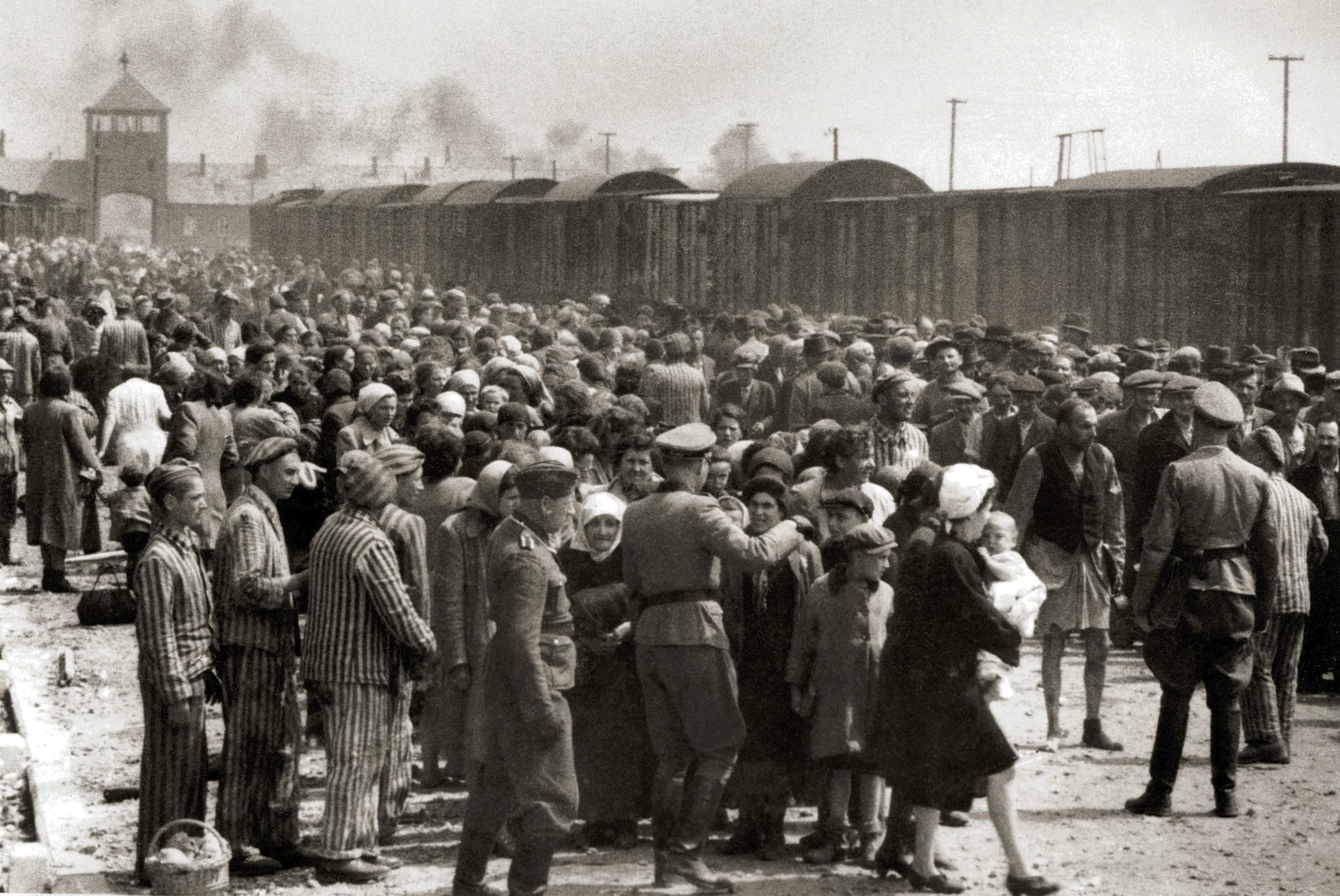
Auschwitz-Birkenau: The Largest Nazi Camp Complex
Auschwitz has become one of the most widely recognised symbols of the Holocaust.
The camp complex was established by Nazi Germany near the Polish town of Oświęcim.
It developed into a vast system of imprisonment, forced labour and mass murder.
The complex included Auschwitz I, the original concentration camp; Auschwitz II-Birkenau, which became the principal killing centre; and Auschwitz III-Monowitz, associated with forced labour for German industry.
Numerous subcamps were also established.
Auschwitz-Birkenau became a major destination for Jewish deportees from across Europe.
Transports arrived from Poland, Hungary, the Netherlands, France, Greece, Slovakia, Belgium and other countries.
At Auschwitz, SS personnel commonly carried out selections upon arrival.
Some deportees were registered as prisoners and assigned to forced labour.
Many others, including large numbers of children, elderly people and parents with young children, were sent directly to the gas chambers.
Those selected for forced labour faced starvation, exhaustion, disease, violence and the constant threat of death.
The camp complex also held and murdered Roma and Sinti, Polish prisoners, Soviet prisoners of war and people from many other backgrounds.
Approximately 1.1 million people were murdered at Auschwitz, around one million of whom were Jews.
These figures represent individual lives: children who never reached adulthood, parents separated from their families, and entire generations whose futures were destroyed.
The Deportation of Hungarian Jews in 1944
One of the most devastating late phases of the Holocaust occurred in Hungary.
Germany occupied Hungary in March 1944.
Although Hungarian Jews had already experienced severe discrimination and persecution, the German occupation led to a rapid escalation of deportations.
Between May and July 1944, Hungarian authorities, working with German officials, deported nearly 440,000 Jews.
Most were sent to Auschwitz-Birkenau.
A large proportion were murdered shortly after arrival.
The speed and scale of these deportations demonstrate that the Nazi genocide continued at an extraordinary pace even as Germany's military position deteriorated.
For Jewish communities in provincial Hungary, centuries of religious, family and cultural life were destroyed within a matter of weeks.
Forced Labour and the Sonderkommando
Not everyone deported to a Nazi camp was murdered immediately.
Some prisoners were selected for forced labour.
They worked in factories, construction projects, mines, camp facilities and other locations under brutal conditions.
The Nazi regime exploited prisoner labour while providing inadequate food, shelter and medical care.
At Auschwitz-Birkenau and certain other killing centres, some Jewish prisoners were forced into special work units known as the Sonderkommando.
These prisoners were compelled to work in areas associated with the gas chambers and the disposal of victims' bodies.
Their work was imposed under extreme coercion and the threat of death.
Many members of these units were themselves murdered and replaced.
The existence of the Sonderkommando illustrates the extraordinary cruelty of a system that forced victims to participate in aspects of the machinery used to destroy their own communities.
Some prisoners nevertheless attempted to document the crimes they witnessed, preserve evidence or organise resistance.
Theft, Exploitation and the Destruction of Identity
The genocide also involved systematic theft.
Jewish families were deprived of homes, businesses, savings, jewellery, clothing and other possessions.
At killing centres, belongings taken from deportees were collected, sorted and redistributed or transferred to German authorities.
The theft of property was closely connected to the persecution itself.
Jewish communities lost not only their members, but also institutions, archives, religious objects and cultural possessions accumulated over generations.
The Nazi regime attempted to destroy both human lives and the social foundations of Jewish existence.
Yet the surviving documents, photographs, personal objects and testimonies preserve evidence of the people behind the statistics.
A suitcase bearing a name, a family photograph or a handwritten letter can reveal a personal history that mass-murder records alone cannot convey.
Attempts to Conceal the Crimes
As the war progressed, Nazi authorities increasingly attempted to destroy evidence of their crimes.
At several killing sites, bodies were exhumed and burned, mass graves were disturbed, and buildings or installations associated with murder were dismantled.
Some sites were altered or disguised to conceal their original purpose.
These efforts did not erase the evidence.
Survivor testimonies, perpetrator records, transport lists, photographs, physical remains and postwar investigations have enabled historians to reconstruct the operation of the killing centres in extensive detail.
The historical evidence for the Holocaust is overwhelming.
The crimes were documented not only by survivors and witnesses, but also by the institutions and individuals who organised and carried them out.
The Human Reality Behind the Numbers
Approximately 2.7 million Jews were murdered at the five principal Nazi killing centres.
Millions of others were murdered through mass shootings, starvation, disease, forced labour and other forms of persecution and violence.
The total number of Jewish victims of the Holocaust is estimated at six million.
These figures are essential to understanding the scale of the genocide, but they cannot fully describe its human consequences.
Every victim had a name, a family, a personal history and a life that existed before persecution.
Some were infants. Others were grandparents.
Some had spent their lives in small rural communities. Others came from Europe's largest cities.
They represented a wide range of languages, traditions, professions and beliefs.
Their destruction was the result of deliberate decisions made by Nazi leaders and implemented through government institutions, armed organisations and networks of collaborators.
The Holocaust demonstrates how ideological hatred, when combined with state power and organised violence, can lead to the systematic destruction of entire populations.
Yet even within this system, people attempted to resist, survive, document events and help others.
The next chapter explores those efforts: Jewish resistance, underground movements, rescue operations and the extraordinary choices made by individuals confronted with persecution and genocide.
Chapter 6 — Resistance, Survival and Acts of Courage
Resistance in the Face of Persecution
The history of the Holocaust is often told through the policies of Nazi Germany, the destruction of Jewish communities and the millions of lives lost.
Yet another essential part of this history concerns those who resisted.
Across German-occupied Europe, Jewish individuals and communities attempted to defend themselves, protect others, preserve their identities and document the crimes committed against them.
Resistance took many forms.
Some joined armed underground organisations, organised uprisings or escaped into forests to fight alongside partisan groups.
Others created secret schools, maintained religious practices, distributed food, forged documents or helped children find hiding places.
In ghettos and concentration camps, even the act of preserving a diary, teaching a child or recording the names of murdered neighbours could represent a refusal to allow the Nazis to erase a community's existence.
The possibilities for resistance were severely limited by starvation, isolation, collective punishment, lack of weapons and the overwhelming power of the German occupation forces.
Many Jewish people also faced the impossible responsibility of protecting children, elderly relatives or other family members.
Resistance should therefore not be understood only through armed struggle. Nor should the absence of visible resistance be interpreted as acceptance of persecution.
The choices available to people under genocidal occupation were profoundly different from those available in ordinary circumstances.
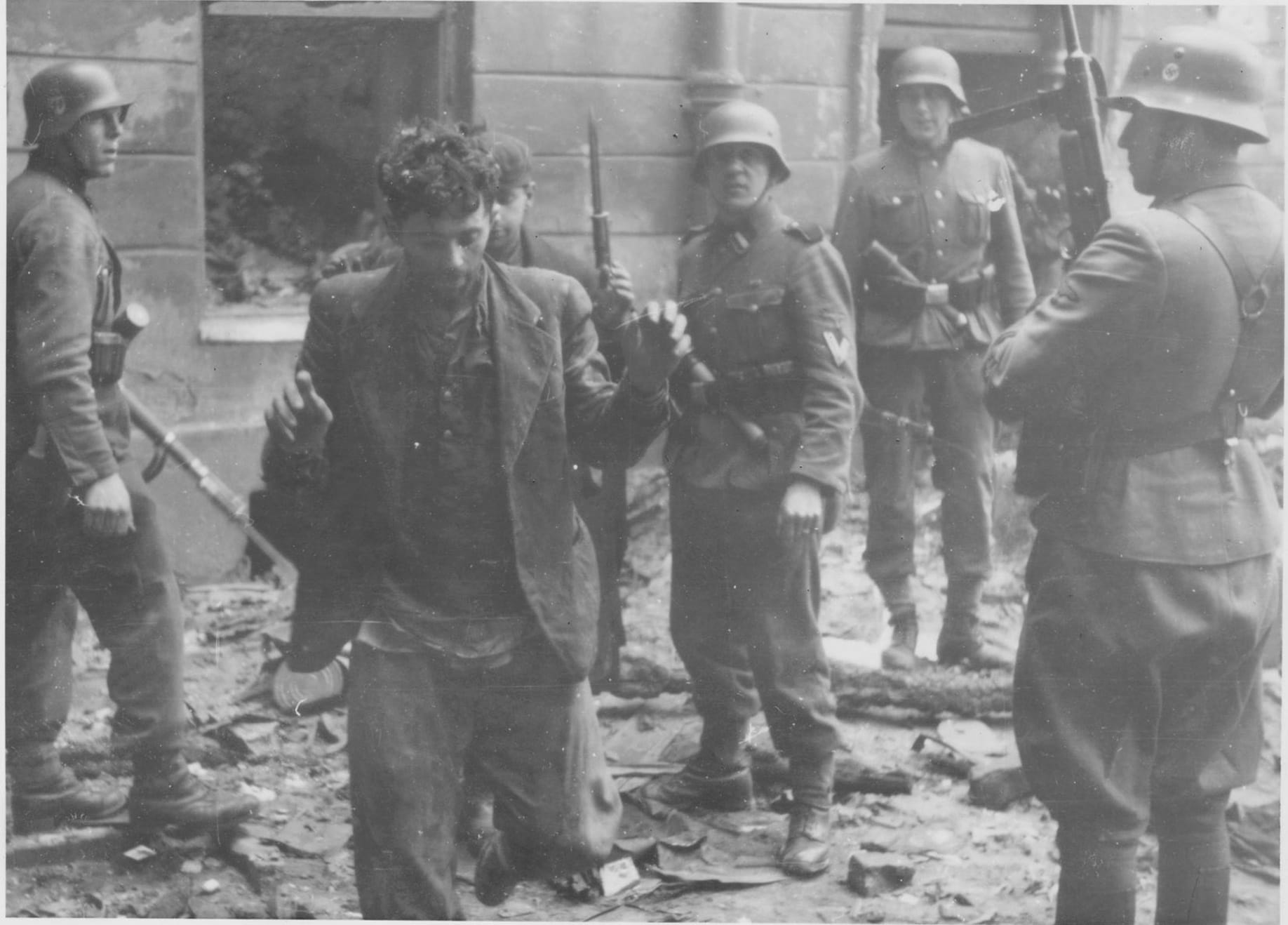
The Warsaw Ghetto Uprising: April 1943
One of the most significant examples of Jewish armed resistance occurred in the Warsaw Ghetto.
Following the mass deportations of 1942, only a fraction of the ghetto's original population remained.
Many residents had learned that deportation did not mean resettlement, as German authorities claimed, but frequently meant death at Treblinka.
Jewish underground organisations began preparing for armed resistance.
Among the principal groups were the Jewish Fighting Organization, known by its Polish initials ŻOB, and the Jewish Military Union, ŻZW.
On 19 April 1943, German forces entered the ghetto to carry out its final liquidation.
They encountered organised resistance.
Jewish fighters, armed with a limited number of pistols, rifles, grenades and homemade incendiary devices, attacked German units.
The resistance was vastly outnumbered and outgunned.
Nevertheless, fighters continued to resist as German forces systematically burned buildings and destroyed sections of the ghetto.
The uprising lasted nearly a month.
On 16 May 1943, SS commander Jürgen Stroop reported the destruction of the ghetto and ordered the demolition of Warsaw's Great Synagogue.
Thousands of Jews were killed during the suppression of the uprising, while many survivors were deported to concentration camps and killing sites.
The Warsaw Ghetto Uprising could not prevent the destruction of the ghetto.
Its historical significance lies in the determination of people who, facing overwhelming force and the likelihood of death, chose to organise armed resistance against their persecutors.
Today, the uprising remains a central event in the history of Jewish resistance during the Holocaust.
Jewish Partisans in the Forests of Eastern Europe
Outside the ghettos, some Jewish people escaped into forests and joined partisan movements.
Partisan groups operated in German-occupied territories, particularly in parts of Poland, Belarus, Lithuania, Ukraine and the Soviet Union.
Their activities included sabotage, attacks on German supply lines, intelligence gathering and assistance to people fleeing persecution.
Jewish participation varied considerably between regions.
Some joined Soviet partisan formations or other resistance organisations. Others formed independent Jewish groups.
Escaping into the forests was itself extremely dangerous.
Fugitives faced hunger, exposure, illness, German military operations and, in some areas, antisemitism within or around partisan movements.
Women, children and elderly people often had particular difficulty finding protection.
Despite these obstacles, some partisan groups developed systems to shelter civilians as well as conduct armed resistance.
The Bielski Partisans: A Community of Survival
Among the best-known Jewish partisan groups were the Bielski partisans, led by brothers Tuvia, Zus, Asael and Aron Bielski.
Operating in the forests of German-occupied Belarus, the group developed into an armed resistance movement and a refuge for Jewish civilians.
Unlike partisan formations focused primarily on military operations, the Bielski group placed particular emphasis on rescuing Jews and sustaining a community in hiding.
Families, children and elderly people were accepted into the forest settlement.
The group established shelters, workshops, food preparation areas and other facilities necessary for survival.
Armed members obtained supplies, defended the community and participated in resistance activities.
Living conditions remained extremely difficult, particularly during winter.
Nevertheless, approximately 1,200 Jews survived the war through the Bielski partisan community.
Their story demonstrates that resistance could involve not only fighting an occupying army, but also protecting lives that the Nazi regime intended to destroy.
Resistance Inside Nazi Camps
Resistance also occurred within concentration camps and killing centres, despite conditions designed to make organised opposition nearly impossible.
Prisoners faced constant surveillance, extreme physical deprivation and severe collective punishment.
Possessing weapons or planning an escape could lead to immediate execution.
Nevertheless, underground networks developed in some camps.
At Treblinka, prisoners organised a revolt on 2 August 1943.
They attempted to seize weapons, set parts of the camp on fire and escape.
Many were killed during the revolt or while attempting to flee, but a number survived the war and later testified about the camp.
At Sobibór, prisoners organised an uprising on 14 October 1943.
The revolt involved the killing of several SS personnel and an attempted mass escape.
Hundreds of prisoners broke out of the camp, although many were killed during the escape or subsequently captured.
Several dozen escapees survived the war.
The revolt contributed to the German decision to dismantle the killing centre.
At Auschwitz-Birkenau, members of the Sonderkommando organised an uprising on 7 October 1944.
Prisoners attacked SS guards and damaged one of the crematorium buildings.
The revolt was suppressed, and many participants were killed.
Women prisoners, including Ala Gertner, Róża Robota, Estusia Wajcblum and Regina Safirsztajn, played important roles in the underground effort to obtain explosives used in the uprising.
They were later executed by the SS.
These acts of resistance did not end the camp system, but they challenged the authority of the perpetrators and provided important evidence of prisoners' determination to fight back.
Preserving Knowledge as an Act of Resistance
Not all resistance involved weapons.
In occupied Europe, Jewish teachers, historians, writers, religious leaders and community members attempted to preserve knowledge and cultural identity.
In the Warsaw Ghetto, Emanuel Ringelblum and the clandestine Oneg Shabbat group assembled documents describing life under Nazi occupation.
Their archive included personal testimonies, diaries, reports, letters and evidence of persecution.
The participants understood that they might not survive.
Their work was intended to ensure that future generations could learn what had happened from the voices of the victims themselves.
Elsewhere, Jewish communities organised secret religious gatherings, educational activities and cultural performances.
Such efforts could not remove the dangers of persecution, but they helped preserve human connection and communal identity.
The survival of diaries, letters and hidden archives remains one of the reasons historians can reconstruct individual experiences alongside official Nazi records.
Hiding and Escape: The Struggle to Survive
For many Jews, survival depended on escaping deportation or finding a place to hide.
Some lived under false identities, using forged documents or adopting unfamiliar names.
Others hid in attics, cellars, barns, convents, private homes or specially constructed concealed rooms.
Living in hiding often meant months or years of uncertainty.
A sudden noise, an unexpected visitor or a denunciation could lead to arrest.
Food, medicine and reliable information were difficult to obtain.
Children were sometimes separated from their parents and placed with non-Jewish families or institutions in an attempt to protect them.
These decisions carried enormous emotional consequences.
Parents frequently had no guarantee that they would ever see their children again.
In some countries, rescue networks helped people cross borders or reach relatively safer territories.
The possibility of survival varied greatly depending on location, timing, available resources, personal connections and the policies of local authorities.
For many, escape remained impossible.
Anne Frank: A Young Voice from the Netherlands
Among the most widely known accounts of Jewish life in hiding is the diary of Anne Frank.
Anne was born in Frankfurt am Main in 1929. Her family moved to Amsterdam after the Nazis came to power in Germany.
Following the German occupation of the Netherlands in May 1940, anti-Jewish restrictions increasingly affected the family's life.
In July 1942, Anne, her parents Otto and Edith, and her sister Margot went into hiding in concealed rooms behind Otto Frank's business premises in Amsterdam.
Four other Jewish people later shared the hiding place.
A small group of trusted helpers provided food, supplies and contact with the outside world.
During the more than two years she spent in hiding, Anne recorded her thoughts, fears, hopes and observations in her diary.
Her writing offers an unusually personal account of adolescence under persecution.
On 4 August 1944, the people in hiding were discovered and arrested.
Anne and Margot were eventually deported to Bergen-Belsen concentration camp, where both died in early 1945.
Their father, Otto Frank, was the only member of the immediate family to survive the Holocaust.
After the war, he arranged for Anne's diary to be published.
The diary became one of the most widely read personal testimonies associated with the Holocaust.
Anne Frank's story is powerful because it reveals the individual life behind the historical statistics.
Yet her experience was one among millions.
Countless Jewish children across Europe were forced into hiding, separated from their families, deported or murdered.
Their stories are equally important, even when their names and writings are less widely known.
The People Who Risked Their Lives to Save Others
Throughout occupied Europe, some non-Jewish individuals chose to help Jews despite the dangers involved.
Their actions included hiding families, providing food, obtaining false documents, helping people escape and protecting children.
The risks differed from country to country and could include imprisonment, deportation or execution.
One of the best-known rescuers was Oskar Schindler, a German industrialist who helped protect approximately 1,200 Jews through employment and intervention on their behalf.
In occupied Poland, social worker Irena Sendler participated in underground efforts to rescue Jewish children from the Warsaw Ghetto.
Working with others, she helped arrange hiding places and false identities for children threatened by deportation.
In the Netherlands, Miep Gies and other helpers supported Anne Frank's family and the other people hiding in the Secret Annex.
Their assistance required discretion, commitment and a willingness to accept serious personal risk.
These individuals were part of wider networks of helpers, many of whom remain less well known.
Rescue was rarely the work of one person alone.
It often depended on cooperation between families, religious communities, resistance organisations and ordinary citizens.
Denmark: A Collective Rescue Effort
In October 1943, a large-scale rescue operation took place in German-occupied Denmark.
After information emerged about plans to arrest and deport Danish Jews, members of the Danish resistance, fishermen, ordinary citizens and others helped Jewish families escape across the Øresund strait to neutral Sweden.
More than 7,000 Danish Jews and several hundred non-Jewish family members reached safety.
The rescue was possible because of a combination of circumstances, including public opposition to the planned deportations, assistance from Danish networks and Sweden's willingness to receive refugees.
Not everyone escaped.
Several hundred Jews were arrested and deported to Theresienstadt, where some died.
Nevertheless, the rescue of Danish Jews remains one of the most significant collective rescue efforts of the Holocaust.
It demonstrates how the actions of institutions, communities and individuals could affect the survival of people targeted for persecution.
Raoul Wallenberg and the Rescue of Hungarian Jews
In 1944, Swedish diplomat Raoul Wallenberg arrived in Budapest during the persecution and deportation of Hungarian Jews.
Working with colleagues and other rescue organisations, Wallenberg issued Swedish protective documents and helped establish buildings associated with Swedish diplomatic protection.
These measures contributed to efforts to protect thousands of Jews in Budapest.
Wallenberg also intervened directly on behalf of people facing deportation or violence.
His work took place amid extreme danger as German and Hungarian fascist forces continued their persecution.
In January 1945, Wallenberg was detained by Soviet authorities.
His subsequent fate remains the subject of historical investigation, although Soviet authorities later reported that he had died in custody in 1947.
Wallenberg's rescue work illustrates the possibilities and limitations of diplomatic intervention during genocide.
The Righteous Among the Nations
After the war, Yad Vashem, Israel's Holocaust remembrance centre, established the title Righteous Among the Nations to honour non-Jews who risked their lives to save Jews during the Holocaust without seeking material reward.
Those recognised include farmers, teachers, diplomats, religious leaders, workers and ordinary families.
Their actions varied widely.
Some sheltered one person for a short period. Others protected entire families or organised networks that saved hundreds or thousands.
The recognition of rescuers is important, but it must also be understood within the wider historical context.
The majority of European Jews did not have access to successful rescue networks.
Many people who sought help were refused, betrayed or unable to find a safe place.
The existence of courageous rescuers does not diminish the scale of the persecution or the responsibility of those who participated in it.
Instead, their stories show that individuals and communities sometimes made different choices under similar systems of occupation and oppression.
Survival Did Not Mean the End of Suffering
For those who survived through resistance, hiding, rescue or imprisonment, liberation did not erase the consequences of persecution.
Many emerged from the war without parents, children, spouses or siblings.
Homes and businesses had been destroyed or confiscated.
Entire communities had disappeared.
Some survivors returned to their hometowns only to discover that relatives had been murdered and that former neighbours were unwilling to welcome them back.
Others remained displaced for years, unable or unwilling to return to the places where they had lived before the war.
Survival was often followed by grief, uncertainty and the difficult task of rebuilding a life.
The experiences of survivors would become central to preserving the historical record of the Holocaust.
Their testimonies provided evidence of Nazi crimes and ensured that individual voices remained part of the history.
Courage, Memory and Historical Responsibility
The history of resistance during the Holocaust challenges the idea that victims simply accepted their fate.
Jewish people resisted in ghettos, forests, camps and hiding places, despite extraordinary obstacles.
Some fought with weapons. Others preserved documents, protected children, maintained religious traditions or supported neighbours.
Non-Jewish rescuers also demonstrated that individual decisions could make a difference, even within systems of extreme persecution.
These stories should not be romanticised.
Resistance was dangerous, rescue was uncertain, and survival often depended on circumstances beyond an individual's control.
Millions of people were murdered despite their efforts to escape or protect their families.
The importance of remembering resistance lies not in suggesting that courage always led to survival, but in recognising the humanity, agency and difficult choices of those who lived through persecution.
The next chapter examines the liberation of Nazi camps, the discovery of the crimes committed there, and the challenges faced by survivors in the immediate aftermath of the Second World War.
Chapter 7 — Liberation and the Aftermath: Survivors, Displacement and the Search for Justice
The Final Months of Nazi Germany
By the second half of 1944, Nazi Germany was facing military defeat on several fronts.
Soviet forces were advancing from the east, while British, American, Canadian and other Allied forces were pushing through Western Europe following the Normandy landings in June 1944.
As Allied armies approached German-occupied territories, they began encountering evidence of Nazi atrocities on an enormous scale.
Concentration camps, mass graves, abandoned detention facilities and surviving prisoners revealed the extent of the regime's persecution and violence.
Yet the final months of the war were among the most dangerous for many prisoners.
As German forces retreated, the SS attempted to evacuate camps and transfer prisoners away from approaching Allied armies.
These evacuations frequently involved forced marches over long distances, often in freezing weather and without adequate food, clothing or medical care.
Prisoners who collapsed or could no longer continue were sometimes shot by their guards.
Thousands died from exhaustion, starvation, exposure and violence.
These evacuations became known as the death marches.
For many prisoners, the approaching end of the war did not bring immediate safety. Instead, it exposed them to another period of extreme danger.
The Liberation of Majdanek
In July 1944, Soviet forces reached the Majdanek concentration camp near Lublin in occupied Poland.
Majdanek was among the first major Nazi concentration camps to be liberated by Allied forces.
Although German authorities had attempted to evacuate prisoners and destroy evidence, much of the camp's infrastructure remained.
Soviet soldiers and investigators discovered gas chambers, cremation facilities, prisoner belongings and other evidence of Nazi crimes.
The findings provided some of the earliest extensive physical evidence available to the outside world about the camp system.
Reports and photographs from Majdanek began reaching international audiences while the war was still underway.
Nevertheless, understanding the full scale of the Holocaust would require years of investigation, testimony and historical research.
Auschwitz: 27 January 1945
On 27 January 1945, Soviet troops entered the Auschwitz concentration and extermination camp complex in German-occupied Poland.
They found approximately 7,000 surviving prisoners in Auschwitz, Birkenau and Monowitz.
Most were severely weakened by starvation, illness and years of brutal treatment.
In the days before liberation, the SS had forced approximately 56,000 prisoners to leave the Auschwitz complex on evacuation marches.
Many died during these evacuations.
Those who remained were often too ill or physically exhausted to be moved.
Soviet soldiers encountered children, women and men who had survived imprisonment under conditions of extraordinary cruelty.
They also discovered warehouses containing vast quantities of clothing, shoes and personal possessions confiscated from prisoners and murdered deportees.
The physical evidence confirmed that Auschwitz had functioned not only as a place of imprisonment and forced labour, but also as a centre of systematic mass murder.
Approximately 1.1 million people had been murdered at Auschwitz, including around one million Jews.
The liberation of Auschwitz became one of the defining moments in the historical documentation of the Holocaust.
Today, 27 January is observed internationally as International Holocaust Remembrance Day.
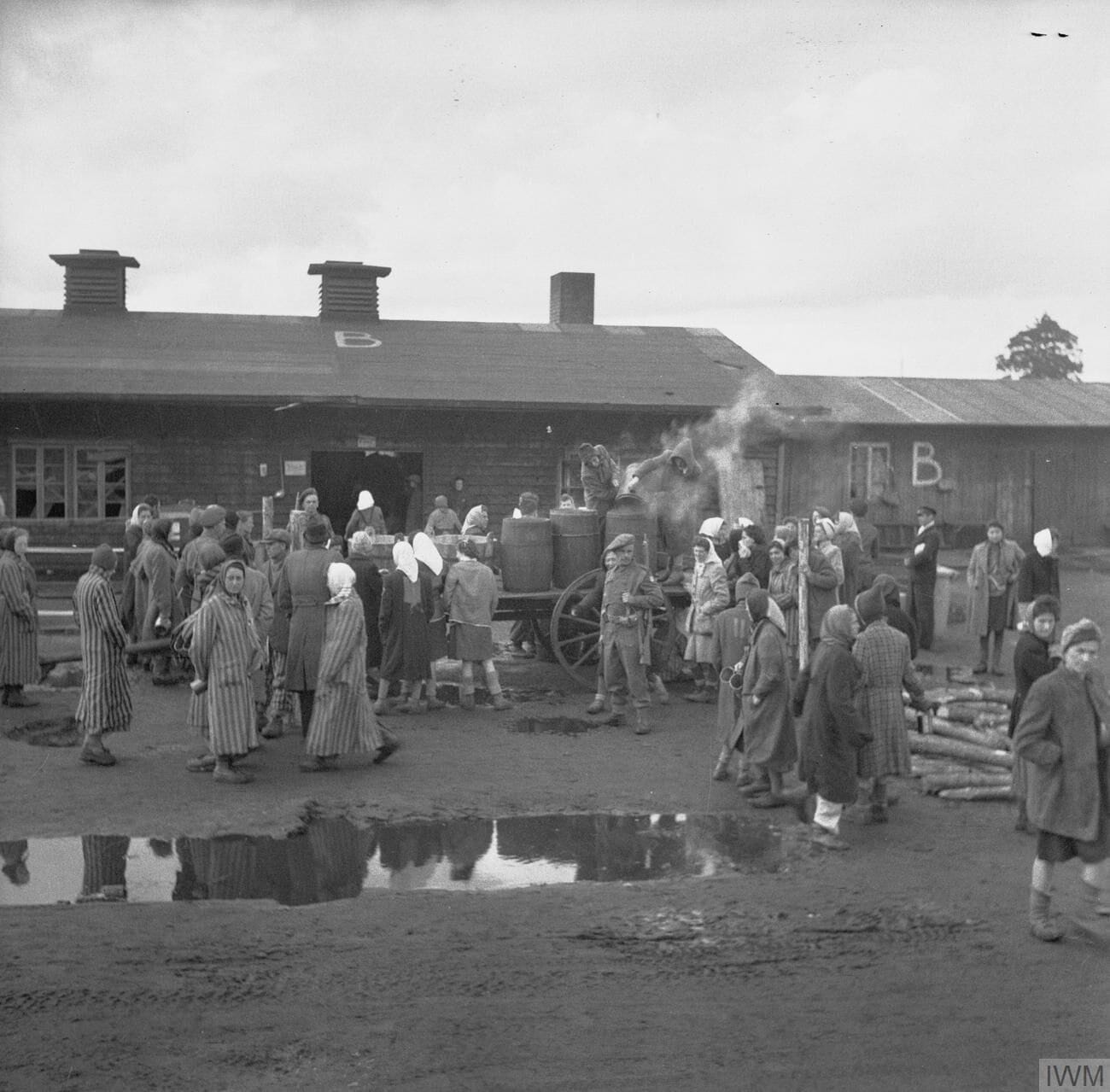
Bergen-Belsen: A Humanitarian Catastrophe
On 15 April 1945, British forces liberated Bergen-Belsen concentration camp in northern Germany.
What they discovered was a humanitarian catastrophe.
Approximately 60,000 prisoners were present in the camp, many suffering from starvation, typhus and other diseases.
Thousands of unburied bodies lay throughout the grounds.
The camp had become severely overcrowded as prisoners were transferred from other facilities during the final months of the war.
Food supplies, sanitation and medical services had largely collapsed.
British medical personnel, soldiers and relief workers attempted to provide emergency treatment, establish sanitation measures and prevent further disease.
Despite these efforts, thousands of liberated prisoners died in the following weeks because of the extreme physical damage caused by imprisonment.
Among those who had died at Bergen-Belsen before liberation were Anne Frank and her sister Margot.
Their deaths illustrate how the consequences of Nazi persecution continued even as Germany's defeat approached.
For those who survived Bergen-Belsen, liberation was followed by a long struggle for physical recovery and emotional stability.
Buchenwald, Dachau and Other Liberated Camps
During April and May 1945, Allied forces liberated numerous concentration camps across Germany and Austria.
American troops entered Buchenwald on 11 April 1945, after prisoners had taken steps to seize control as SS guards withdrew.
On 29 April, American forces liberated Dachau, one of the earliest Nazi concentration camps.
Other camps, including Mauthausen and Ravensbrück, were liberated during the final weeks of the war.
At these locations, Allied soldiers encountered prisoners suffering from severe malnutrition, disease and the effects of forced labour and abuse.
They also found evidence of executions, medical experimentation and other crimes.
Photographs and films taken during liberation became important historical records.
For many people outside Europe, these images provided their first direct visual understanding of the brutality of the Nazi camp system.
However, not every liberated camp was an extermination centre.
The Nazi camp system included concentration camps, forced-labour camps, transit camps and killing centres, each with different functions.
Understanding these distinctions remains essential to accurately documenting the history of the Holocaust.
Liberation Did Not Mean Immediate Recovery
For survivors, the arrival of Allied soldiers was often accompanied by a complex mixture of relief, disbelief, fear and grief.
Many had spent years under conditions of hunger, violence, humiliation and constant uncertainty.
Their bodies were severely weakened.
Some survivors were unable to eat normal meals immediately because prolonged starvation had damaged their health.
Others required extensive medical treatment for infectious diseases, injuries and chronic illness.
Many were traumatised by the murder of family members and the destruction of their communities.
The psychological consequences were often profound.
Survivors had witnessed executions, endured forced labour, experienced separation from loved ones or spent years in hiding.
Some had lost every member of their immediate family.
Even after liberation, many did not know whether their parents, children, spouses or siblings were alive.
The end of Nazi rule removed the immediate system of persecution, but it could not restore the lives and communities that had been destroyed.
Searching for Missing Family Members
One of the first priorities for many survivors was finding relatives.
People searched through refugee centres, hospitals, registration offices and lists of survivors.
They wrote letters, placed notices and contacted humanitarian organisations.
Some travelled across Europe hoping to discover whether family members had survived.
The International Committee of the Red Cross and other relief organisations assisted with tracing efforts, although records were incomplete and communication systems had been severely disrupted by the war.
In many cases, survivors discovered that their relatives had been murdered.
Others never received definite information about what had happened to missing family members.
The destruction of entire communities meant that there were often no surviving witnesses who could provide answers.
For children who had survived in hiding or in camps, the situation could be especially difficult.
Some were orphaned, while others struggled to reconnect with surviving relatives after years of separation.
The search for family members continued long after the war ended.
Displaced Persons Camps: Life After the Holocaust
At the end of the Second World War, millions of people across Europe were displaced.
Among them were Jewish survivors who had no homes to return to or who feared returning to places where they had experienced persecution.
Many were housed in displaced persons camps, commonly known as DP camps, established in Allied-occupied Germany, Austria and Italy.
Conditions varied between camps and changed over time.
Initially, some survivors lived in overcrowded facilities with inadequate food, housing and medical care.
In certain locations, Jewish survivors were housed alongside non-Jewish displaced persons, including people from countries that had collaborated with Nazi Germany.
This situation raised serious concerns about the treatment and security of Holocaust survivors.
Following criticism and investigations, separate facilities and improved arrangements were introduced for many Jewish displaced persons.
Over time, Jewish communities in DP camps organised schools, newspapers, religious services, cultural activities and political organisations.
Children were born, marriages took place and survivors began rebuilding social networks.
These activities represented an effort to restore ordinary life after years of persecution.
The camps became temporary centres of Jewish communal life, even as residents continued searching for permanent homes.
Returning Home: A Difficult and Sometimes Dangerous Journey
For some survivors, returning to their hometowns was an important first step.
They hoped to recover property, locate relatives or reconnect with familiar communities.
Yet the reality was often painful.
Homes and businesses had been destroyed, confiscated or occupied by others.
Jewish religious institutions had been damaged or eliminated.
In some areas, antisemitism remained widespread despite the defeat of Nazi Germany.
Survivors occasionally encountered hostility when attempting to reclaim property or resume their former lives.
One particularly disturbing example occurred in Kielce, Poland, on 4 July 1946.
A violent antisemitic pogrom resulted in the murder of more than 40 Jews, many of whom had survived the Holocaust.
The massacre shocked Jewish communities and reinforced fears that returning to prewar homes might not provide safety.
For many survivors, rebuilding a future in Europe appeared increasingly difficult.
Emigration and the Search for a New Home
In the years following the war, large numbers of Jewish survivors sought to leave Europe.
Some hoped to join relatives in the United States, Canada, Australia or other countries.
Others wished to immigrate to British Mandatory Palestine, where Jewish communities and Zionist organisations were working toward the establishment of a Jewish state.
Immigration restrictions, financial difficulties and political disputes frequently complicated these efforts.
British authorities maintained restrictions on Jewish immigration to Palestine, even as the number of survivors seeking entry increased.
Some refugees attempted to reach Palestine aboard ships organised by Jewish immigration networks.
One of the best-known examples was the Exodus 1947, which carried more than 4,500 Jewish refugees.
British forces intercepted the ship, and its passengers were ultimately returned to Germany, provoking international criticism.
For many Holocaust survivors, the search for a permanent home became closely connected to broader debates about refugee protection, national self-determination and the future of Palestine.
These developments would form part of the historical background to the establishment of Israel in 1948.
However, Jewish migration to Palestine and the Zionist movement had begun decades before the Holocaust.
The relationship between the Holocaust, Jewish national aspirations and the creation of Israel therefore requires careful historical examination rather than a simple explanation of cause and effect.
The Nuremberg Trials: Holding Nazi Leaders Accountable
As the war ended, Allied governments faced the question of how to prosecute those responsible for Nazi crimes.
Between November 1945 and October 1946, the International Military Tribunal at Nuremberg tried 22 major Nazi defendants.
The charges included crimes against peace, war crimes and crimes against humanity.
The proceedings examined evidence of aggressive warfare, mass persecution, forced labour, deportations and systematic murder.
Documents produced by Nazi institutions, testimony from witnesses and films recorded during the liberation of camps were presented as evidence.
The tribunal convicted 19 defendants, acquitted three and imposed sentences ranging from imprisonment to death.
The Nuremberg proceedings established important principles of international criminal accountability.
They demonstrated that senior government officials and military leaders could be held personally responsible for crimes committed under state authority.
The trials also helped create a substantial documentary record of Nazi policies and actions.
However, the Nuremberg Trials did not bring every perpetrator to justice.
Many individuals involved in persecution, deportation and mass murder were never prosecuted.
Others escaped, concealed their identities or resumed civilian lives after the war.
The Auschwitz Trials and Later Prosecutions
In the decades following the war, additional trials examined crimes committed at Auschwitz and other Nazi camps.
Polish authorities prosecuted former camp personnel during the immediate postwar period.
In West Germany, the Frankfurt Auschwitz trials, held between 1963 and 1965, brought renewed public attention to the crimes committed at Auschwitz.
These proceedings were significant because they took place in a society still confronting the legacy of Nazi rule.
Survivors testified about selections, killings, forced labour and the daily operation of the camp.
The trials helped expose the roles of individuals who had participated in the camp system and encouraged wider public discussion about responsibility.
Nevertheless, legal accountability remained incomplete.
The passage of time, missing evidence, the deaths of witnesses and defendants, and political circumstances made prosecutions increasingly difficult.
For survivors, participation in trials could involve the painful experience of recounting traumatic events.
Yet their testimony also contributed to the preservation of historical truth.
The Development of International Human Rights Law
The Holocaust and the wider atrocities of the Second World War influenced major developments in international law.
In December 1948, the United Nations adopted the Convention on the Prevention and Punishment of the Crime of Genocide.
The convention established genocide as a crime under international law and recognised the obligation of states to prevent and punish it.
The same month, the United Nations General Assembly adopted the Universal Declaration of Human Rights.
The declaration affirmed fundamental rights and freedoms belonging to all human beings.
Although international human rights law developed through multiple historical influences, the crimes of Nazi Germany were central to the postwar determination to establish stronger protections against persecution and mass violence.
These legal frameworks did not eliminate genocide or human rights abuses.
They did, however, provide important principles and institutions through which such crimes could be documented, challenged and prosecuted.
Survivors as Witnesses to History
As the years passed, Holocaust survivors became essential witnesses to one of the most extensively documented genocides in history.
Some wrote memoirs or published diaries.
Others gave testimony to historians, courts, museums and educational institutions.
Their accounts described not only the camps and ghettos, but also the lives they had known before the war.
Survivors remembered parents, siblings, neighbours, schools, religious traditions and ordinary experiences that had been destroyed.
Their testimony helped restore individuality to people whom the Nazi regime had attempted to reduce to categories and numbers.
Among the most influential survivor-writers was Elie Wiesel, whose memoir Night described his experiences during deportation and imprisonment at Auschwitz and Buchenwald.
Primo Levi, an Italian Jewish survivor of Auschwitz, examined the physical and moral consequences of imprisonment in works including If This Is a Man.
Other survivors devoted their lives to education, documentation and the preservation of memory.
Their work has helped subsequent generations understand the Holocaust through both historical evidence and personal experience.
Rebuilding Life After Destruction
The years following the Holocaust were marked by grief, displacement and the difficult process of rebuilding.
Survivors established new families, resumed education, pursued careers and created communities in countries around the world.
Some remained in Europe.
Others emigrated to Israel, North America, Australia, South America and elsewhere.
Their experiences were diverse.
For some, speaking about the Holocaust became a lifelong responsibility.
Others remained silent for years, whether because of trauma, the difficulty of being understood or a desire to protect their children from painful memories.
There was no single way to recover from the destruction of family, home and community.
The consequences of the Holocaust continued across generations, shaping family histories, Jewish cultural life, historical scholarship and international debates about memory and responsibility.
Liberation ended Nazi control over surviving prisoners.
It did not undo the genocide.
Approximately six million European Jews had been murdered, alongside millions of other victims of Nazi persecution and mass violence.
The destruction of these lives left a lasting absence in families, communities and societies across Europe.
The next chapter examines the relationship between the Holocaust, the history of Zionism, Jewish migration to Palestine and the establishment of the State of Israel in 1948, while also considering the historical experiences of the Arab Palestinian population during the same period.
Chapter 8 — The Holocaust, Zionism and the Establishment of Israel
A Historical Connection That Requires Context
The Holocaust and the establishment of the State of Israel are closely connected in modern Jewish history, but they are not the same historical event, nor did one simply create the other.
The modern Zionist movement emerged in the late nineteenth century, decades before Nazi Germany came to power. Its development reflected longstanding Jewish historical and religious connections to the Land of Israel, the growth of European nationalism and the experiences of antisemitism and persecution.
The Holocaust profoundly affected Jewish communities worldwide and strengthened the determination of many survivors to find a place where they could live in security and exercise national self-determination.
At the same time, the territory in which Israel was established was already home to an Arab Palestinian population, including Muslims and Christians, alongside longstanding and growing Jewish communities.
For both peoples, the political developments of the 1940s carried enormous consequences.
Understanding this period requires examining Jewish aspirations for statehood, Palestinian Arab opposition to partition, British colonial administration, international diplomacy and the violence that accompanied the end of the British Mandate.
Zionism Before the Holocaust
The modern political Zionist movement developed in Europe during the late nineteenth century.
Jewish communities had maintained religious, cultural and historical connections to Jerusalem and the Land of Israel for centuries. Jewish communities also continued to exist in the region throughout different periods of its history.
However, modern political Zionism was shaped by the political conditions of nineteenth-century Europe.
Nationalist movements were redefining the relationship between peoples, territories and states. At the same time, antisemitism remained widespread, even in countries where Jewish citizens had gained greater legal equality.
Theodor Herzl, an Austro-Hungarian Jewish journalist and political thinker, became one of the movement's most influential figures.
In 1896, Herzl published Der Judenstaat (The Jewish State), arguing that Jews needed a political solution to persistent antisemitism.
In 1897, he convened the First Zionist Congress in Basel, Switzerland.
The congress established an organised political movement seeking a publicly recognised and legally secured homeland for the Jewish people in Palestine, then part of the Ottoman Empire.
Zionism was never a completely uniform movement.
Its supporters disagreed about religion, socialism, economic development, political strategy and the relationship between Jewish national aspirations and the Arab population of Palestine.
Not all Jews supported Zionism. Some preferred political integration in their countries of residence, while others opposed Zionism for religious or ideological reasons.
These differences are important because Jewish identity, Judaism and Zionism are related but distinct concepts.
Jewish and Arab Communities in Ottoman Palestine
Before the First World War, the territory later administered as British Mandatory Palestine formed part of the Ottoman Empire.
Its population was predominantly Arabic-speaking and included Muslim and Christian communities, alongside Jewish communities in cities such as Jerusalem, Safed, Tiberias and Hebron.
During the late nineteenth and early twentieth centuries, Jewish immigration increased, partly through movements associated with Zionism.
Jewish immigrants established agricultural settlements, new neighbourhoods, schools and political organisations.
Land purchases and settlement development contributed to economic and social changes.
These developments also generated tensions.
Some Arab residents feared that expanding Jewish immigration and political organisation would threaten their position, access to land and prospects for self-government.
Jewish immigrants and Zionist organisations, meanwhile, viewed settlement and institution-building as part of a movement for national renewal and security.
The political conflict that later developed was therefore rooted in processes that began well before the Holocaust.
The Balfour Declaration and the British Mandate
The First World War transformed the political landscape of the Middle East.
In November 1917, the British government issued the Balfour Declaration, expressing support for the establishment of a national home for the Jewish people in Palestine.
The declaration also stated that the civil and religious rights of existing non-Jewish communities should not be prejudiced.
It did not, however, provide an equivalent explicit commitment to Palestinian Arab national self-determination.
Following the defeat of the Ottoman Empire, Britain assumed responsibility for administering Palestine under a League of Nations mandate.
The mandate incorporated the commitment to a Jewish national home.
During the 1920s and 1930s, Jewish immigration, land development and the growth of Jewish national institutions continued.
Palestinian Arab political movements increasingly opposed British rule and Zionist settlement, demanding independence and restrictions on immigration.
Violence occurred between communities and against British authorities.
The Arab Revolt of 1936–1939 reflected widespread Palestinian Arab opposition to British policies and fears about the territory's political future.
British authorities suppressed the revolt and later introduced new restrictions on Jewish immigration.
By the late 1930s, Palestine had become the centre of competing national movements whose political goals were increasingly difficult to reconcile.
The Holocaust and the Search for Refuge
When the Nazis came to power in Germany in 1933, Jewish families began seeking ways to escape persecution.
Some hoped to reach Palestine, while others sought refuge in the United States, Britain, Latin America and elsewhere.
Yet immigration opportunities were limited.
Governments imposed visa requirements, financial conditions and quotas that prevented many refugees from finding safety.
In May 1939, the British government issued a White Paper limiting Jewish immigration to Palestine to 75,000 people over the following five years, with further immigration thereafter dependent on Arab consent.
The restrictions were introduced at a time when Jewish persecution in Europe was rapidly intensifying.
During the Second World War, Nazi Germany and its allies and collaborators murdered approximately six million European Jews.
Entire communities were destroyed.
For many survivors, the genocide reinforced the conviction that Jewish people needed a state where they would not depend entirely on the protection or immigration policies of other governments.
However, survivors held different political views and personal aspirations.
Some supported Zionism and wanted to immigrate to Palestine.
Others hoped to rebuild their lives in Europe or settle in North America, South America, Australia or other destinations.
There was no single response shared by all Holocaust survivors.
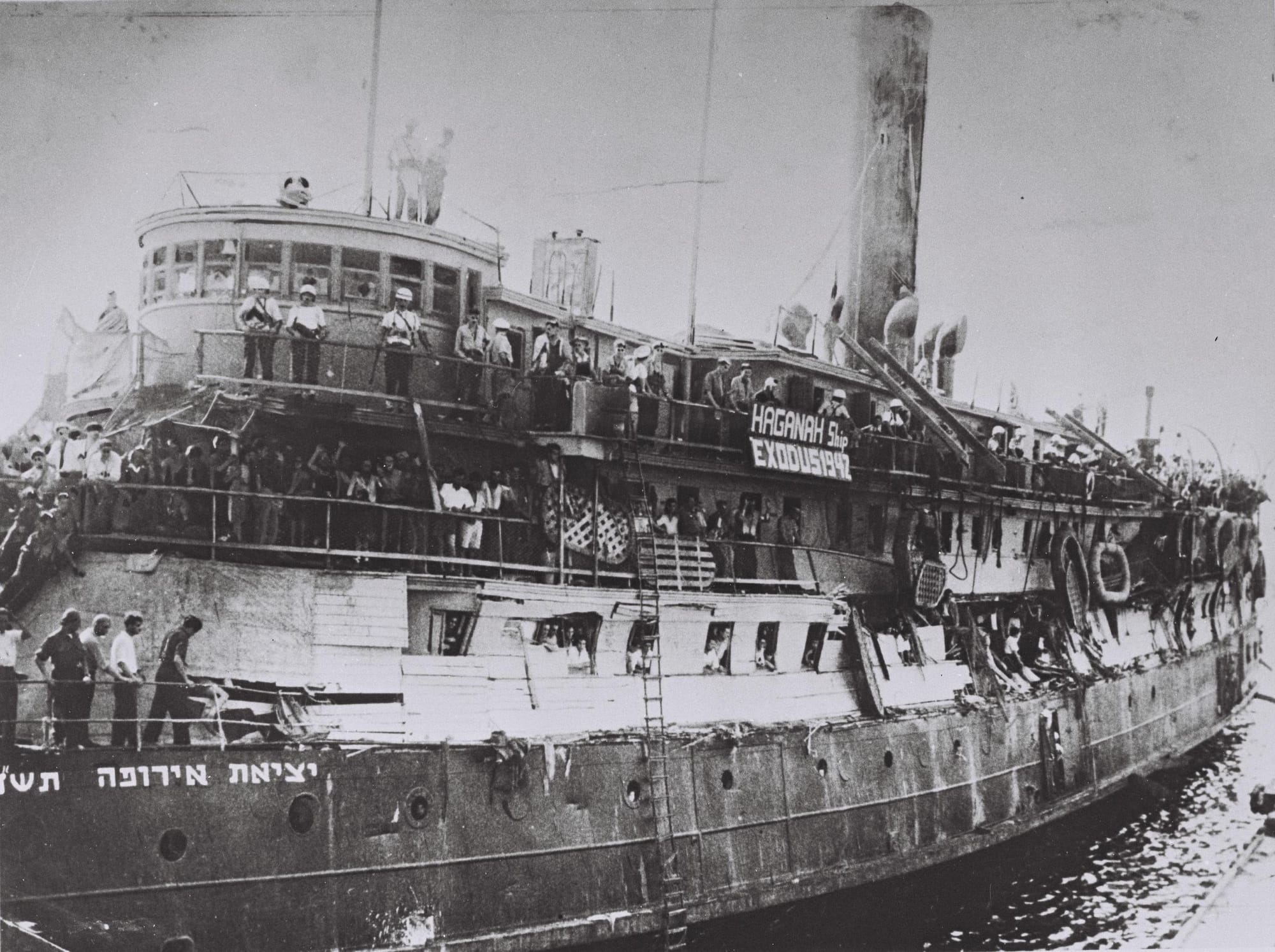
Displaced Persons and the Postwar Refugee Crisis
Following Germany's defeat in May 1945, hundreds of thousands of Jewish survivors remained displaced across Europe.
Many had no homes or surviving families to return to.
Others feared renewed antisemitism in their countries of origin.
Allied authorities established displaced persons camps in Germany, Austria and Italy.
By 1947, approximately 250,000 Jewish displaced persons were living in camps and other centres in these areas.
Within these communities, survivors established schools, newspapers, cultural organisations and political groups.
For many, emigration became a central goal.
Jewish organisations helped survivors travel across Europe and attempted to arrange passage to Palestine.
British authorities continued to restrict immigration, intercepting ships and placing thousands of Jewish refugees in detention camps on Cyprus.
The voyage of the Exodus 1947 became internationally known after British forces intercepted the ship carrying more than 4,500 Jewish refugees and ultimately returned its passengers to Europe.
The incident drew attention to the unresolved refugee crisis and increased international pressure for a political solution.
The plight of Holocaust survivors became an important part of the debate over Palestine's future, although the conflict between Jewish and Palestinian Arab national movements had developed much earlier.
The United Nations Partition Plan of 1947
By 1947, Britain had decided to refer the question of Palestine's future to the United Nations.
A United Nations committee examined possible political arrangements, including partition and proposals for a federal state.
On 29 November 1947, the UN General Assembly adopted Resolution 181 (II), recommending the partition of British Mandatory Palestine into two independent states.
One would be Jewish and the other Arab.
Jerusalem and its surrounding area were to be placed under a special international regime.
The plan also proposed economic cooperation between the two states.
Mainstream Jewish political leadership accepted the partition proposal, despite reservations about the proposed boundaries and other provisions.
Palestinian Arab leaders and Arab governments rejected it.
They argued that partition violated the principle of majority self-determination and unfairly allocated territory to a Jewish state when Arabs constituted the majority of Palestine's population.
For supporters of Jewish statehood, the UN vote represented a significant step toward international recognition of Jewish national independence.
For Palestinian Arabs, the proposal raised fundamental objections concerning political rights, territory and the future of their communities.
The General Assembly's resolution recommended partition, but it did not itself establish the proposed states or bring the plan into effect.
The Outbreak of War
Violence intensified following the November 1947 partition vote.
The first phase of the 1947–1949 war took place between Jewish and Palestinian Arab armed groups while Britain still administered Palestine.
Attacks, reprisals, battles over roads and communities, and efforts to control strategically important territory increased.
Civilians on both sides were killed.
During the fighting, Palestinian Arab communities began experiencing displacement.
Some residents fled because of combat, insecurity or fear of attacks.
Others were expelled by Jewish forces.
The circumstances varied between locations and changed as the war progressed.
On 14 May 1948, as the British Mandate was ending, David Ben-Gurion proclaimed the establishment of the State of Israel.
The declaration referred to Jewish historical connections to the land, the development of the Zionist movement and the Holocaust as part of the case for Jewish statehood.
The United States recognised the new state that day.
Following Israel's declaration of independence, armies from neighbouring Arab countries entered the conflict.
The fighting developed into a regional war.
For Israelis, the war became known as the War of Independence.
For Palestinians, the events of 1948 are remembered as the Nakba, an Arabic word meaning catastrophe.
These terms reflect different national experiences of the same historical period.
The Palestinian Nakba: Displacement and Loss
The war of 1947–1949 had devastating consequences for Palestinian Arab society.
Approximately 700,000 Palestinians became refugees or were displaced from their homes during the conflict.
Hundreds of Palestinian villages were depopulated, and many were subsequently destroyed or transformed.
Palestinian families lost homes, farmland, businesses and community institutions.
Some fled to the West Bank or Gaza Strip.
Others crossed into neighbouring countries, including Jordan, Lebanon and Syria.
The causes of displacement differed across communities and included flight from fighting, fear, military assaults and direct expulsions.
The extent to which different military and political decisions contributed to the refugee crisis has been examined extensively by historians.
What is not in dispute is that the displacement profoundly transformed Palestinian society and created a refugee question that remains unresolved.
For many Palestinians, the Nakba is not only a historical event but also a central part of family memory and national identity.
The creation of Israel represented independence and a new national home for Jewish Israelis, while the same war brought dispossession and displacement to a large part of the Palestinian Arab population.
Both histories are necessary to understand the consequences of 1948.
Holocaust Survivors in the New State of Israel
The establishment of Israel transformed the possibilities for Jewish immigration.
Restrictions that had prevented many survivors from entering British Mandatory Palestine were removed by the new state.
Holocaust survivors began arriving in Israel in substantial numbers.
Some came directly from displaced persons camps in Europe.
Others had spent years moving between countries, waiting for immigration opportunities or searching for surviving relatives.
For many, arrival represented the possibility of rebuilding a life within a Jewish-majority state.
Yet integration was not always easy.
The new country was engaged in war and faced shortages of housing, employment and essential resources.
Survivors also carried the physical and psychological consequences of persecution.
Some struggled with grief, illness or the loss of entire families.
Others faced difficulties adapting to a new language, society and political environment.
Over time, Holocaust survivors became part of Israel's social, economic, cultural and political life.
They established families, worked in different professions, contributed to public institutions and helped shape the country's evolving relationship with Holocaust memory.
The Holocaust and Israeli National Memory
The Holocaust became an important element of Israeli public memory, but the way it was understood and commemorated changed over time.
In Israel's early years, public discussion often emphasised Jewish resistance, national renewal and the creation of a sovereign state.
Survivors' experiences of persecution, hiding and life in the camps were not always fully understood by wider society.
The 1961 trial of Adolf Eichmann in Jerusalem marked a major turning point.
Eichmann, a senior Nazi official involved in organising the deportation of European Jews, had been captured in Argentina and brought to Israel for trial.
The proceedings included extensive survivor testimony and attracted international attention.
They helped bring individual experiences of the Holocaust into public discussion.
The trial also raised important legal and historical questions concerning accountability for crimes against humanity.
Over subsequent decades, Holocaust remembrance became increasingly prominent in Israeli education, public ceremonies, research and cultural life.
Yad Vashem, established in Jerusalem in 1953, developed into a major institution for Holocaust documentation, research and commemoration.
Its archives, memorials and educational programmes preserve the histories of victims, survivors and destroyed Jewish communities.
Two Histories, Different Experiences
The Holocaust and the Nakba occupy central places in Jewish and Palestinian historical memory, respectively.
They were different events, with different perpetrators, circumstances, objectives and historical contexts.
The Holocaust was the systematic genocide of European Jews carried out by Nazi Germany and its allies and collaborators.
The Nakba refers to the mass displacement and dispossession of Palestinians during the 1947–1949 war and its aftermath.
Understanding one does not require denying or diminishing the other.
Nor should the experiences be treated as interchangeable.
The history of Israel's establishment cannot be separated from Jewish national aspirations, the destruction of European Jewry, British imperial policy, Palestinian Arab society and the war that accompanied the end of the mandate.
Each of these developments has its own history.
Together, they help explain why the events of the 1940s continue to shape political debates, national identities and personal memories across the region.
Understanding the Historical Legacy
The establishment of Israel in 1948 was a major turning point in Jewish history.
For many Holocaust survivors, it offered a destination after years of persecution, displacement and uncertainty.
For Zionist supporters of Jewish statehood, it represented the achievement of a political movement that had begun decades earlier.
For Palestinians, the war surrounding Israel's establishment brought large-scale displacement, loss of property and the fragmentation of communities.
These experiences continue to influence how the history of 1948 is remembered.
The Holocaust must be understood within the history of European antisemitism, Nazi ideology and genocide.
The creation of Israel must also be understood through the longer histories of Zionism, Palestinian national aspirations, British rule and international diplomacy.
Examining these histories together provides essential context, but preserving their distinctions is equally important.
The next chapter explores how the Holocaust has been remembered, documented and taught across generations, and why the preservation of historical evidence remains essential in confronting denial and distortion.
Chapter 9 — Remembering the Holocaust: Testimonies, Memorials and Historical Education
Remembering a Genocide That Changed Europe
When the Second World War ended in 1945, Europe faced the consequences of destruction on an unprecedented scale.
Cities had been devastated, millions of people were displaced, and entire communities had disappeared.
Among the most profound losses was the destruction of approximately six million European Jews during the Holocaust.
The genocide had eliminated families, religious institutions, schools, businesses and cultural communities that had existed for generations.
In many towns and villages, Jewish life had almost entirely disappeared.
The challenge facing survivors, historians and future generations was not only to understand how these crimes had occurred, but also to preserve the memory of those who had been murdered.
Remembering the Holocaust would become a responsibility shared by survivors, families, researchers, museums, educational institutions and governments.
Yet Holocaust remembrance did not develop in the same way everywhere.
Different countries confronted their wartime histories at different times and with varying degrees of openness.
For some survivors, public testimony became a means of preserving memory.
Others remained silent for years, struggling with grief, trauma or the difficulty of communicating experiences that many people could scarcely comprehend.
The history of Holocaust remembrance is therefore also a history of how societies have gradually confronted responsibility, loss and the importance of historical truth.
Survivor Testimonies: Giving History a Human Voice
One of the most important sources for understanding the Holocaust is the testimony of those who experienced it.
Survivors have described life before the war, the gradual introduction of discriminatory laws, deportations, ghettos, hiding places, concentration camps and the struggle to rebuild their lives after liberation.
Their accounts provide details that official records alone cannot capture.
A transport document may record the movement of hundreds of people from one location to another.
A survivor's testimony can explain what it felt like to be separated from family members, to endure a journey in an overcrowded railway wagon or to arrive at an unfamiliar camp.
Personal testimony also reveals the diversity of experiences during the Holocaust.
Not every survivor was imprisoned in Auschwitz.
Some survived in hiding, others escaped across borders, joined resistance movements or endured forced labour.
Some were children when persecution began.
Others were parents, grandparents, teachers or workers whose lives had already been established.
These different experiences help historians understand the Holocaust as a continent-wide genocide that affected people in many different circumstances.
Survivor testimony is especially valuable when examined alongside documents, photographs, physical evidence and other historical sources.
Together, these forms of evidence provide a detailed and extensively corroborated record of Nazi persecution and mass murder.
Diaries, Letters and Personal Documents
Not all Holocaust witnesses survived to tell their stories.
Many left behind diaries, letters, drawings and other documents that provide direct evidence of their experiences.
Some wrote in secret while living in ghettos or hiding places.
Others recorded events in the hope that future generations would learn what had happened.
Anne Frank's diary remains one of the most widely read examples.
Written while she was hiding with her family in Amsterdam, it describes daily life under persecution through the observations of a young girl.
Her writing reflects fear, uncertainty, family relationships, personal ambitions and the desire for a future beyond the war.
The diary's importance lies partly in its ability to connect readers with an individual whose life was shaped and ultimately destroyed by Nazi persecution.
Yet Anne Frank was one of many young people who documented their experiences.
In the Łódź Ghetto, young writers recorded the conditions of life under German occupation.
In Warsaw, members of the clandestine Oneg Shabbat group collected diaries, reports, testimonies and documents describing the destruction of their community.
These records provide evidence from the perspective of people who were living through the events.
They also preserve the voices of individuals who were murdered before liberation.
Such documents remind us that historical memory is not limited to the accounts of those who survived.
Yad Vashem: Preserving the Names and Stories of Victims
In 1953, Israel established Yad Vashem, the World Holocaust Remembrance Center, in Jerusalem.
Its mission includes documenting the Holocaust, preserving the memory of Jewish victims, conducting historical research and supporting education.
One of Yad Vashem's major projects is the collection of names and biographical information about Jews murdered during the Holocaust.
For many victims, official records are incomplete or were deliberately destroyed.
Families and researchers have therefore contributed testimony pages, photographs, documents and other information to help reconstruct individual histories.
The Central Database of Shoah Victims' Names contains millions of victim records and continues to be updated.
The effort reflects a fundamental principle of Holocaust remembrance: the victims were not anonymous statistics.
They were individuals with names, families, occupations, communities and personal histories.
Yad Vashem also recognises non-Jews who risked their lives to save Jews during the Holocaust through its Righteous Among the Nations programme.
Its museum, archives, memorial spaces and educational activities attract visitors and researchers from around the world.
The institution plays a major role in preserving historical evidence and connecting new generations with the experiences of those who lived through the genocide.
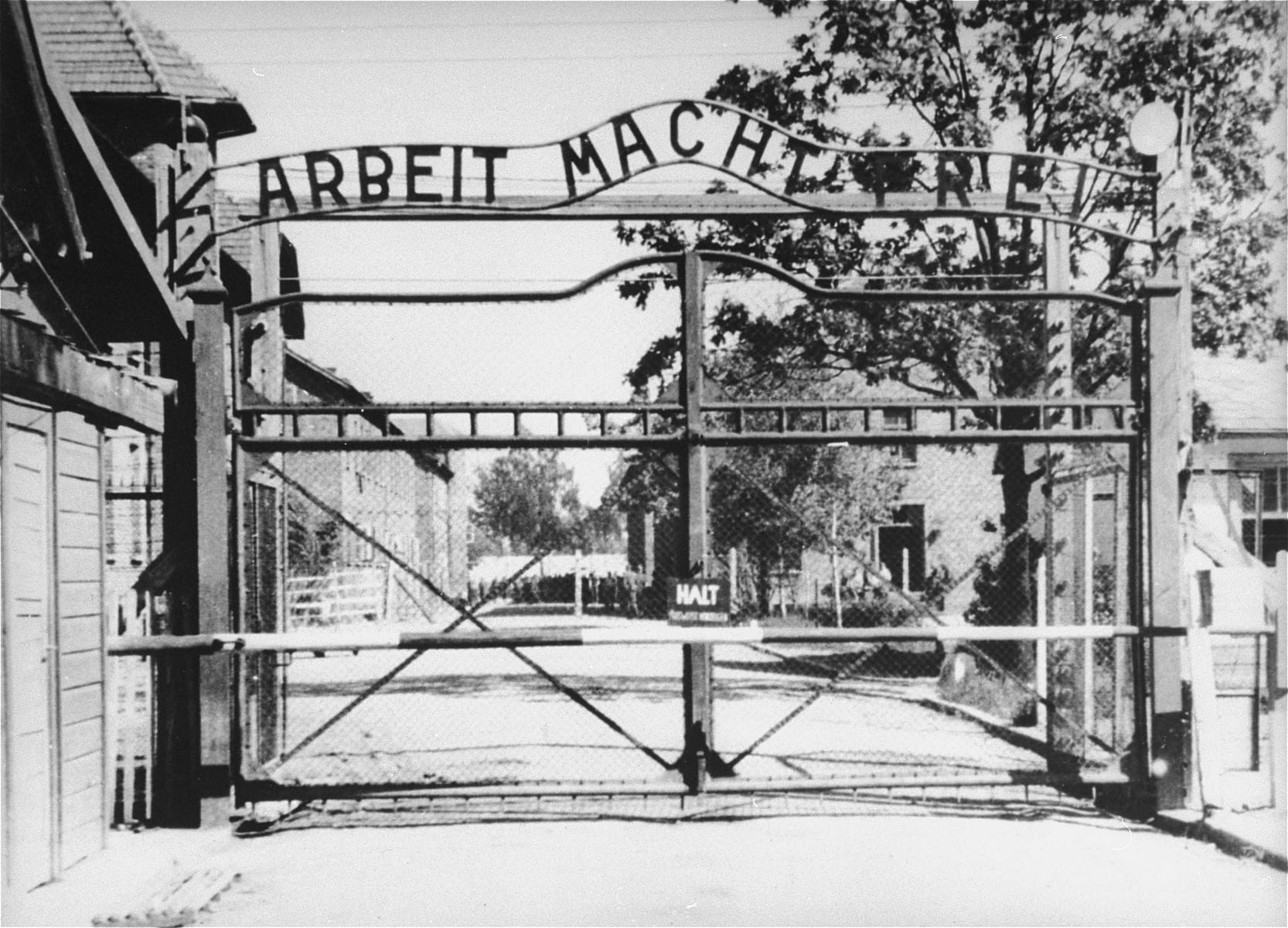
Auschwitz-Birkenau: A Place of Historical Evidence and Remembrance
Auschwitz-Birkenau, located near Oświęcim in southern Poland, has become one of the most internationally recognised Holocaust memorial sites.
Established by Nazi Germany during the occupation of Poland, Auschwitz developed into a complex of concentration camps, forced-labour facilities and extermination installations.
Approximately 1.1 million people were murdered there, including around one million Jews.
After the war, parts of the former camp complex were preserved as a memorial and museum.
The Auschwitz-Birkenau State Museum was established in 1947.
Today, visitors can see surviving barracks, watchtowers, railway infrastructure, camp buildings and other physical remains.
The museum also preserves personal belongings taken from victims, including shoes, suitcases and other objects.
These items provide a direct connection to the people who were imprisoned and murdered.
Auschwitz is not simply a museum about the past.
It is also a cemetery and a place of mourning.
For survivors and descendants of victims, visiting the site may carry deep personal significance.
For students, researchers and other visitors, the memorial provides an opportunity to confront the physical evidence of Nazi crimes.
Preserving the site requires extensive conservation work, as buildings and objects continue to deteriorate with time.
The responsibility of preservation is therefore both historical and practical.
Memorials Across Europe
Holocaust remembrance is not limited to Auschwitz or Jerusalem.
Memorials, museums and former camp sites exist across Europe and beyond.
In Berlin, the Memorial to the Murdered Jews of Europe occupies a prominent place near the Brandenburg Gate.
Opened in 2005, the memorial consists of a field of concrete stelae and an underground information centre documenting the persecution and murder of European Jews.
In Warsaw, memorials commemorate the destruction of the city's Jewish community and the Warsaw Ghetto Uprising.
In Amsterdam, the Anne Frank House preserves the building where Anne Frank and seven other people hid from Nazi persecution.
Former concentration camps such as Dachau, Bergen-Belsen, Buchenwald and Mauthausen also serve as memorial and educational sites.
Each location reflects a different aspect of Nazi persecution.
Some preserve the remains of imprisonment and forced labour.
Others commemorate deportations, mass shootings, destroyed Jewish neighbourhoods or acts of resistance.
Together, these places form an international landscape of remembrance.
They also demonstrate how the Holocaust affected communities far beyond the locations of the principal extermination camps.
Stolpersteine: Remembering Individuals in Everyday Streets
One of the most distinctive forms of Holocaust remembrance can be found in streets and neighbourhoods across Europe.
The Stolpersteine, often translated as stumbling stones, are small memorial plaques placed in pavements outside the last freely chosen residences or other significant locations associated with victims of Nazi persecution.
The project was initiated by German artist Gunter Demnig.
Each brass-covered plaque usually records a person's name, birth year and information about their fate.
The memorials commemorate Jews and other people persecuted by the Nazi regime.
Unlike large national monuments, Stolpersteine are integrated into ordinary public spaces.
People may encounter them while walking to work, shopping or visiting a neighbourhood.
The project brings remembrance into the places where victims once lived.
A single plaque can reveal that a family once occupied an apartment, that a child attended a nearby school or that a neighbour was deported and murdered.
In this way, the memorials connect historical persecution to familiar streets and everyday life.
They also encourage people to recognise that the Holocaust did not begin only in distant camps.
It began in societies where Jewish families had lived, worked and participated in community life.
International Holocaust Remembrance Day
On 1 November 2005, the United Nations General Assembly adopted Resolution 60/7, designating 27 January as International Holocaust Remembrance Day.
The date marks the anniversary of the liberation of Auschwitz-Birkenau by Soviet forces on 27 January 1945.
The resolution calls for remembrance of Holocaust victims and encourages educational programmes that preserve the lessons of the genocide.
Commemorations take place in schools, museums, government institutions and communities around the world.
Ceremonies often include survivor testimony, historical presentations, readings of victims' names and moments of silence.
International Holocaust Remembrance Day is distinct from Israel's Yom HaShoah, the national Holocaust remembrance day observed according to the Hebrew calendar.
Both commemorate the victims, but they developed within different historical and institutional contexts.
These annual commemorations provide opportunities for education and reflection.
However, meaningful remembrance requires more than a single day.
It depends on sustained historical research, access to reliable sources and the willingness of societies to examine uncomfortable aspects of their past.
Holocaust Education and Historical Understanding
Education plays a central role in preserving knowledge of the Holocaust.
Teaching the subject involves more than presenting the number of victims or identifying the principal concentration camps.
It requires examining the political, social and historical processes that made genocide possible.
Students need to understand the development of antisemitism, the destruction of democratic institutions, the use of propaganda, the role of discriminatory laws and the participation of different institutions in persecution.
They also need to examine the experiences of victims, the decisions made by perpetrators and collaborators, and the actions of rescuers and resistance movements.
The Holocaust should be taught through accurate historical evidence and within its specific context.
It should not be reduced to a general lesson about intolerance without explaining the particular ideology, policies and actions of Nazi Germany.
Educational organisations, including the United States Holocaust Memorial Museum, Yad Vashem and the International Holocaust Remembrance Alliance, provide research and guidance for teachers and institutions.
Their work supports historically informed education and encourages critical examination of sources.
As the number of living Holocaust survivors decreases, recorded testimony, archives and educational resources become increasingly important.
The Responsibility of Museums and Archives
Museums and archives play an essential role in preserving evidence of the Holocaust.
Their collections include official Nazi documents, transport records, photographs, survivor testimonies, personal letters, diaries, films and physical objects.
These materials help historians reconstruct events and identify victims, perpetrators and institutions involved in persecution.
Preservation also requires careful interpretation.
A photograph may show a location or event without explaining its full context.
A document may use bureaucratic language that conceals the violence it records.
Historical researchers must therefore examine sources critically, compare evidence and explain uncertainty where it exists.
Digital archives have expanded public access to historical material.
Researchers, teachers, descendants and members of the public can increasingly consult documents and testimony without travelling to the institutions that hold the original records.
At the same time, digital publication creates responsibilities concerning accuracy, identification and the ethical presentation of sensitive material.
Photographs of victims, for example, should not be used merely for dramatic effect.
They require appropriate context and respect for the people depicted.
The Role of Descendants and New Generations
For children and grandchildren of Holocaust survivors, remembrance can be deeply personal.
Family histories may include experiences of persecution, hiding, deportation, displacement and the loss of relatives.
Some descendants grew up hearing detailed accounts from parents or grandparents.
Others learned about their family histories only later in life.
The transmission of memory differs between families.
In some cases, silence reflected the difficulty of discussing traumatic experiences.
In others, survivors made deliberate efforts to preserve their stories for future generations.
As time passes, descendants increasingly participate in educational projects, memorial ceremonies, archival research and the preservation of family documents.
Their work helps connect personal memory with the broader historical record.
However, family testimony and historical scholarship serve complementary purposes.
Personal experiences provide essential human perspectives, while systematic research places those experiences within the wider evidence of the genocide.
Both contribute to a fuller understanding of the past.
Why Historical Accuracy Matters
The Holocaust is among the most extensively documented crimes in modern history.
Evidence comes from Nazi administrative records, military reports, transport lists, photographs, surviving camp structures, archaeological research, perpetrator testimony and the accounts of victims and witnesses.
These sources establish the systematic persecution and murder of approximately six million European Jews.
Nevertheless, Holocaust denial and distortion continue to circulate.
Some forms of denial reject established historical facts outright.
Others minimise the scale of the genocide, misrepresent the purpose of Nazi camps or manipulate historical evidence.
Distortion can also occur when Holocaust imagery or comparisons are used without regard for historical context.
Responding to such claims requires evidence-based historical education rather than treating documented facts as matters of opinion.
Historians may debate particular decisions, local events, administrative processes or the interpretation of individual sources.
Such scholarly discussion is fundamentally different from denying the genocide itself.
The existence and central facts of the Holocaust are established by overwhelming historical evidence.
Memory Beyond National Borders
The Holocaust took place across a continent and involved governments, institutions and individuals from many countries.
Its history cannot be understood through the experience of one nation alone.
German authorities directed the genocide, while collaborators and institutions in occupied and allied countries played varying roles in persecution and deportation.
At the same time, resistance movements, rescuers and humanitarian organisations operated across national boundaries.
The experiences of victims also crossed borders.
A Jewish family might have lived in Germany, fled to the Netherlands, been deported through a transit camp and ultimately murdered in occupied Poland.
Another might have escaped from Poland into the Soviet Union and survived through displacement.
These histories demonstrate why international cooperation is essential for Holocaust research and remembrance.
Archives in different countries often hold separate parts of the same individual's story.
Connecting those records can help restore names, reconstruct journeys and answer questions that families have carried for generations.
Remembering the Lives That Existed Before the Holocaust
Holocaust remembrance is often associated with images of concentration camps, railway tracks and memorial ceremonies.
These images are important, but they represent only part of the history.
Before persecution, Europe's Jewish communities were places of ordinary human life.
Children attended school, families celebrated weddings, neighbours met in markets, and people pursued careers, friendships and ambitions.
There were religious communities and secular organisations, political disagreements, cultural achievements and everyday routines.
The Holocaust destroyed much of this world.
Remembering the victims therefore means more than documenting how they died.
It also means recognising how they lived.
Photographs of families before the war, letters between relatives and records of local Jewish communities help restore the individuality of those who were murdered.
They remind us that the Holocaust was not an abstract historical event.
It was the deliberate destruction of people whose lives were as complex and meaningful as those of any other generation.
Preserving Memory for the Future
More than eight decades after the end of the Second World War, the responsibility for Holocaust remembrance is increasingly passing to generations who did not experience the events directly.
The voices of survivors remain essential, but fewer witnesses are alive to share their experiences in person.
This makes the preservation of recorded testimony, historical documents, memorial sites and educational resources especially important.
The task is not simply to repeat familiar facts.
It is to maintain the historical context that explains how persecution developed, how institutions participated and how individuals responded.
Responsible remembrance also requires resisting the misuse of Holocaust history for political purposes and recognising the dignity of victims.
The Holocaust cannot be undone.
The people who were murdered cannot be restored to their families, and the communities destroyed by genocide cannot be recreated exactly as they existed before the war.
But their names, experiences and histories can be preserved.
Through research, education, testimony and remembrance, future generations can continue to confront the historical reality of the Holocaust and understand the consequences of antisemitism, dictatorship and organised mass violence.
The final chapter examines Holocaust denial and distortion, the continuing challenges of historical responsibility, and why the preservation of truth remains essential in contemporary society.
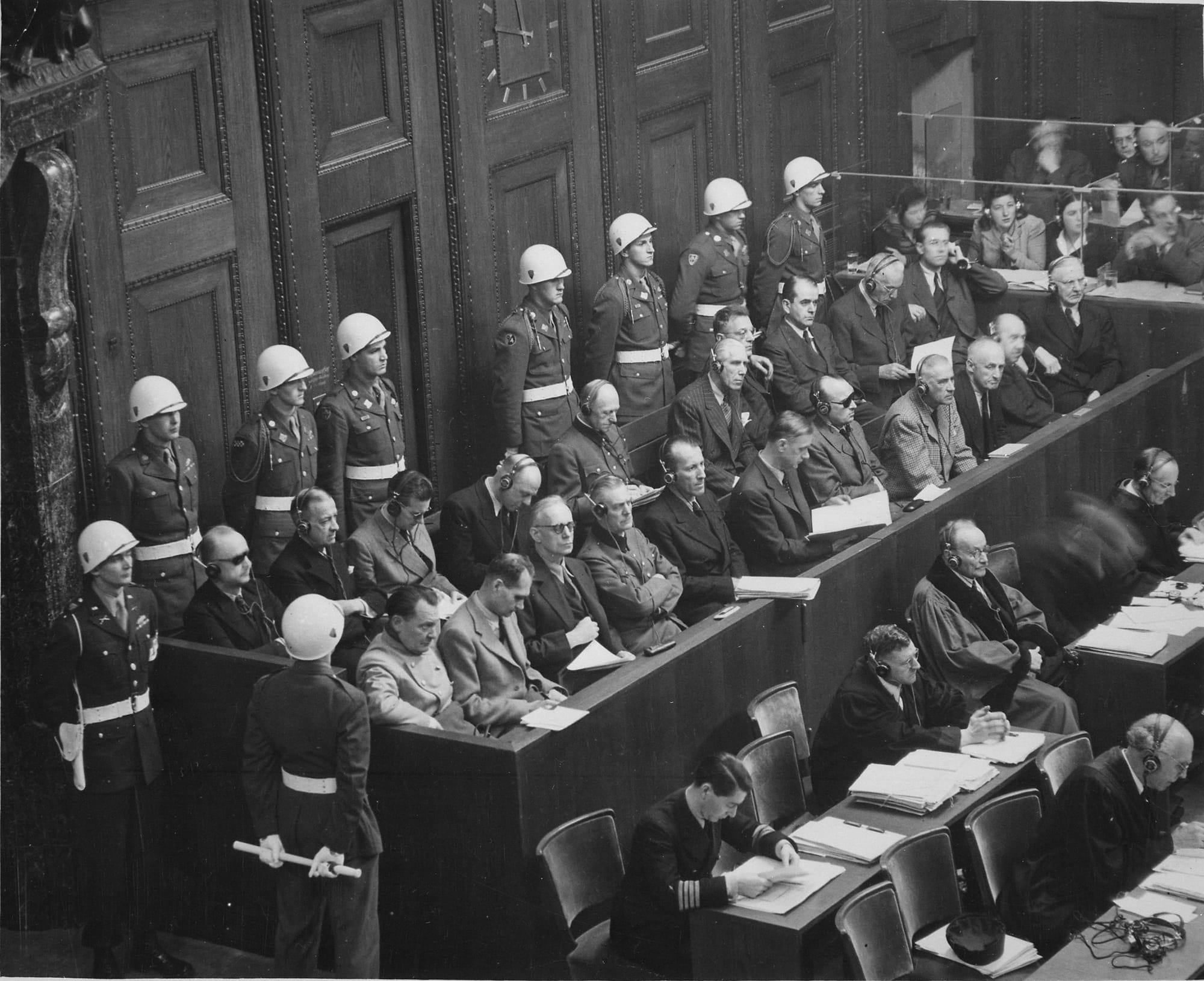
Chapter 10 — Holocaust Denial, Historical Responsibility and the Lessons of Remembrance
The Holocaust and the Responsibility of Historical Truth
More than eight decades after the end of the Second World War, the Holocaust remains one of the most extensively documented genocides in human history.
Approximately six million European Jews were systematically murdered by Nazi Germany and its allies and collaborators.
The genocide was carried out through discriminatory legislation, forced displacement, mass shootings, ghettos, deportations, forced labour and extermination camps.
Its history is supported by an enormous body of evidence, including documents produced by Nazi authorities, photographs, transport records, survivor testimonies, perpetrator statements, physical remains and decades of historical research.
Yet despite this evidence, Holocaust denial and distortion continue to exist.
The challenge facing contemporary societies is therefore not simply to remember that the Holocaust happened.
It is also to preserve an accurate understanding of how it happened, who was responsible and what its consequences were.
Historical truth requires careful research, critical examination of evidence and a willingness to confront difficult aspects of the past.
The Holocaust cannot be understood through slogans, political narratives or simplified explanations.
It must be examined as a historical event involving identifiable decisions, institutions, perpetrators, victims and witnesses.
What Is Holocaust Denial?
Holocaust denial refers to attempts to reject or fundamentally falsify the established historical reality of the genocide of European Jews.
Deniers may falsely claim that the systematic murder of six million Jews did not occur, that Nazi killing centres did not operate as documented, or that the scale of the genocide has been deliberately exaggerated.
Such claims contradict extensive and mutually reinforcing historical evidence.
The Holocaust was documented not only by survivors, but also by the perpetrators themselves.
German administrative records contain information about deportations, confiscated property, killing operations and the organisation of Nazi persecution.
Reports produced by SS and police units document mass shootings in occupied Eastern Europe.
Railway records, camp documents and surviving correspondence provide further evidence of the deportation and murder of Jewish populations.
Physical remains at former camps and killing sites support the documentary record.
Historical research has also examined demographic changes, destroyed communities and the identities of individual victims.
Holocaust denial is therefore not a legitimate alternative interpretation of uncertain historical evidence.
It is a rejection or deliberate misrepresentation of facts established through extensive research.
Holocaust Distortion: A Different but Related Problem
Holocaust distortion does not always involve outright denial.
It may involve minimising the scale of Nazi crimes, misrepresenting the roles of perpetrators and collaborators, or presenting the Holocaust without essential historical context.
Distortion can also occur when the genocide is used as a rhetorical comparison without attention to the specific circumstances of Nazi persecution and mass murder.
Another form involves attempting to remove or obscure the Jewish identity of the principal victims.
The Nazi regime persecuted and murdered many groups, including Roma and Sinti, people with disabilities, Polish civilians, Soviet prisoners of war and political opponents.
Their suffering must be documented and remembered.
At the same time, the Holocaust refers specifically to the genocide of European Jews, whose destruction was a central objective of Nazi racial ideology.
Recognising the experiences of other victims does not require diminishing the particular history of the Holocaust.
Accurate historical education must preserve both the distinctions and the connections between different Nazi crimes.
Antisemitism Before and After 1945
The defeat of Nazi Germany did not bring an end to antisemitism.
Prejudice against Jews had existed in Europe for centuries before the rise of Nazism.
Religious hostility, economic stereotypes, racial theories and conspiracy narratives contributed to a long history of exclusion and violence.
The Nazi regime drew upon these traditions while transforming antisemitism into a central principle of state policy.
After 1945, antisemitic attitudes and incidents continued in different societies.
Some survivors encountered hostility when returning to their former homes.
Others faced discrimination or found that property confiscated during the war had not been restored.
In later decades, antisemitism continued to appear through conspiracy theories, vandalism, threats, harassment and violence.
The internet and social media have created additional opportunities for antisemitic narratives to circulate across national borders.
Some contemporary antisemitic claims repeat older conspiracy theories in modified forms.
Others incorporate Holocaust denial or distortion.
Understanding these connections is important because antisemitism did not begin with Hitler, and it did not disappear with the collapse of the Nazi regime.
Criticism of Governments and Antisemitism
Contemporary discussions about antisemitism sometimes intersect with debates about Israel and the Israeli-Palestinian conflict.
These discussions require careful distinctions.
Criticism of the policies or actions of the Israeli government is not inherently antisemitic.
Like other governments, Israel's government can be examined, questioned and criticised through political debate, legal analysis and journalism.
Antisemitism concerns prejudice, hostility or discrimination directed against Jews because they are Jewish.
It can also appear when Jews collectively are held responsible for the actions of the Israeli state, when longstanding antisemitic conspiracy theories are invoked, or when Jewish individuals and institutions are targeted because of events in the Middle East.
There are differences among scholars and organisations concerning how particular expressions related to Israel should be classified.
These disagreements should be examined carefully rather than used to obscure either antisemitism or legitimate political discussion.
Responsible journalism must distinguish between governments, political movements, religious identities, national communities and individual citizens.
These distinctions are essential to accurate reporting.
The Role of Journalism in Preserving Historical Accuracy
Journalism has an important responsibility when reporting on the Holocaust and its continuing legacy.
Historical reporting should be based on reliable evidence, transparent sourcing and careful contextualisation.
Journalists should distinguish between established facts, historical interpretations and claims that remain disputed.
They should also avoid presenting demonstrably false claims as though they carry equal evidentiary weight to well-established historical findings.
The Holocaust is not a matter of competing opinions about whether the genocide occurred.
Its central facts are supported by overwhelming evidence.
However, historians continue to investigate specific events, individual responsibilities, administrative decisions and regional differences.
Responsible reporting can explain these areas of ongoing research without undermining the established historical record.
Language also matters.
Terms such as concentration camp, extermination camp, deportation, forced labour and genocide have specific historical meanings.
Using them accurately helps readers understand the different mechanisms of Nazi persecution.
Visual material requires equal care.
Photographs should be correctly dated and attributed whenever possible.
Images from one location should not be presented as though they document another.
Digitally altered or AI-generated images must never be represented as authentic historical photographs.
In journalism, accuracy is not simply a technical requirement.
It is a responsibility toward the people whose experiences are being documented.
The Importance of Primary Sources
Primary sources provide direct evidence from the period being studied.
For Holocaust research, these include official Nazi documents, correspondence, diaries, photographs, camp records, deportation lists and eyewitness testimony.
They can reveal how policies were developed, how institutions operated and how individuals experienced persecution.
Yet primary sources also require interpretation.
A Nazi administrative document may use euphemisms to conceal murder.
A photograph may capture only one moment without explaining what happened before or afterward.
A survivor's testimony may describe an individual experience that cannot automatically be generalised to every camp or region.
Historians therefore compare different sources and place them within their historical context.
Archives such as those maintained by the United States Holocaust Memorial Museum, Yad Vashem, the Arolsen Archives and the Auschwitz-Birkenau Memorial and Museum preserve extensive collections of historical material.
Their work allows researchers and the public to examine the evidence on which historical understanding is based.
Access to these records is especially important in an era when misinformation can spread rapidly.
Education Beyond Dates and Numbers
Teaching the Holocaust requires more than memorising dates, names and casualty figures.
Students need to understand the historical conditions that allowed Nazi Germany to dismantle democratic institutions, institutionalise discrimination and organise genocide.
They should examine how propaganda functioned, how legal systems were used to remove rights, and how institutions participated in persecution.
Education should also explore the experiences of victims, the roles of perpetrators and collaborators, and the actions of those who resisted or helped others.
These subjects require historical specificity.
The Holocaust should not be reduced to a general story about prejudice without explaining the antisemitic ideology and deliberate policies that drove the genocide.
Nor should every contemporary political conflict automatically be compared to Nazi Germany.
Historical comparisons can be useful when carefully defined and supported by evidence, but careless comparisons may obscure important differences.
Effective Holocaust education encourages critical thinking while preserving the distinct historical circumstances of the events.
Responsibility, Collaboration and the Choices of Individuals
One of the difficult questions raised by Holocaust history concerns the participation of ordinary institutions and individuals.
Nazi leaders directed the genocide, but its implementation depended on many different organisations.
Government departments drafted regulations.
Police forces carried out arrests and deportations.
Railway systems transported victims.
Businesses benefited from confiscated property and forced labour.
Local authorities and collaborators assisted persecution in different occupied territories.
Some people actively supported Nazi policies.
Others participated through professional duties, political loyalty, fear, opportunism or antisemitic beliefs.
Still others resisted, helped victims or refused particular forms of cooperation.
The circumstances differed considerably across countries and periods.
Historical responsibility therefore requires examining both the decisions of senior leaders and the actions of those who implemented, facilitated or benefited from persecution.
This does not mean that every individual held equal responsibility.
The roles of perpetrators, collaborators, bystanders, rescuers and victims must be distinguished.
Understanding these differences is essential to understanding how the Holocaust became possible.
The Responsibility of Nations
After the Second World War, European countries faced difficult questions about their wartime histories.
Some governments and institutions had participated directly in persecution and deportation.
Others had failed to protect Jewish citizens or refugees.
In certain countries, collaboration was initially minimised in public narratives that emphasised national resistance.
Over time, historical research, survivor testimony and public debate challenged simplified accounts.
Governments and institutions have since undertaken different forms of remembrance, investigation, restitution and acknowledgement.
These efforts have included compensation programmes, the return of confiscated property, educational initiatives and the establishment of memorials.
The process has not been uniform.
Disputes over responsibility, restitution and historical interpretation continue.
National remembrance is most meaningful when it is based on evidence and includes a willingness to examine uncomfortable historical facts.
Justice and Its Limitations
The Nuremberg Trials and subsequent prosecutions established important precedents for holding individuals accountable for international crimes.
They demonstrated that government authority did not automatically shield officials from criminal responsibility.
Yet justice after the Holocaust remained incomplete.
Many perpetrators were never brought before a court.
Some escaped prosecution, while others lived for decades without facing legal consequences.
Survivors often encountered substantial obstacles when seeking compensation or the return of property.
The destruction of documents, the deaths of witnesses and political circumstances complicated legal proceedings.
No judicial process could restore the six million Jewish lives lost or rebuild every destroyed community.
Nevertheless, trials contributed to the historical record by collecting documents, hearing testimony and publicly establishing responsibility for specific crimes.
The pursuit of justice became one of the ways in which postwar societies attempted to confront the legacy of Nazi rule.
The Holocaust and the Development of International Law
The atrocities of the Second World War influenced the development of international human rights and criminal law.
In 1948, the United Nations adopted the Convention on the Prevention and Punishment of the Crime of Genocide.
The convention defined genocide as certain prohibited acts committed with the intent to destroy, in whole or in part, a national, ethnic, racial or religious group.
It established obligations for states to prevent and punish the crime.
The Universal Declaration of Human Rights, also adopted in 1948, affirmed fundamental rights and freedoms for all human beings.
These developments reflected a broader international effort to respond to wartime atrocities and establish legal protections against persecution and mass violence.
However, international law alone cannot guarantee that such crimes will not occur again.
Its effectiveness depends on political decisions, institutions, evidence, accountability and enforcement.
The Holocaust remains a central historical reference in discussions about genocide prevention, human rights and international justice.
The Last Generation of Survivors
As the decades pass, the number of living Holocaust survivors continues to decline.
For many years, survivors have spoken in schools, museums, universities and public commemorations.
Their testimony has helped younger generations understand the Holocaust through individual experiences rather than historical statistics alone.
The disappearance of living witnesses presents a significant challenge.
Future generations will increasingly encounter the Holocaust through recorded interviews, written testimony, archival documents and historical scholarship.
Institutions around the world are working to preserve survivor accounts through film, audio recordings, digital archives and educational projects.
These efforts help ensure that personal experiences remain accessible even when witnesses can no longer speak in person.
Yet preserving testimony requires more than recording words.
It also requires explaining historical context, identifying sources and protecting the integrity of the original accounts.
The responsibility for remembrance is gradually moving from those who witnessed the events to those who inherit their histories.
Remembering Victims as Individuals
The figure of six million Jewish victims communicates the enormous scale of the Holocaust.
But no number can fully represent the lives that were destroyed.
Each victim belonged to a family, a community and a personal history.
Some were children who had only begun to discover the world.
Others were parents, grandparents, teachers, doctors, musicians, shopkeepers, students or religious leaders.
They lived in cities, towns and villages across Europe.
They spoke different languages and held different beliefs.
They had ambitions, relationships, disagreements, traditions and ordinary daily routines.
The Nazi regime attempted to erase these lives through a system that reduced human beings to racial categories, prisoner numbers and administrative records.
Holocaust remembrance seeks to restore the individuality that persecution attempted to destroy.
This is why personal photographs, letters, diaries and names remain so important.
They remind us that the victims were not defined by the circumstances of their deaths.
They were people whose lives existed long before the Holocaust.
What the Holocaust Teaches Future Generations
The Holocaust raises fundamental questions about the relationship between political power, ideology, institutions and human responsibility.
It demonstrates how discrimination can become embedded in law and how propaganda can be used to portray entire populations as enemies.
It also shows how state institutions, professional organisations and ordinary individuals can participate in systems of persecution.
These historical lessons should be approached carefully.
The Holocaust was not an inevitable outcome of European history.
It resulted from deliberate decisions made by political leaders, institutions and individuals within particular historical circumstances.
Understanding those decisions helps explain how genocide developed and how opportunities to oppose persecution were constrained or ignored.
The history also contains examples of resistance, rescue and moral courage.
These actions did not prevent the genocide, but they demonstrate that individuals sometimes made choices that challenged the policies of the Nazi regime.
Remembering these different experiences does not provide simple answers to every contemporary political or moral question.
It does, however, offer an essential historical foundation for examining the consequences of antisemitism, authoritarian rule, dehumanisation and organised violence.
Conclusion — Beyond the Numbers, Beyond the Silence
The Holocaust was the systematic murder of approximately six million European Jews by Nazi Germany and its allies and collaborators.
It was preceded by years of antisemitic propaganda, discriminatory laws, social exclusion and the destruction of democratic protections.
During the Second World War, persecution escalated into mass shootings, deportations, forced labour and the operation of extermination camps.
Entire Jewish communities were destroyed.
Families disappeared.
Centuries of religious, cultural and social life were lost.
Yet the history of the Holocaust is also preserved through the voices of those who survived, the documents left by those who did not, and the work of generations of historians, archivists, educators and families.
Their efforts have established a historical record supported by overwhelming evidence.
Remembering the Holocaust requires more than acknowledging the number of victims.
It requires recognising the individuals behind those numbers, understanding the institutions and decisions that made genocide possible, and confronting the continuing danger of antisemitism and historical distortion.
It also requires accuracy.
The Holocaust should neither be minimised nor used carelessly as a political analogy.
Its history deserves careful research, precise language and respect for the people whose lives were destroyed.
For journalism, this responsibility is especially important.
The purpose of historical reporting is not merely to repeat familiar accounts, but to examine evidence, explain context and preserve the distinction between documented fact and interpretation.
The Holocaust belongs to the history of Europe, to Jewish history and to the broader history of humanity.
Its victims cannot be brought back.
The communities that disappeared cannot be restored exactly as they once existed.
But their stories can be preserved.
Their names can be remembered.
And the historical truth of what happened can continue to be documented, taught and defended.
Because remembrance is not only about the past. It is also about the responsibility to ensure that the truth is not lost.
Sources and References
This article draws upon historical research, archival collections, survivor testimonies, official documentation and educational resources from internationally recognised institutions.
Holocaust History and Nazi Persecution
United States Holocaust Memorial Museum (USHMM)
Holocaust Encyclopedia
Historical research covering the rise of Nazi Germany, antisemitism, anti-Jewish legislation, ghettos, mass shootings, deportations, killing centres, resistance and liberation.
https://encyclopedia.ushmm.org/
Yad Vashem — World Holocaust Remembrance Center
Historical research, survivor testimonies, documentation of Jewish communities, Holocaust victims' names and educational resources.
https://www.yadvashem.org/
Arolsen Archives — International Center on Nazi Persecution
Archival documentation relating to concentration camp prisoners, forced labour, displacement and the tracing of victims and survivors.
https://arolsen-archives.org/en/
Concentration Camps, Killing Centres and Liberation
Auschwitz-Birkenau State Museum
Historical documentation of the Auschwitz camp complex, deportations, mass murder, prisoners and liberation.
https://www.auschwitz.org/en/
United States Holocaust Memorial Museum — Nazi Killing Centers
Research on the killing centres established by Nazi Germany in occupied Poland.
https://encyclopedia.ushmm.org/content/en/article/killing-centers-an-overview
United States Holocaust Memorial Museum — Liberation of Nazi Camps
Historical overview of the liberation of Nazi camps and the experiences of surviving prisoners.
https://encyclopedia.ushmm.org/content/en/article/liberation-of-nazi-camps
Jewish Resistance, Rescue and Survivor Testimonies
United States Holocaust Memorial Museum — Jewish Resistance
Research on armed resistance, underground movements and other forms of Jewish resistance during the Holocaust.
https://encyclopedia.ushmm.org/content/en/article/jewish-resistance
Anne Frank House
Research into Anne Frank, the persecution of Jews in the Netherlands, hiding, deportation and remembrance.
https://www.annefrank.org/en/
Yad Vashem — Righteous Among the Nations
Documentation of non-Jews who risked their lives to rescue Jews during the Holocaust.
https://www.yadvashem.org/righteous.html
The Holocaust, Refugees and the Establishment of Israel
United States Holocaust Memorial Museum — Displaced Persons
Historical research on Holocaust survivors, displaced persons camps and postwar migration.
https://encyclopedia.ushmm.org/content/en/article/displaced-persons
United Nations — The Question of Palestine
Historical documents concerning British Mandatory Palestine, the 1947 UN partition proposal and subsequent developments.
https://www.un.org/unispal/
United Nations Digital Library — General Assembly Resolution 181 (II), 1947
The United Nations recommendation for the partition of Palestine.
https://digitallibrary.un.org/record/671195
Justice, Human Rights and Remembrance
United States Holocaust Memorial Museum — The Nuremberg Trials
Historical research on the prosecution of major Nazi war criminals and the development of international criminal accountability.
https://encyclopedia.ushmm.org/content/en/article/the-nuremberg-trials
United Nations — Convention on the Prevention and Punishment of the Crime of Genocide (1948)
International legal framework for the prevention and punishment of genocide.
https://www.un.org/en/genocide-prevention/1948-convention
International Holocaust Remembrance Alliance (IHRA)
Research-based resources on Holocaust remembrance, education, denial and distortion.
https://holocaustremembrance.com/
United Nations — International Holocaust Remembrance Day
Information about the international commemoration observed annually on 27 January.
https://www.un.org/en/observances/holocaust-remembrance-day