When Support for Hamas Appears on Dutch Streets: The Netherlands Confronts Extremism and Antisemitism
Images of explicit Hamas support at an Amsterdam protest renew questions about extremism, antisemitism and Dutch law.

Masked demonstrators, explicit pro-Hamas banners and rising concerns about antisemitism have placed renewed scrutiny on Dutch authorities. As the country debates the limits of protest, a fundamental question remains: when does freedom of expression become a platform for the promotion of terrorism?
Beyond the Lines | In-Depth | 8 November 2026
Estimated reading time: 14 minutes
The Story in Brief
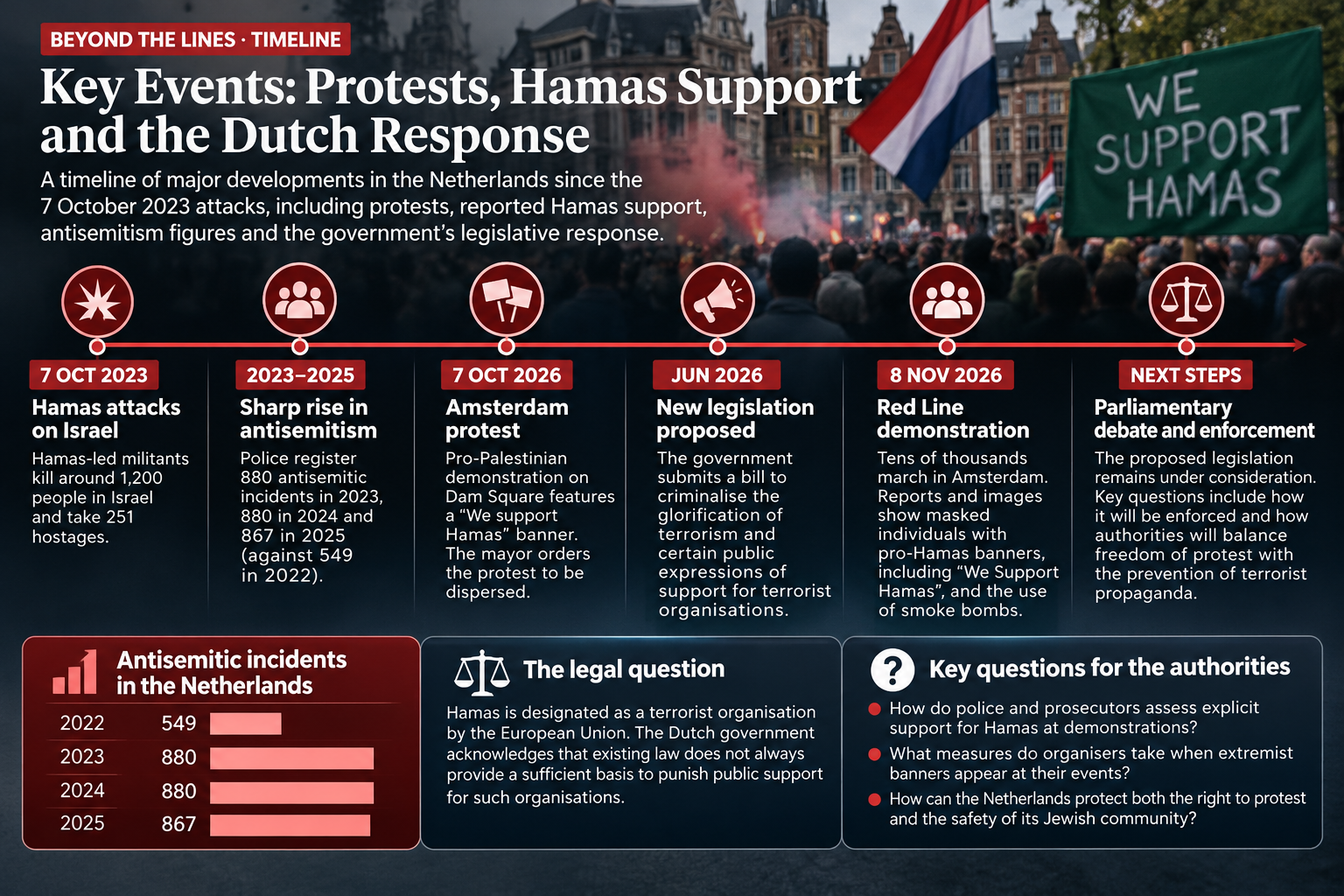
On 8 November 2026, tens of thousands of people marched through Amsterdam during another Red Line demonstration demanding stronger Dutch action against Israel. Among the images emerging from the protest were masked individuals displaying banners openly supporting Hamas, the Palestinian organisation designated as terrorist by the European Union.
The controversy is not isolated. A previous pro-Palestinian demonstration in Amsterdam on 7 October 2026 also featured explicit Hamas support and was eventually dispersed by the authorities.
Meanwhile, official statistics show that antisemitic incidents in the Netherlands remain substantially elevated compared with the period before the Hamas-led attacks against Israel in October 2023.
The Dutch government has proposed legislation targeting the glorification of terrorism and public support for terrorist organisations. Yet the proposal remains under parliamentary consideration.
The central issue is no longer simply whether extremist expressions exist. It is how effectively Dutch institutions distinguish legitimate protest from intimidation, extremist propaganda and conduct that threatens public safety.
Introduction — A Democracy Facing Difficult Questions
The Netherlands has traditionally presented itself as a country built on tolerance, freedom of expression, religious liberty and democratic participation.
These principles remain essential to Dutch society.
Citizens have the right to criticise governments, oppose military operations, demand political change and demonstrate against perceived injustice.
But democratic freedom also brings responsibilities.
When people appear in public carrying banners expressing support for an organisation responsible for terrorist attacks, the question extends beyond political disagreement.
It becomes a matter of public safety, legal boundaries and the protection of vulnerable communities.
On 8 November 2026, those questions returned to Amsterdam.
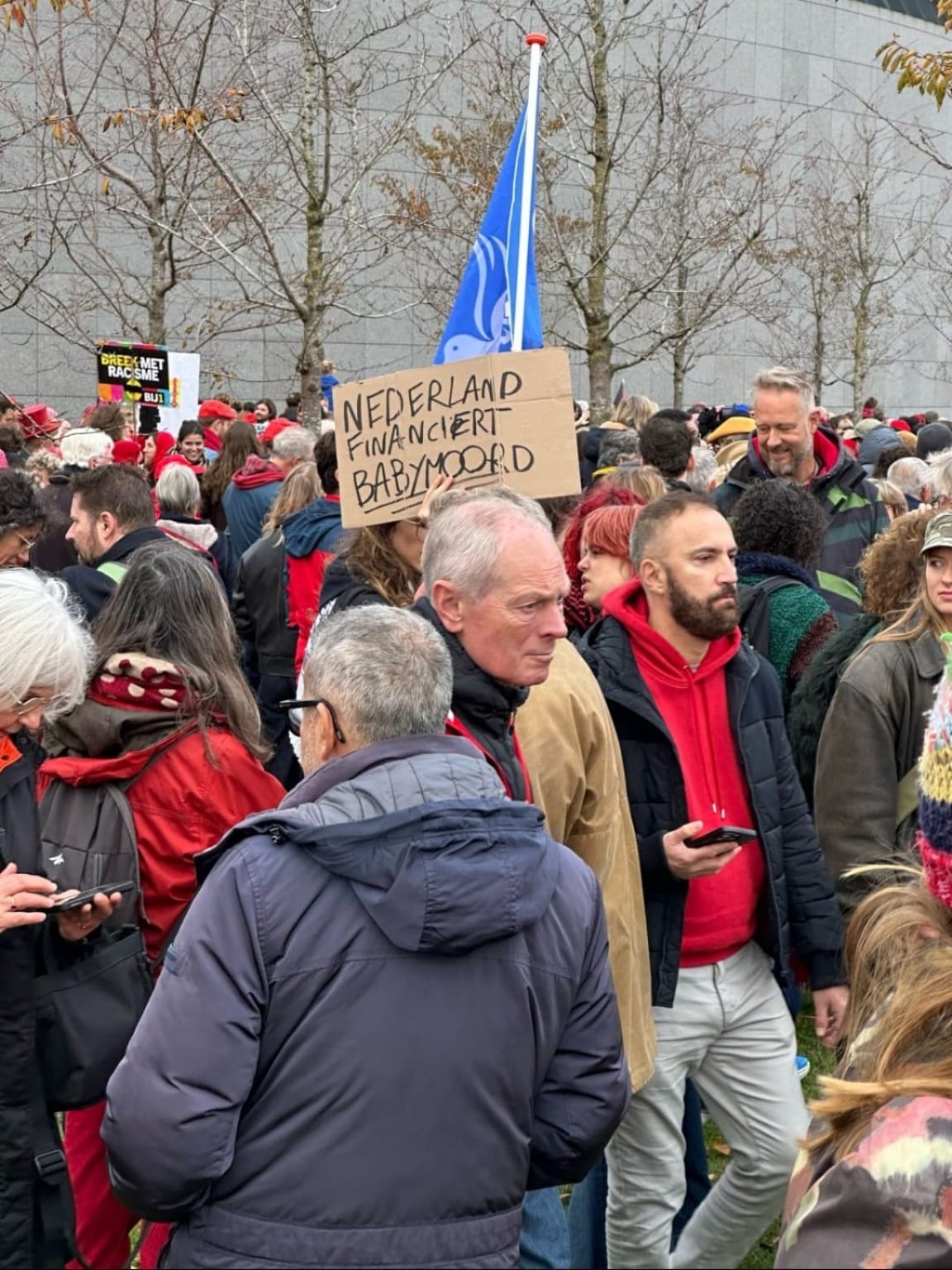
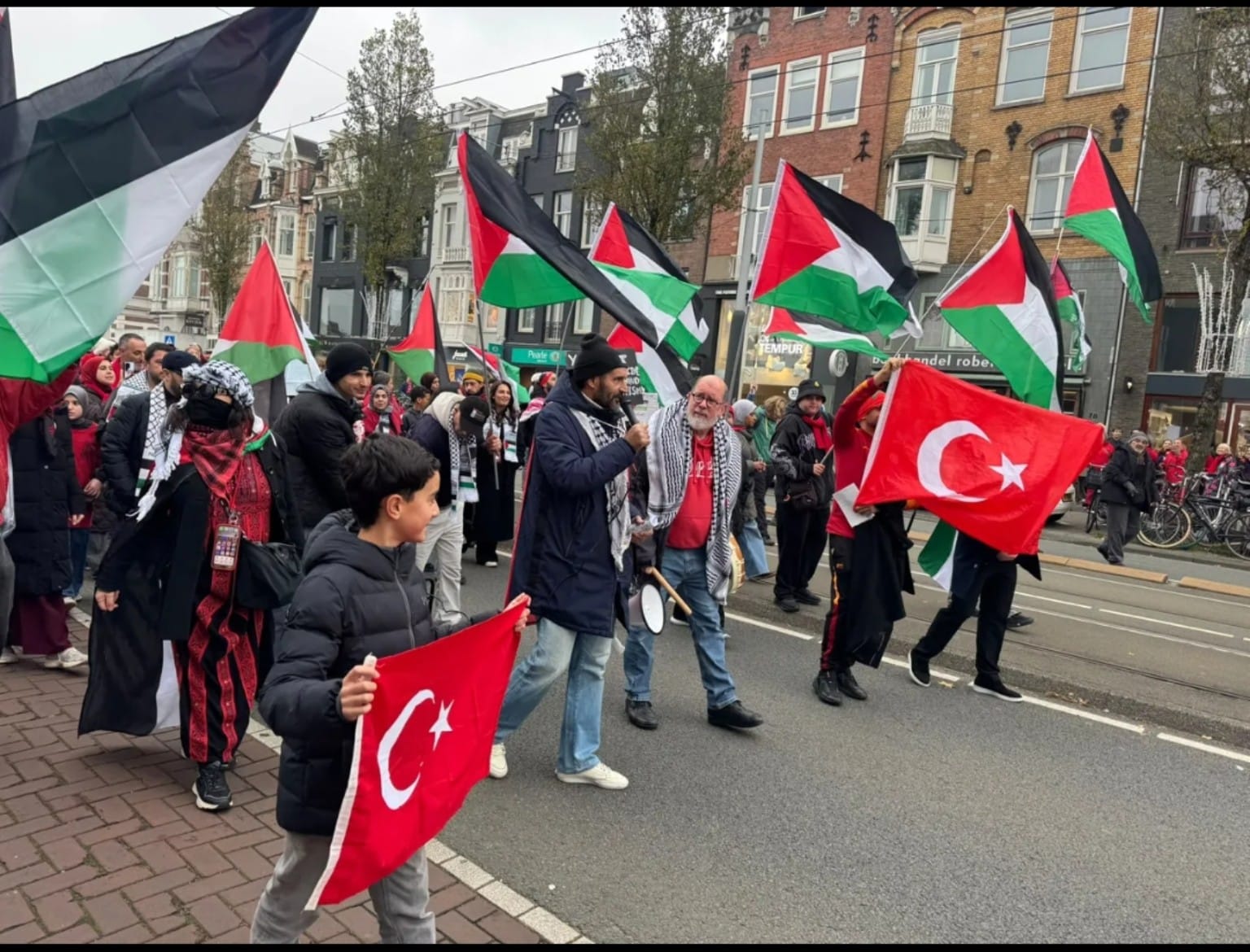
Thousands of demonstrators gathered to demand stronger action against Israel. Many carried Palestinian flags, wore red clothing and expressed concern about the humanitarian situation in Gaza.
Others carried signs calling for peace.
Yet photographs and media reports also documented explicit support for Hamas.
These contrasting messages reveal the complexity of the demonstrations. They also expose an unresolved question for the Dutch authorities: how can a country protect legitimate political protest without allowing extremist messages to gain public visibility and potentially intimidate others?
The concern is particularly serious in a country where antisemitic incidents remain at persistently high levels.
1. Amsterdam, 8 November — When a Protest Becomes a National Controversy
The Red Line demonstration began at Museumplein in Amsterdam.
Organised by thirteen civil society organisations, the protest called for stronger economic and political measures against Israel over its conduct in Gaza and the occupied Palestinian territories.
According to Associated Press, tens of thousands attended. Amnesty International's Dutch branch estimated participation at more than 200,000.
The organisers argued that the Dutch government had failed to take sufficiently strong action against Israeli policies.
Their demands included economic restrictions, measures concerning arms transfers and greater pressure on Israel.
These are political demands that fall within the democratic right to protest.
However, reports emerging from the demonstration raised a separate concern.
De Telegraaf reported that masked demonstrators displayed pro-Hamas banners and set off smoke bombs.
Photographs supplied to Beyond the Lines show individuals holding a large green banner with the unmistakable words:
WE SUPPORT HAMAS
The wording is explicit.
Unlike the Palestinian national flag, which represents a people and a national cause, this banner expresses support for a specific organisation designated as terrorist by the European Union.
A second reported banner referred to the Al-Qassam Brigades, Hamas's armed wing, as resistance.
According to an account circulated from the demonstration, approximately ten masked individuals gathered near the Leidsebosjes, close to the exit towards the Overtoom.
The account described mixed reactions from other protesters. Some reportedly turned away in disapproval, while others cheered or whistled.
Those reactions have not been independently established by Beyond the Lines.
Nevertheless, the photographs of explicit Hamas support raise questions that warrant a response from the authorities.
Were the individuals identified?
Did police investigate whether their actions constituted criminal offences?
Were organisers informed?
Did those responsible for the demonstration attempt to distance themselves from the banners?
And were any measures taken to prevent further intimidation?
These are not questions about whether people should be permitted to support Palestinian civilians.
They concern the public promotion of an organisation responsible for deliberate attacks against civilians.
2. Hamas — A Designated Terrorist Organisation
Hamas is a Palestinian Islamist political and armed movement established in 1987.
It has exercised de facto control over Gaza since 2007, following violent conflict with its Palestinian political rivals.
The European Union designates Hamas as a terrorist organisation.
On 7 October 2023, Hamas-led militants attacked communities, military positions and a music festival in southern Israel.
Approximately 1,200 people were killed and 251 were taken hostage, according to Israeli authorities.
Civilians were deliberately targeted, and the attacks included killings, hostage-taking and other serious abuses.
The subsequent Israeli military campaign in Gaza caused enormous civilian suffering, widespread destruction and tens of thousands of Palestinian deaths.
Both realities must be acknowledged.
The suffering of Palestinian civilians does not justify Hamas's attacks against Israeli civilians.
Equally, the atrocities committed by Hamas do not remove Israel's obligations under international humanitarian law.
These principles are not contradictory.
They are central to any serious discussion of the conflict.
Supporting Palestinian self-determination is not equivalent to supporting Hamas.
But publicly declaring support for Hamas is different from advocating Palestinian rights.
The distinction should remain clear in political debate, public reporting and the enforcement of Dutch law.
3. This Has Happened Before — The October Demonstration
The events reported on 8 November followed an earlier confrontation in Amsterdam.
On 7 October 2026, the third anniversary of the Hamas-led attacks against Israel, a pro-Palestinian demonstration took place on Dam Square.
According to Dutch public broadcaster NOS, participants displayed a large green banner reading “We support Hamas”.
Other demonstrators reportedly praised the 7 October attacks.
An Israeli flag was burned.
Amsterdam Mayor Femke Halsema ultimately ordered the demonstration to be dispersed.
However, NOS reported that police had examined the banners and concluded that their wording did not violate the law under the circumstances.
This distinction is important.
The authorities did intervene by ending the gathering, but the explicit Hamas-supporting message was not itself treated as a criminal offence.
The incident illustrates the difficulty of enforcing legal boundaries around extremist expression.
It also raises a question about consistency.
If a banner openly supporting Hamas is displayed during one demonstration, and similar messages appear again weeks later, what practical steps can the authorities take?
The answer depends partly on the existing legal framework.
But it also depends on whether police, prosecutors, municipal authorities and political leaders communicate clearly about the conduct they consider unacceptable and the actions available to them.
4. Why Is Public Support for Hamas Not Automatically Illegal?
The legal situation is more complicated than the designation of Hamas as a terrorist organisation might suggest.
Dutch law protects freedom of expression and the right to demonstrate.
These protections extend to controversial and deeply offensive political opinions.
Restrictions must have a legal basis and satisfy requirements of necessity and proportionality.
The fact that an organisation is designated as terrorist does not automatically make every expression associated with that organisation a criminal offence.
Existing Dutch criminal law already provides mechanisms for prosecuting incitement, threats, discrimination, participation in terrorist organisations and certain other terrorism-related offences.
However, an expression of sympathy or support does not necessarily satisfy the elements of those offences.
This distinction has become increasingly controversial.
Critics argue that the existing framework can allow explicit expressions of support for terrorist organisations to appear in public without criminal consequences.
Others warn that criminalising political symbols too broadly could undermine fundamental rights and lead to inconsistent enforcement.
The government has recognised the issue.
In June 2026, it submitted a legislative proposal intended to criminalise the glorification of serious terrorist offences and certain public expressions of support for terrorist organisations.
The proposal includes circumstances involving flags, symbols, clothing and public statements.
However, the proposed offence requires more than the mere appearance of a symbol. The expression must satisfy specific legal conditions concerning support for the organisation's terrorist objectives.
As of 8 November 2026, the proposal remained under consideration in the Dutch House of Representatives.
The debate therefore concerns both the adequacy of existing legislation and the appropriate limits of any new law.
5. Antisemitism — A Persistent and Documented Problem
The concerns surrounding extremist expressions cannot be separated from the broader situation facing Jewish communities in the Netherlands.
Official figures provide a troubling picture.
According to the National Coordinator for Combating Antisemitism, Dutch police registered 867 antisemitic incidents in 2025.
In 2024, the figure was 880.
In 2023, police also registered 880 incidents, compared with 549 in 2022.
The figures do not demonstrate an uninterrupted annual increase. They do, however, show that antisemitic incidents have remained at a substantially elevated level since 2023.
The nature of the incidents is also significant.
In 2025, police registered 93 antisemitic threats, compared with 88 in 2024.
More than 400 recorded incidents involved actual or perceived Jewish individuals and institutions in residential areas, public spaces, Jewish buildings and cemeteries.
The National Coordinator has warned about the danger of society becoming accustomed to persistently high levels of antisemitism.
Jewish people account for less than 0.3 per cent of the Dutch population, yet antisemitism represented 26 per cent of the discrimination offences registered by the Public Prosecution Service in 2025.
These statistics do not mean that every antisemitic incident is connected to demonstrations about Israel.
Antisemitism has multiple sources, including far-right extremism, conspiracy theories, religious extremism and other forms of prejudice.
Nevertheless, the figures demonstrate that Jewish communities face a serious and continuing problem.
For a country whose history includes the persecution and deportation of Jews during the Nazi occupation, the protection of Jewish life carries particular historical significance.
6. The Responsibility of the Dutch Government
The Dutch government has several responsibilities that must be considered together.
It must protect the right to peaceful assembly.
It must enforce criminal law.
It must protect individuals and communities against threats, violence and unlawful discrimination.
And it must ensure that the public understands the difference between legitimate political expression and conduct that may constitute an offence.
The presence of a Hamas-supporting banner does not, by itself, prove that the government approves of Hamas or deliberately tolerates terrorism.
However, repeated incidents can reasonably prompt scrutiny of whether existing enforcement powers are sufficient.
There are several institutions involved.
Municipal authorities are responsible for important aspects of public-order management.
Police assess immediate risks and investigate suspected offences.
The Public Prosecution Service determines whether criminal proceedings are appropriate.
The national government establishes the broader legislative and policy framework.
Accountability therefore cannot be reduced to a single political leader or government department.
It requires examining decisions at each level.
The government's proposed legislation suggests that ministers recognise the limits of existing provisions.
But public confidence also depends on what happens before new legislation enters into force.
Clear communication, evidence-based enforcement and transparent explanations of decisions are essential.
Without them, controversial incidents can leave communities uncertain about what is permitted, what is prohibited and whether the law is being applied consistently.
7. What Responsibility Do the Demonstration Organisers Have?
The Red Line demonstration was organised by a coalition that included prominent humanitarian and civil society organisations.
Among them were Amnesty International, Oxfam Novib, PAX, Save the Children, The Rights Forum and PGNL.
Their publicly stated objective was to pressure the Dutch government over Israeli policy and the humanitarian situation facing Palestinians.
Participation in the same demonstration does not establish that these organisations endorse Hamas.
Nor is there evidence presented here that the coalition authorised the Hamas-supporting banners.
Nevertheless, large-scale demonstrations create practical responsibilities for organisers.
These include communicating expectations to participants, cooperating with authorities and responding when extremist expressions or threatening conduct are reported.
The questions are straightforward.
Did the coalition establish rules concerning support for terrorist organisations?
Were volunteer stewards instructed on how to respond to extremist banners?
Did organisers become aware of the individuals displaying support for Hamas?
If so, what action did they take?
And do the organisers publicly reject the glorification of the 7 October attacks?
These questions should be put directly to the organisations involved.
Humanitarian advocacy and the rejection of terrorism are not mutually exclusive.
A demonstration can demand protection for Palestinian civilians while explicitly rejecting attacks against Israeli civilians.
Indeed, making that distinction clear can strengthen the credibility of peaceful protest.
8. When Calls for Peace and Support for Hamas Share the Same Streets
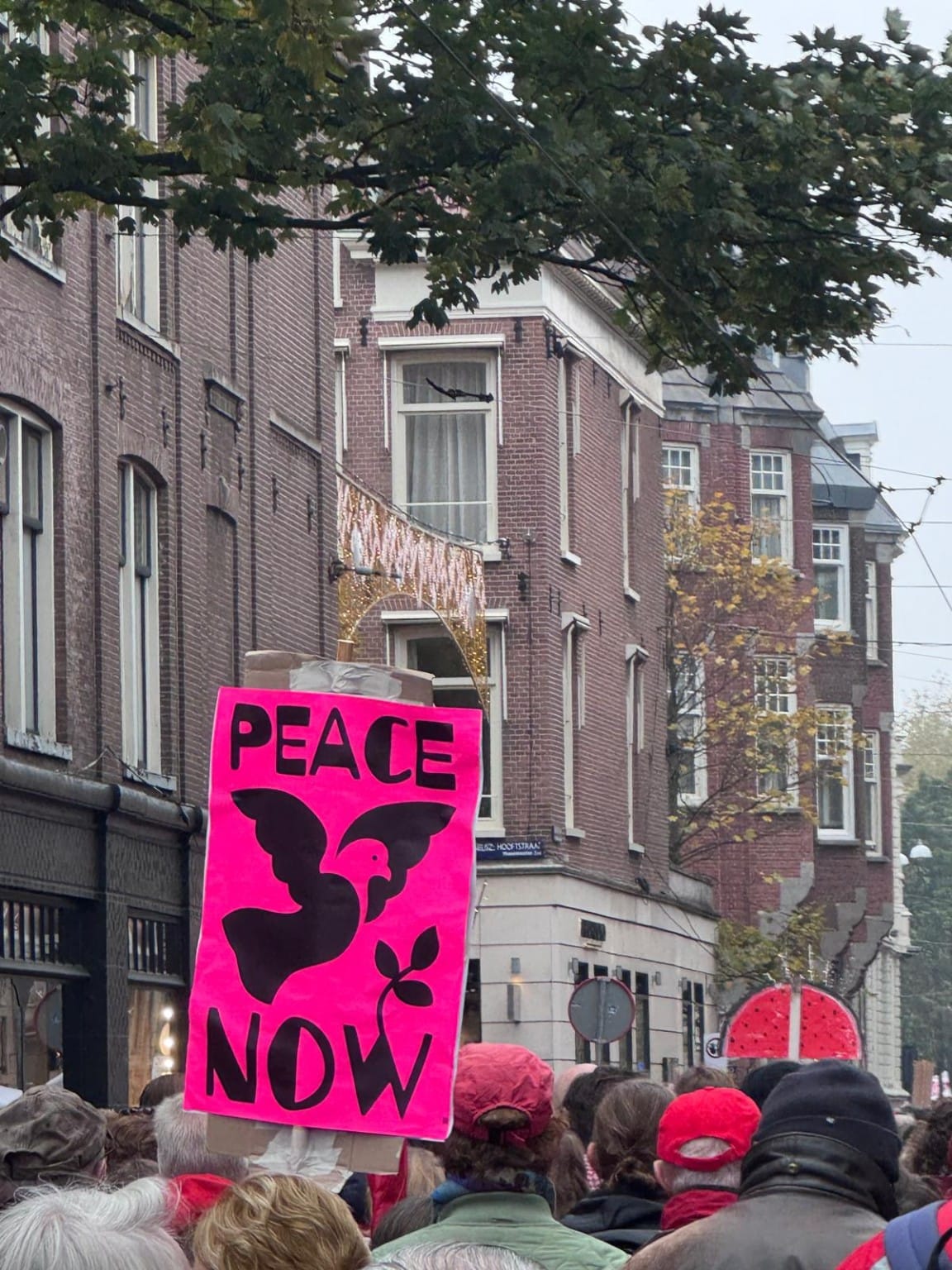
Photographs supplied to Beyond the Lines illustrate the contrasting messages visible during the demonstration.
One image shows a bright pink sign carrying the words “PEACE NOW” alongside a dove.
Another shows a handwritten message in Dutch calling for love, peace and happiness for all beings.
Elsewhere, participants carried Palestinian national flags and signs condemning Israeli military actions.
These images reflect the diversity of motivations among those attending.
They also contrast sharply with the photograph of individuals holding a banner declaring support for Hamas.
The difference matters.
Peaceful protesters should not be held collectively responsible for the conduct of a small group.
But neither should the presence of peaceful participants prevent scrutiny of extremist messages appearing at the same event.
One of the most important questions is how the broader crowd responds.
Where extremist expressions are challenged or rejected by fellow demonstrators, that response deserves attention.
Where they are celebrated, that too is relevant.
A responsible assessment requires reliable video evidence, eyewitness accounts and confirmation of the surrounding circumstances.
The right to demonstrate belongs to people advocating peace as much as to those expressing controversial political positions.
Protecting that right also means ensuring that intimidation and threats do not prevent others from exercising their own freedoms.
9. Political Slogans, Religious Language and the Risk of Misinterpretation
Another reported feature of the demonstration was the use of the Arabic chant:
“Bir-ruh, bid-dam, nafdika ya Aqsa.”
A close English translation is:
“With our souls and our blood, we will sacrifice ourselves for you, Al-Aqsa.”
The phrase is associated with political and religious expressions of solidarity concerning the Al-Aqsa Mosque in Jerusalem.
Its language is emotionally charged and invokes sacrifice.
However, it would be inaccurate to claim that the chant automatically constitutes an endorsement of Hamas or a call to commit terrorist violence.
Its meaning depends on context, including the speakers, surrounding messages and intended audience.
The distinction is important because inflammatory interpretations can intensify hostility without establishing what participants actually intended.
At the same time, authorities should assess whether particular chants, in combination with other conduct, cross legal boundaries involving threats or incitement.
The standard should be consistent: investigate the context, establish the facts and avoid treating assumptions as evidence.
10. The Netherlands, Jewish History and the Question of Public Safety
The Netherlands occupies a significant place in European Jewish history.
Before the Second World War, Amsterdam was home to a substantial Jewish community with a rich religious, cultural and intellectual life.
During the Nazi occupation, approximately 102,000 Jews from the Netherlands were murdered in the Holocaust.
The persecution of Dutch Jews remains one of the darkest chapters in the country's history.
Today, remembrance ceremonies, museums and educational programmes preserve the memory of those events.
Yet remembrance also raises questions about contemporary responsibilities.
How should a democracy respond when Jewish citizens experience threats, harassment or intimidation?
How can authorities ensure that Jewish schools, synagogues and community institutions remain safe without requiring extraordinary security measures to become a permanent feature of everyday life?
And how should political leaders respond when expressions of support for an organisation responsible for attacks on Jewish and Israeli civilians appear in public?
The historical comparison must be handled carefully.
Contemporary Dutch society is not Nazi-occupied Europe, and present-day demonstrations should not be equated with the Holocaust.
But the history of antisemitism provides a compelling reason to take present-day threats seriously.
Remembering the past is not only about commemorating victims.
It also means recognising the importance of protecting minorities, defending equal citizenship and responding to hatred before it becomes normalised.
11. Extremism Is Not Limited to One Community or Political Movement
The debate over antisemitism and Hamas support is often absorbed into broader arguments about immigration, religion and national identity.
Such discussions can quickly become polarised.
However, extremism cannot responsibly be attributed to an entire religious, ethnic or political community.
Muslims are not collectively responsible for Hamas.
Palestinians are not collectively responsible for terrorism.
Critics of Israel are not automatically antisemitic.
Likewise, Jewish citizens should not be treated as representatives of the Israeli government or held responsible for its decisions.
These distinctions are essential.
The Netherlands faces several forms of extremism and discrimination, including antisemitism, anti-Muslim hatred and threats associated with different ideological movements.
An effective response must focus on specific conduct, identifiable organisations and verifiable threats.
It must also protect people from collective blame.
Otherwise, attempts to address extremism risk producing further division rather than greater public safety.
12. What This Means — The Questions Dutch Authorities Must Answer
The latest controversy presents the Netherlands with an important test of institutional accountability.
It is not enough to condemn extremism in general terms.
Citizens need to understand how the authorities respond when specific incidents occur.
Several questions remain unanswered about 8 November.
Did police identify the individuals carrying the Hamas-supporting banners?
Were the smoke bombs investigated as potential public-order or criminal offences?
Did the Public Prosecution Service assess the banners?
Were any arrests made in connection with these incidents?
What communication took place between police and the demonstration organisers?
And what measures are being considered to address repeated public expressions of support for designated terrorist organisations?
Answers should be based on official records rather than speculation.
The proposed legislation on glorifying terrorism may eventually provide additional legal mechanisms.
But legislation is only one part of the response.
Police training, clear operational guidance, transparent prosecutorial decisions and meaningful engagement with Jewish communities are also necessary.
The authorities must demonstrate that freedom of expression and protection against intimidation can coexist.
Conclusion — Freedom Requires Both Protection and Responsibility
The images emerging from Amsterdam on 8 November 2026 illustrate a difficult reality.
A large demonstration can bring together people demanding peace, humanitarian protection and political accountability while also attracting individuals who openly express support for Hamas.
These are not equivalent messages.
Nor should they be treated as such.
The Netherlands has a legitimate responsibility to protect peaceful demonstrations, including protests against Israel.
It also has a responsibility to investigate threats, incitement and potentially unlawful support for terrorist organisations.
Official figures demonstrate that antisemitism remains a serious concern. Previous incidents show that explicit Hamas-supporting banners have appeared in Amsterdam before.
The government's proposed legislation acknowledges that existing law may not adequately address every form of public terrorist glorification.
What remains to be established is whether the institutions responsible for public order and criminal enforcement are responding effectively to the incidents occurring now.
The most important question is not whether freedom of expression should be restricted whenever a message causes offence.
It is whether the Netherlands can maintain clear, lawful and consistently enforced boundaries between democratic dissent and the promotion of terrorist violence.
A society committed to human rights must protect Palestinian civilians, Jewish citizens and the democratic freedoms of all its residents.
Those obligations do not compete with one another.
They are part of the same responsibility.
Independent Journalism. Beyond the Headlines.
Sources & References
- De Telegraaf, live coverage of the Red Line demonstration, 8 November 2026. Reports concerning Hamas-supporting banners, masked protesters and smoke bombs.
https://www.telegraaf.nl/binnenland/live-hamas-vlaggen-bij-rode-lijn-demonstratie-gemaskerde-demonstranten-steken-rookbommen-af/164247408.html - Associated Press, 8 November 2026. Reporting on the Amsterdam demonstration, attendance estimates and the organisers' demands.
https://apnews.com/article/1107e783bba2da73e7053a5d07367a93 - Amnesty International Netherlands, 29 October 2026. Official demonstration programme, route and list of thirteen organising organisations.
https://www.amnesty.nl/actueel/rode-lijn-demonstratie-8-november - NOS, 7 October 2026. Reporting on the dispersal of an Amsterdam demonstration featuring explicit Hamas-supporting banners.
https://nos.nl/artikel/2634063-pro-palestijns-protest-met-hamas-steunbetuigingen-in-amsterdam-ontbonden - National Coordinator for Combating Antisemitism, 15 April 2026. Official antisemitism statistics for 2025.
https://www.ncab.nl/actueel/nieuws/2026/04/15/antisemitismecijfers-2025-opnieuw-zorgwekkend-hoog - Government of the Netherlands, 19 June 2026. Proposed legislation concerning the glorification of terrorism and public support for terrorist organisations.
https://www.rijksoverheid.nl/actueel/nieuws/2026/06/19/het-kabinet-stuurt-het-wetsvoorstel-dat-terrorismeverheerlijking-strafbaar-stelt-naar-de-tweede-kamer - Dutch Parliament, Legislative dossier 36.971. Parliamentary status of the proposed terrorism-glorification legislation.
https://www.eerstekamer.nl/wetsvoorstel/36971_strafbaarstelling - Reformatorisch Dagblad, 7 November 2026. Background reporting on concerns about Hamas-related networks and the Red Line demonstration.
https://www.rd.nl/artikel/palestijnse-terreurgroep-hamas-wint-terrein-in-nederland - Beyond the Lines — Reader-Supplied Visual Material, 8 November 2026. Photographs and video excerpts showing demonstration signs, Palestinian flags, peace messages and a banner declaring support for Hamas. Original authorship, precise locations and publication permissions remain to be confirmed.
Editorial Note
This article combines official government records, published news reporting and photographs and video material supplied to Beyond the Lines.
The visible wording of the “We Support Hamas” banner can be established from the supplied photograph. However, the identities of the individuals, the precise location and time of the photograph, the original photographer and any police response have not been independently confirmed.
Accounts of smoke bombs, crowd reactions and specific chants are attributed to reporting or supplied accounts where independent confirmation remains incomplete.
The presence of extremist expressions at a demonstration does not establish endorsement by its organisers or other participants.
The article will be updated if further verified information becomes available from Amsterdam police, the Public Prosecution Service or the demonstration organisers.