Before 1948: The History of the Land That Became Israel
Discover the history of the land before 1948, from ancient civilizations and Ottoman Palestine to the rise of Zionism, British rule, the UN partition plan and the events that led to Israel's establishment and the Palestinian Nakba.

From ancient history and Ottoman Palestine to Zionism, British rule, partition and the war that reshaped the Middle East.
By Leonie Raffaelli | Beyond the Lines
Introduction: A History That Did Not Begin in 1948
On May 14, 1948, David Ben-Gurion proclaimed the establishment of the State of Israel in Tel Aviv.
For many Jews, the declaration represented the realization of a modern national movement rooted in an ancient historical and religious connection to the land. It also came in the aftermath of the Holocaust, during which Nazi Germany and its collaborators murdered approximately six million European Jews.
For Palestinians, the events surrounding Israel's establishment became associated with war, displacement and the loss of homes and communities. This experience is remembered as the Nakba, the Arabic word for "catastrophe."
Yet the history of the land did not begin in 1948.
For thousands of years, the territory between the Mediterranean Sea and the Jordan River has been shaped by civilizations, empires, religious traditions, migration and political change.
The emergence of modern Israel and the unresolved question of Palestinian statehood cannot be understood without examining the developments that preceded them.
From ancient Jewish kingdoms and centuries of Ottoman administration to European nationalism, British imperial policy and international diplomacy, the history is complex.
Understanding it requires more than choosing between competing national narratives. It requires examining historical evidence, political decisions and the experiences of the people whose lives were affected.
1. A Land with Thousands of Years of History
The territory has been known by different names throughout history, including Canaan, Israel, Judah, Judea and Palestine.
These names developed in different historical contexts and did not always describe the same geographical boundaries or political entities.
Ancient Israelite and Judahite kingdoms emerged in parts of the region during the first millennium BCE.
Jerusalem became central to Jewish religious and historical identity, particularly through its association with the First and Second Temples.
The region subsequently experienced periods of Assyrian, Babylonian, Persian, Hellenistic and Roman rule.
Following the Roman destruction of the Second Temple in 70 CE and the suppression of the Bar Kokhba revolt in the second century, Jewish communities experienced major political and demographic changes.
Jewish life nevertheless continued in the region, particularly in Galilee and other locations, while Jewish communities also developed throughout the diaspora.
Christianity emerged in this historical environment. Jerusalem, Bethlehem and other locations became central to Christian religious traditions.
Following the Muslim conquests of the seventh century, Jerusalem and the surrounding region also acquired profound significance within Islamic civilization.
Successive rulers, migrations, religious conversions and cultural exchanges transformed the population over many centuries.
By the nineteenth century, the region was predominantly inhabited by Arabic-speaking Muslims, alongside Christian and Jewish communities.
Jerusalem, Hebron, Safed and Tiberias maintained significant Jewish religious traditions and communities.
At the same time, Arab communities had developed longstanding social, economic and cultural connections to the land.
These histories are essential to understanding the region's modern political development.
Jewish historical connections to the land long predate modern Zionism. Palestinian Arab society likewise developed through centuries of community life and historical change.
Neither history can be adequately explained by treating the region as belonging exclusively to one national narrative.
2. Ottoman Palestine: Society Before the Modern Conflict
From 1516–1517 until the First World War, most of the territory that later became Israel and the Palestinian territories belonged to the Ottoman Empire.
It was administered through different districts and provincial arrangements rather than continuously existing as one separate administrative unit called Palestine.
During much of this period, the population lived in agricultural villages, trading towns and religious centers.
Agriculture played a central role in everyday life.
Farmers cultivated grains, olives, citrus fruits and other crops, while merchants and craftspeople supported commercial activity in urban communities.
Jerusalem was a major religious center. Jaffa developed as an important Mediterranean port, while Nablus, Acre, Gaza, Hebron and Safed served important regional functions.
Ottoman reforms during the nineteenth century introduced changes to administration, taxation and property ownership.
The Ottoman Land Code of 1858 became particularly significant for land registration and ownership.
However, legal ownership, customary use and the rights of tenant farmers did not always coincide.
These distinctions would later become important as land transactions and immigration increased.
European diplomatic, commercial and religious involvement also expanded during the nineteenth century.
At the same time, political developments in Europe and the Ottoman Empire were beginning to influence the territory's future.
Growing European antisemitism, Jewish nationalist movements and changing patterns of immigration contributed to the emergence of modern Zionism.
Arabic-speaking communities were also experiencing cultural and political transformations that would contribute to the development of Palestinian Arab nationalism.
The territory was entering a new political era.
3. The Rise of Zionism: A Movement for Jewish Self-Determination
Modern political Zionism emerged in late nineteenth-century Europe.
It developed within the context of European nationalism, antisemitism and debates about Jewish identity and political self-determination.
Although Jewish religious and historical connections to the Land of Israel extended back thousands of years, political Zionism represented a modern movement seeking a national home for the Jewish people.
The movement was not politically uniform.
Religious, cultural, socialist and political Zionists held different views about how Jewish national aspirations should be realized.
Nor did all Jewish communities support Zionism.
Some religious leaders opposed political Zionism for theological reasons, while other Jewish thinkers favored integration into existing societies, socialism or alternative forms of cultural autonomy.
Antisemitism and the Search for Security
During the nineteenth century, Jewish communities across Europe experienced both emancipation and continuing discrimination.
In some countries, Jews gained greater civil rights and access to education, employment and public life.
Yet antisemitism remained widespread.
In the Russian Empire, waves of anti-Jewish violence following the assassination of Tsar Alexander II in 1881 contributed to growing insecurity.
Restrictions on residence, education and employment affected many Jewish families.
Large numbers emigrated, particularly to the United States and Western Europe.
Others increasingly supported the idea of rebuilding Jewish national life in the historical homeland.
Theodor Herzl and Political Zionism
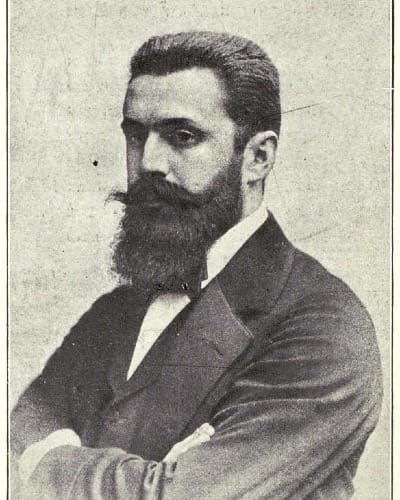
Theodor Herzl, an Austro-Hungarian Jewish journalist and writer, became one of the most influential figures in modern political Zionism.
In 1896, he published Der Judenstaat (The Jewish State), arguing that persistent antisemitism required a political solution to Jewish insecurity.
In 1897, Herzl convened the First Zionist Congress in Basel, Switzerland.
The congress adopted the Basel Program, seeking a publicly and legally secured home for the Jewish people in Palestine.
Herzl believed international diplomacy and political recognition were essential.
However, Jewish settlement initiatives and proto-Zionist movements had already emerged before his political leadership.
Modern Zionism therefore developed both as a response to contemporary European conditions and as a movement drawing upon longstanding Jewish historical traditions.
The Emergence of Competing National Aspirations
The rise of Zionism also raised questions about the political future of the Arab population living in the territory.
By the late nineteenth century, Palestine was predominantly inhabited by Arabic-speaking Muslims and Christians, alongside established Jewish communities.
Increasing Jewish immigration and the development of Zionist institutions generated concerns among some Arab residents about land ownership, political representation and the future of their communities.
Arab intellectual and political movements were also developing during the late Ottoman period.
Distinct Palestinian Arab national consciousness became increasingly prominent in the early twentieth century, particularly under British rule.
These national movements would eventually seek different political futures in the same territory.
4. Jewish Immigration and the First Aliyah
Jewish immigration to the region did not begin with Herzl or the First Zionist Congress.
Jewish communities had maintained a presence in the territory for centuries, and religious migration had taken place before modern political Zionism.
What changed during the late nineteenth century was the scale, organization and political significance of certain immigration movements.
The First Aliyah: 1882–1903
The Hebrew term Aliyah, meaning "ascent," is commonly used to describe Jewish immigration to the Land of Israel.
The First Aliyah is generally dated from 1882 to 1903.
According to the National Library of Israel, approximately 30,000 Jewish immigrants arrived during the First Aliyah, from 1882 to 1903.
Many were motivated by antisemitic persecution, economic difficulties and the desire to establish new communities.
Agricultural settlements established or developed during this period included Rishon LeZion, Rosh Pina and Zikhron Ya'akov.
These communities faced significant challenges, including disease, financial insecurity, agricultural difficulties and complicated relations with Ottoman authorities.
Financial support from Jewish philanthropists, particularly Baron Edmond de Rothschild, helped sustain several settlements.
Land Ownership and Local Communities
Some land was purchased legally from Ottoman-era landowners, including absentee owners living outside the immediate area.
However, legal property transactions did not always protect the interests of people already cultivating the land.
In some cases, Arab tenant farmers experienced displacement or the loss of access to agricultural land.
The consequences differed across communities and locations.
For Jewish immigrants, settlement could represent safety, opportunity and national renewal.
For some Palestinian Arab residents, immigration and changing patterns of land ownership created concerns about economic security and political control.
These experiences increasingly influenced relations between the communities.
The Second Aliyah: 1904–1914
A second major immigration wave began in 1904 and continued until the outbreak of the First World War.
According to the National Library of Israel, approximately 35,000 Jewish immigrants arrived during the Second Aliyah, from 1904 to 1914.
Many came from the Russian Empire and were influenced by antisemitism, socialism and Jewish nationalism.
Some promoted collective agricultural labor, Hebrew cultural revival and the development of new institutions.
Degania, widely regarded as the first kibbutz, was established in 1910.
Tel Aviv began developing in 1909 as a Jewish neighborhood outside Jaffa.
These developments contributed to the institutional foundations of the Jewish community that would later establish the State of Israel.
By the beginning of the First World War, the region was undergoing significant demographic, economic and political change.
5. The Balfour Declaration of 1917: A Promise That Changed the Region
On November 2, 1917, British Foreign Secretary Arthur James Balfour sent a letter to Lord Walter Rothschild, a prominent figure in Britain's Jewish community.
The letter expressed British government support for the establishment of a national home for the Jewish people in Palestine.
The declaration became one of the most consequential diplomatic statements in the modern history of the region.
British Interests During the First World War
When the First World War began in 1914, Palestine was part of the Ottoman Empire, which entered the conflict on the side of Germany and Austria-Hungary.
Britain sought to weaken Ottoman control over the Middle East while protecting its strategic interests.
The region's proximity to the Suez Canal made it particularly important to British imperial communications and trade.
During the war, Britain entered into several diplomatic commitments concerning Ottoman territories.
These included correspondence with Sharif Hussein of Mecca, the secret Sykes–Picot Agreement with France and the Balfour Declaration.
The relationship between these commitments remains an important subject of historical debate.
They reflected different wartime priorities and contributed to competing expectations about the region's political future.
What Did the Declaration Promise?
The Balfour Declaration expressed British support for the establishment of a national home for the Jewish people in Palestine. However, the declaration did not explicitly promise the creation of an independent Jewish state, nor did it define what political form such a national home would ultimately take.
It also stated that the civil and religious rights of existing non-Jewish communities should not be prejudiced.
However, the declaration did not explicitly recognize the political or national rights of Palestine's Arab majority.
This distinction became one of the central controversies surrounding the document.
For Zionist leaders, British support represented an important diplomatic achievement.
For Palestinian Arab leaders, the declaration raised fundamental questions about Britain's authority to make commitments concerning the future of a territory whose inhabitants had not been consulted.
The Declaration's Political Legacy
Following the First World War, the Balfour Declaration was incorporated into the framework of the British Mandate for Palestine.
The mandate was approved by the League of Nations in 1922 and entered into force in 1923.
It recognized the historical connection of the Jewish people to Palestine and assigned Britain responsibility for facilitating a Jewish national home while safeguarding specified rights of the population.
Yet the political framework did not resolve the competing demands for national self-determination.
Instead, it established the environment in which those demands would increasingly come into conflict.

6. The British Mandate: Immigration, Resistance and Rising Tensions
British forces captured Jerusalem in December 1917.
Following the First World War, Britain administered Palestine under military occupation before establishing civilian administration in 1920.
The League of Nations approved the mandate in July 1922, and it entered into force in September 1923.
Under this arrangement, Britain was responsible for governing the territory and implementing the provisions associated with the Balfour Declaration.
Two National Movements, One Territory
The Zionist movement pursued the development of a Jewish national home through immigration, institution-building and international diplomacy.
Palestinian Arab political leaders sought representative government, independence and protection against developments they believed threatened the Arab majority's political position.
These objectives were difficult to reconcile.
For many Zionists, Jewish national self-determination was essential to security and collective identity.
For many Palestinian Arabs, British support for Zionism appeared to threaten their own right to determine the political future of their homeland.
British policy shifted repeatedly as officials attempted to manage the competing demands.
Jewish Institutions and the Yishuv
During the mandate period, the Jewish community in Palestine, commonly known as the Yishuv, developed increasingly sophisticated political, economic and social institutions.
The Jewish Agency became a central organization representing Zionist interests and assisting immigration and settlement.
Jewish labor organizations, educational institutions, agricultural communities and political bodies expanded.
Hebrew became an increasingly important language of public life.
Tel Aviv developed into a major economic and cultural center.
The Haganah, established in 1920, grew into an important Jewish paramilitary organization and later formed a major foundation of the Israel Defense Forces.
These developments strengthened the Jewish community's capacity for political organization and eventual statehood.
Palestinian Arab Society and Political Organization
Palestinian Arab society also underwent significant political and social changes.
Jerusalem, Jaffa, Haifa and Nablus remained important centers of commerce, education and cultural activity.
Newspapers, associations and political movements contributed to the development of Palestinian national consciousness.
Palestinian Arab leaders organized petitions, protests and political campaigns opposing British policies and Zionist immigration.
Political divisions among influential families and competing leadership groups complicated efforts to establish a unified strategy.
The British administration's institutional arrangements also created differences between Jewish and Arab political representation.
These factors would influence the political balance in the years leading to 1948.
Immigration and the Rise of Nazi Germany
Jewish immigration increased substantially during parts of the mandate period.
Immigrants arrived from Eastern and Central Europe and other regions, motivated by persecution, economic conditions and Zionist convictions.
The rise of Nazi Germany in 1933 intensified the urgency of Jewish emigration.
As persecution escalated across Europe, Palestine became an increasingly important destination for Jews seeking refuge.
However, immigration restrictions and international barriers prevented many European Jews from escaping.
The Holocaust profoundly strengthened Jewish demands for security and statehood.
At the same time, Palestinian Arabs feared that continued large-scale immigration would transform the demographic and political future of the territory.
These competing concerns contributed to increasing instability.
Communal Violence and the Arab Revolt
The mandate period was marked by serious episodes of communal violence in 1920, 1921 and 1929.
In 1929, tensions surrounding religious rights and access near Jerusalem's Western Wall and Haram al-Sharif contributed to widespread violence.
In Hebron, Arab rioters killed 67 Jews, while some Arab residents sheltered Jewish neighbors.
The violence deepened fear and mistrust.
In 1936, a major Palestinian Arab uprising began against British rule and Zionist immigration.
The revolt included strikes, demonstrations, armed resistance and attacks.
Its participants demanded restrictions on Jewish immigration and land transfers, as well as national independence.
British authorities responded with extensive military and security operations.
The revolt continued until 1939, causing thousands of deaths and significantly weakening Palestinian Arab political and military organizations.
Partition Proposals and the 1939 White Paper
In 1937, the British Peel Commission proposed partitioning Palestine into separate Jewish and Arab states.
Zionist leaders accepted partition as a possible basis for negotiation but objected to aspects of the proposal.
Palestinian Arab leaders rejected the plan.
It was never implemented.
In 1939, Britain issued a White Paper proposing restrictions on Jewish immigration and envisioning an independent Palestine within ten years.
Zionist leaders strongly opposed the immigration restrictions, particularly as European Jews faced increasing persecution.
Palestinian Arab responses were mixed, with continued distrust of British commitments.
The outbreak of the Second World War transformed the political situation.
The End of British Rule
Following the war, Britain faced growing pressure over Palestine's future.
Jewish survivors of the Holocaust sought refuge, while Zionist organizations intensified demands for statehood.
Jewish underground groups carried out attacks against British targets.
Palestinian Arab leaders continued to oppose the establishment of a Jewish state in a territory with a substantial Arab population.
Britain struggled to maintain control amid escalating violence and diplomatic pressure.
In February 1947, the British government referred the question of Palestine to the United Nations.
The international community would now confront the unresolved question of sovereignty.
7. The United Nations Partition Plan of 1947
In May 1947, the United Nations established the United Nations Special Committee on Palestine, known as UNSCOP.
The committee was tasked with examining conditions in Palestine and recommending possible solutions.
The Jewish Agency cooperated with the inquiry and presented arguments supporting Jewish statehood.
The Arab Higher Committee boycotted the process, arguing that Palestinian Arab independence should not be made conditional on a process that could authorize partition.
UNSCOP did not reach a unanimous recommendation.
A majority supported partition into separate Jewish and Arab states, linked through an economic union, with Jerusalem under international administration.
A minority supported a federal state.
UN Resolution 181
On November 29, 1947, the United Nations General Assembly adopted Resolution 181 (II).
The resolution recommended the termination of the British Mandate and the partition of Palestine into independent Jewish and Arab states.
Jerusalem and its surrounding area were to be placed under a special international regime.
The proposed Jewish state would receive approximately 55–56 percent of Mandatory Palestine west of the Jordan River, while the proposed Arab state would receive approximately 43–44 percent.
Jerusalem would be administered separately.
The boundaries were controversial.
Jews represented roughly one-third of the population, yet the proposed Jewish state would receive the larger territorial share, including much of the sparsely populated Negev.
Substantial Arab populations would also live within the proposed Jewish state.
The resolution passed with 33 votes in favor, 13 against and 10 abstentions.
The partition plan also proposed an economic union between the two states and a separate international administration for Jerusalem. However, the proposed political arrangements were never implemented as originally envisioned. Instead, the territory entered a period of escalating armed conflict that would fundamentally alter its political boundaries and the lives of its inhabitants.
Different Responses to Partition
The Jewish Agency leadership accepted partition in principle, despite reservations about the proposed boundaries and Jerusalem's status.
For Zionist leaders, the resolution represented an internationally endorsed pathway toward Jewish statehood.
Palestinian Arab leaders and Arab governments rejected the proposal.
They argued that partition violated the right of the Arab majority to national self-determination and opposed the allocation of a large part of the territory to a proposed Jewish state.
The opposing responses had immediate consequences.
From Diplomacy to Civil War
Violence intensified following the UN vote.
Jewish and Palestinian Arab armed organizations fought over transportation routes, towns and strategically important territory.
Attacks on civilians and communities increased.
The conflict unfolded while Britain prepared to withdraw and its authority weakened.
In April 1948, members of the Irgun and Lehi attacked the Palestinian village of Deir Yassin, killing more than 100 residents according to widely cited estimates. The exact death toll remains debated.
The killings and reports about them contributed to fear among Palestinian Arab communities.
Other attacks, including the April 1948 assault on a Jewish medical convoy traveling toward Hadassah Hospital on Mount Scopus, intensified the violence.
By May 1948, Palestine was already experiencing a devastating civil war.
The proposed partition boundaries had not been implemented, and the future of the territory remained unresolved.
8. The Road to 1948: Independence, War and the Nakba
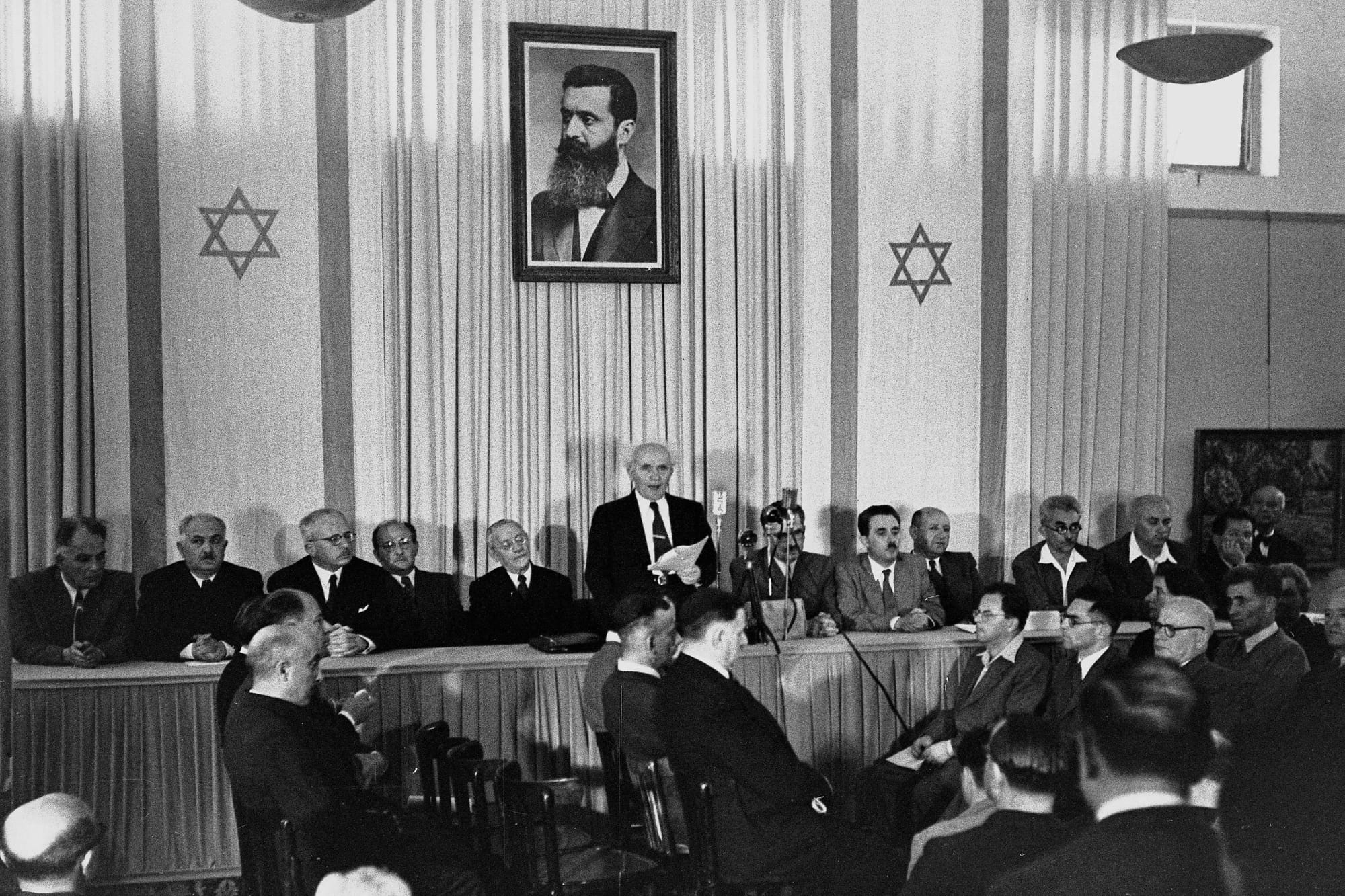
On May 14, 1948, David Ben-Gurion proclaimed the establishment of the State of Israel.
The declaration came shortly before the scheduled end of the British Mandate.
For the Zionist movement and much of the Jewish population, it represented the achievement of national sovereignty in the historical Jewish homeland.
The declaration also came only three years after the end of the Holocaust.
For many Jews, independence carried profound significance as an expression of collective security and national self-determination.
However, Israel's establishment occurred amid an ongoing war that had already displaced large numbers of Palestinian Arabs.
For Palestinians, 1948 became associated with the destruction of communities, displacement and the beginning of a prolonged refugee crisis.
Israel Declares Independence
Israel's Declaration of Independence invoked the historical connection of the Jewish people to the land, the Zionist movement, the Holocaust and the United Nations partition resolution.
It promised equality of social and political rights to inhabitants irrespective of religion, race or sex.
The United States recognized Israel's provisional government de facto shortly after the declaration.
The Soviet Union granted de jure recognition several days later.
However, the declaration did not settle the questions of borders, Jerusalem or the future of Palestinian Arab communities affected by the conflict.
The 1948 Arab-Israeli War
Following the end of the British Mandate, armies from neighboring Arab states entered the conflict.
Egypt, Transjordan, Syria, Iraq and Lebanon participated to varying degrees, alongside other Arab forces.
Their political and military objectives were not identical.
Israel's armed forces, organized into the Israel Defense Forces during the war, fought against these forces and Palestinian Arab armed groups.
The conflict developed through several military phases, interrupted by internationally mediated truces.
Fighting took place in Jerusalem, Galilee, the coastal plain, the Negev and other areas.
By the time armistice agreements were concluded in 1949, Israel controlled approximately 78 percent of Mandatory Palestine west of the Jordan River.
This was more territory than had been allocated to the proposed Jewish state under the 1947 partition plan.
The West Bank, including East Jerusalem, came under Jordanian control, while the Gaza Strip came under Egyptian administration.
The Palestinian Arab state proposed by the United Nations was not established.
The Nakba: Palestinian Displacement and Loss
The displacement of Palestinian Arabs began during the civil war following the UN partition vote in November 1947, before Israel declared independence in May 1948.
It continued during the subsequent war.
An estimated 700,000 to 750,000 Palestinians fled or were expelled from their homes during the 1947–1949 conflict. The circumstances of displacement differed between communities and across different stages of the war.
The causes of displacement differed across locations and stages of the conflict.
Some families fled approaching battles, insecurity or fear of attacks.
Others were forcibly expelled during military operations.
The breakdown of local institutions, economic disruption and the destruction or depopulation of villages contributed to the wider refugee crisis.
Hundreds of Palestinian villages were depopulated, and many were subsequently destroyed or transformed.
Refugees sought safety in the West Bank, Gaza Strip, Jordan, Lebanon, Syria and elsewhere.
Many expected their displacement to be temporary.
However, large numbers were prevented from returning to their former homes after the war.
Questions concerning return, compensation, property and national rights became central unresolved issues.
For Palestinians, these events are remembered as the Nakba.
Jewish Displacement and Regional Change
The war also affected Jewish communities.
Jewish residents of areas captured by Arab forces experienced displacement, including inhabitants of Jerusalem's Old City.
In the years following Israel's establishment, large numbers of Jews left or were forced to leave countries in the Middle East and North Africa.
Their departures occurred under different circumstances, including persecution, discriminatory policies, political pressure, insecurity, Zionist migration and broader regional upheaval.
Many settled in Israel.
These developments significantly reshaped Jewish communities across the Middle East.
Although connected to the wider regional conflict, the circumstances of Jewish departures from Arab and Muslim-majority countries should be examined within their own historical contexts.
The Armistice Agreements of 1949
In 1949, Israel concluded separate armistice agreements with Egypt, Lebanon, Jordan and Syria.
The agreements established military armistice demarcation lines, commonly associated with the term "Green Line."
They did not constitute comprehensive peace treaties or final internationally agreed political borders.
Jerusalem remained divided between Israeli-controlled western sectors and Jordanian-controlled eastern sectors, including the Old City.
The Gaza Strip remained under Egyptian administration, while Jordan controlled the West Bank.
The armistice agreements ended the principal military phase of the war but did not settle the competing national claims.
Two National Memories of 1948
The year 1948 occupies a central place in both Israeli and Palestinian historical memory.
For Israelis, it marks the establishment of the State of Israel, the achievement of Jewish national sovereignty and the survival of the new state during war.
For Palestinians, it marks the Nakba: the loss of homes, the displacement of much of the Arab population and the failure to establish an independent Palestinian state.
These experiences are not interchangeable, but both are essential to understanding the region's modern history.
The conflict cannot be adequately explained by beginning with the events of a single year.
It emerged through decades of political developments, immigration, competing national movements, imperial decisions, international diplomacy and violence.
Conclusion: Understanding the Past to Understand the Present
The establishment of Israel in 1948 was the result of a long historical process rather than an isolated political decision.
Ancient Jewish connections to the land, the development of Palestinian Arab society, Ottoman administration, European antisemitism, the emergence of Zionism, British imperial policy and international diplomacy all contributed to the circumstances surrounding statehood and war.
For Jewish communities, the creation of Israel represented the realization of a modern national movement rooted in a much older historical identity.
For Palestinians, the same period brought the loss of political control over much of their homeland and the displacement of hundreds of thousands of people.
The consequences continue to influence debates about borders, security, refugees, sovereignty and national identity.
Historical understanding cannot, by itself, resolve these disputes.
But without an accurate understanding of the past, meaningful discussion of the present becomes considerably more difficult.
At Beyond the Lines, our purpose is to examine the history behind the headlines, question simplified narratives and provide readers with the context needed to understand complex international events.
Because understanding the present begins with examining the past.
Sources and Further Reading
- League of Nations. Mandate for Palestine, July 24, 1922. United Nations archival reproduction. https://avalon.law.yale.edu/20th_century/palmanda.asp
- United Nations General Assembly. Resolution 181 (II): Future Government of Palestine, November 29, 1947. https://digitallibrary.un.org/record/671195
- U.S. Department of State, Office of the Historian. Creation of Israel, 1948. https://history.state.gov/milestones/1945-1952/creation-israel
- U.S. Department of State, Office of the Historian. The Arab-Israeli War of 1948. https://history.state.gov/milestones/1945-1952/arab-israeli-war
- United Nations. The Origins and Evolution of the Palestine Problem. https://www.un.org/unispal/history/
- UNRWA. Historical documentation on Palestine refugees. https://www.unrwa.org/palestine-refugees
- National Library of Israel — History of Zionism https://www.nli.org.il/en/discover/israel/zionism/zionism-history
- UNRWA — The United Nations and Palestinian Refugees https://www.unrwa.org/resources/un-unrwa/united-nations-and-palestinian-refugees