Anne Frank and the Persecution of Jews in the Netherlands: A Story of Courage, Loss and Remembrance
Discover Anne Frank's life, the persecution of Dutch Jews during the Holocaust, and the lasting importance of her diary, courage and remembrance.

Introduction — A Young Voice That Survived the Holocaust
In the heart of Amsterdam, behind an ordinary-looking building along the Prinsengracht canal, a young Jewish girl spent more than two years hiding from Nazi persecution. Separated from the outside world, surrounded by uncertainty and living under the constant threat of discovery, she continued to write.
Her name was Anne Frank.
Anne was thirteen years old when she went into hiding with her family in July 1942. What began as a private diary, given to her for her birthday just weeks earlier, would eventually become one of the most widely read personal accounts of the Holocaust.
Yet Anne Frank's story is much more than the history of a famous diary. It is the story of a young girl growing up during one of Europe's darkest periods, a family struggling to survive, and a Jewish community systematically targeted for exclusion, deportation and murder.
Before the Second World War, the Netherlands was home to a diverse Jewish population with centuries of history. Jewish families contributed to Dutch society through business, education, science, culture and everyday community life. Amsterdam, in particular, had long been an important centre of Jewish life.
When Nazi Germany invaded the Netherlands on 10 May 1940, that world began to change.
The German occupation authorities gradually introduced discriminatory measures designed to isolate Jews from the rest of Dutch society. Jewish citizens were registered, excluded from professions, removed from schools and public spaces, and increasingly deprived of their rights.
By 1942, persecution had escalated into systematic deportation.
For Anne Frank and her family, the danger became immediate when her older sister, Margot, received a summons to report for what the authorities described as labour in Germany. The family went into hiding the following day.
Inside the Secret Annex, Anne recorded her observations, frustrations, fears and hopes. She wrote about relationships, personal identity, the difficulties of adolescence and her ambition to become a writer.
Her words reveal a young person who was not defined solely by persecution, even as persecution increasingly shaped every aspect of her life.
On 4 August 1944, the eight people hiding in the Secret Annex were discovered and arrested. Anne and her family were deported through Westerbork to Auschwitz-Birkenau. Anne and Margot were later transferred to Bergen-Belsen, where both died in early 1945, most likely from typhus and the catastrophic conditions in the camp.
Anne was fifteen years old.
Of the eight people who had hidden in the Secret Annex, only her father, Otto Frank, survived the Holocaust.
Anne's diary survived because Miep Gies, one of the people who had helped the family, preserved her writings after the arrest. Following the war, Otto Frank arranged for the diary's publication in the Netherlands in 1947.
Today, Anne Frank's words are read across the world. They have become an important introduction to the Holocaust for generations of readers.
But understanding her story requires looking beyond the Secret Annex.
It means examining how antisemitism became government policy, how persecution developed under German occupation, how Dutch institutions and individuals responded, and how more than 100,000 Jews from the Netherlands were murdered during the Holocaust.
It also means remembering that Anne Frank was one of countless young people whose futures were destroyed.
Her diary survived. Millions of other voices did not.
This article explores Anne Frank's life within the wider history of Jewish persecution in the Netherlands, from the communities that existed before the war to the machinery of deportation, the experiences of those who resisted or helped others, and the enduring responsibility to preserve historical memory.
Anne Frank's story remains deeply personal. Its historical significance reaches far beyond one family, one diary or one hiding place.
It is a reminder of what was lost, what survived and why the evidence of the Holocaust must continue to be studied, understood and remembered.
Chapter 1 — Jewish Life in the Netherlands Before the War
A Community with Centuries of History
Long before Anne Frank and her family arrived in Amsterdam, Jewish communities had been part of Dutch history for centuries. Their presence shaped the cultural, intellectual, religious and economic life of the Netherlands, particularly in Amsterdam, which became one of Europe's most significant centres of Jewish life.
The history of Jews in the Netherlands was not a single story. It was shaped by migration, religious traditions, economic opportunities, social integration and periods of discrimination. By the beginning of the twentieth century, Jewish communities had established deep roots in Dutch society, contributing to its development while maintaining a variety of cultural and religious identities.
Understanding this history is essential to understanding what was destroyed during the Holocaust.
The Nazi persecution of Dutch Jews did not begin with an isolated population unfamiliar to the country in which they lived. It targeted families whose histories, relationships, businesses and traditions were woven into Dutch society across generations.
The Arrival of Sephardic and Ashkenazi Jews
Two major historical communities contributed to the development of Jewish life in the Netherlands: Sephardic and Ashkenazi Jews.
Sephardic Jews, many of whom had roots in Spain and Portugal, arrived in the Dutch Republic during the late sixteenth and early seventeenth centuries. Some were descendants of families who had been forced to convert to Christianity or leave the Iberian Peninsula during periods of religious persecution.
Amsterdam offered opportunities for religious and commercial life that were relatively unusual in Europe at the time. Although Jewish residents did not enjoy complete equality, the city became an important place where Sephardic communities could establish synagogues, schools, charitable institutions and businesses.
The Portuguese Synagogue, completed in Amsterdam in 1675, remains one of the most recognisable historical landmarks of this community.
Ashkenazi Jews, whose ancestors came largely from Central and Eastern Europe, also settled in the Netherlands, particularly during the seventeenth century and afterward. Many arrived from German-speaking territories and other regions affected by war, poverty and persecution.
Over time, Ashkenazi Jews became the largest Jewish community in the Netherlands.
These communities developed distinct religious customs, languages and cultural traditions. Yet they also shared institutions, experiences and an evolving relationship with Dutch society.
Their history demonstrates that Jewish identity in the Netherlands was never uniform. It encompassed different backgrounds, levels of religious observance, occupations and ways of life.
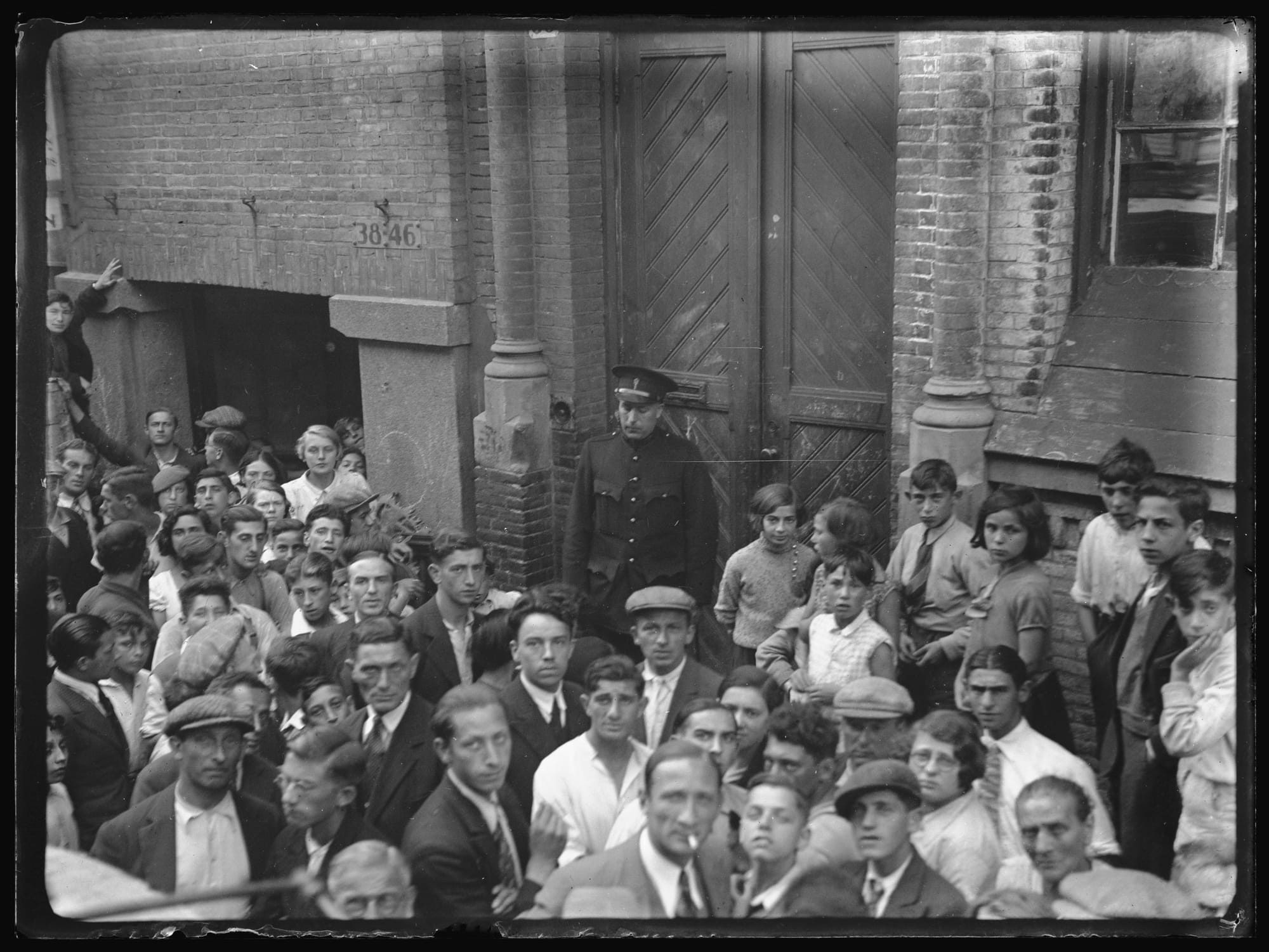
Amsterdam: A Centre of Jewish Culture and Community
Amsterdam became particularly important in the history of European Jewry.
Its Jewish neighbourhoods contained synagogues, markets, schools, workshops, cultural organisations and charitable institutions. Jewish merchants participated in international trade, while craftsmen, shopkeepers, teachers, religious leaders and labourers contributed to the city's daily life.
The area surrounding the Waterlooplein and the streets near the Portuguese Synagogue and the Ashkenazi synagogue complex became closely associated with Jewish Amsterdam.
For many residents, Jewish identity was expressed through religious practice, family traditions, language and community institutions. Others increasingly participated in secular political movements, professional organisations and Dutch cultural life.
Jewish Amsterdam also became a place of intellectual exchange.
The philosopher Baruch Spinoza, born in Amsterdam in 1632 to a family of Portuguese Jewish origin, remains one of the city's most internationally recognised historical figures. Although he was expelled from his Jewish congregation in 1656, his life illustrates the complex intellectual and religious environment of seventeenth-century Amsterdam.
By the nineteenth and early twentieth centuries, Jewish residents participated in an increasingly broad range of professions and public activities.
They were doctors, lawyers, journalists, musicians, teachers, business owners, factory workers and civil servants. Some families enjoyed financial security, while others experienced poverty and difficult working conditions.
The community was diverse, and its experiences varied considerably according to social class, location, religious background and personal circumstances.
Emancipation and Integration into Dutch Society
A major turning point came in 1796, when Jews in the Batavian Republic were granted equal civil rights.
This legal emancipation created new opportunities for Jewish participation in Dutch public life. However, formal equality did not immediately eliminate social prejudice or economic disadvantage.
Throughout the nineteenth century, Jewish families gradually gained greater access to education, employment and civic institutions.
Some became increasingly integrated into Dutch society, speaking Dutch as their primary language and participating in national political and cultural life. Others maintained strong religious traditions and community structures.
For many families, these identities were not contradictory.
A person could be deeply connected to Jewish traditions while also considering the Netherlands their homeland.
By the early twentieth century, Jewish citizens were active in Dutch political movements, trade unions, cultural organisations and professional associations.
In Amsterdam, Jewish workers played important roles in industries such as diamond cutting and garment production. Jewish involvement in labour organisations and socialist politics also became an important part of the city's social history.
At the same time, antisemitic stereotypes and discrimination had not disappeared.
The Netherlands was often regarded as comparatively tolerant, but that reputation should not obscure the barriers and prejudices Jewish residents continued to encounter.
The distinction matters because the history of Jewish life before the Holocaust cannot be understood simply as a story of uninterrupted acceptance.
It was a history of belonging, achievement, inequality, adaptation and resilience.
Jewish Life Beyond Amsterdam
Although Amsterdam was home to the largest Jewish population in the Netherlands, Jewish communities existed throughout the country.
Cities such as Rotterdam, The Hague, Utrecht, Groningen and Arnhem had established Jewish populations. Smaller towns and rural areas also contained Jewish families, congregations and community institutions.
In many places, Jewish residents were shopkeepers, traders, teachers, artisans or professionals whose businesses and relationships connected them closely to their neighbours.
Religious life often centred on local synagogues, Jewish schools and charitable organisations.
Families celebrated holidays, maintained traditions and participated in the ordinary rhythms of Dutch society.
These communities were not isolated from the wider population. Jewish and non-Jewish residents frequently worked together, attended public institutions and shared neighbourhoods.
Yet local Jewish life could also be fragile.
Smaller congregations depended on relatively limited populations to sustain their religious and cultural institutions. Migration toward larger cities, economic changes and shifting patterns of religious observance affected many communities even before the war.
The Holocaust would devastate this network of Jewish life across the Netherlands.
In numerous towns, entire families were deported and murdered. Synagogues lost their congregations, businesses disappeared, and communities that had existed for generations were left with few or no survivors.
The Netherlands Between the Two World Wars
The First World War ended in 1918, but its political and economic consequences continued to influence Europe throughout the following decades.
The Netherlands had remained neutral during the war. Nevertheless, Dutch society was affected by international instability, economic difficulties and the political developments taking place in neighbouring countries.
During the 1920s and 1930s, Jewish citizens continued to participate in Dutch public life.
Children attended schools, families built businesses, religious communities maintained their institutions, and cultural organisations contributed to the country's intellectual and artistic environment.
At the same time, the economic crisis of the 1930s created hardship across Dutch society.
Unemployment and financial insecurity affected many families, including Jewish households.
Political extremism was also becoming more visible in Europe.
In Germany, Adolf Hitler and the Nazi Party gained power in January 1933. The Nazi regime rapidly began dismantling democratic institutions and introducing policies that excluded Jews from German public life.
These developments would soon have direct consequences for the Netherlands.
Jewish Refugees from Nazi Germany
Following Hitler's rise to power, thousands of Jews sought to leave Germany.
Some looked toward neighbouring countries, including the Netherlands, where they hoped to find safety, employment and the possibility of rebuilding their lives.
The Dutch government admitted refugees under changing and increasingly restrictive conditions. Officials were concerned about unemployment, economic pressures and the number of people seeking entry.
Although many refugees found temporary or longer-term shelter, others encountered bureaucratic obstacles and limits on admission.
The situation became more urgent as Nazi persecution intensified.
The Nuremberg Laws of 1935 deprived German Jews of citizenship rights and prohibited marriages and sexual relations between Jews and people classified as having German or related blood.
In November 1938, the widespread anti-Jewish violence known as Kristallnacht demonstrated the escalating danger faced by Jewish communities in Germany and Austria.
Synagogues were burned, Jewish businesses were destroyed, and approximately 30,000 Jewish men were arrested and sent to concentration camps.
For Jewish refugees living in the Netherlands, these events reinforced the belief that leaving Germany had been necessary.
Yet the future remained uncertain.
The Netherlands was geographically close to Germany, and the growing threat of another European war raised questions about whether any neighbouring country could remain safe.
The Frank Family's New Beginning in Amsterdam
Among the German Jewish families who sought a new life in the Netherlands were Otto and Edith Frank and their daughters, Margot and Anne.
Anne Frank was born on 12 June 1929 in Frankfurt am Main, Germany.
Her family lived in a period when German Jews had long been integrated into the country's economic, cultural and social life. Otto Frank had served in the German army during the First World War, an experience that reflected the family's connection to German society.
After the Nazi Party came to power in 1933, the family's future in Germany became increasingly uncertain.
Otto Frank moved to Amsterdam to establish a business, and the family followed him. By February 1934, they were reunited in the Netherlands.
The Franks settled in Amsterdam's Rivierenbuurt neighbourhood, an area where several German Jewish refugee families had made their homes.
Anne attended school, learned Dutch and developed friendships.
For a young child, Amsterdam offered opportunities to experience an ordinary upbringing.
She played with other children, explored her surroundings and became increasingly familiar with Dutch life.
Her sister Margot was known as a diligent student, while Anne developed a reputation for being lively, curious and outspoken.
Their parents worked to create a stable family environment despite the uncertainty that had forced them to leave Germany.
Otto Frank developed his business activities, including Opekta, a company associated with products used in making jam.
The family established routines and relationships that made Amsterdam feel increasingly like home.
Yet the security they had sought would prove temporary.
A Childhood Before the Occupation
Photographs of Anne Frank before the war show a young girl growing up in a family environment that, in many ways, resembled the lives of other middle-class children in Amsterdam.
She attended birthday celebrations, spent time with friends and participated in school activities.
Her childhood was shaped by family relationships, education, friendships and the ordinary discoveries of growing up.
These details matter.
Anne Frank is often remembered through the circumstances of her hiding and death. But before she became a victim of Nazi persecution, she was a child with interests, ambitions and a developing personality.
Her story also illustrates the experiences of many Jewish refugee children who had already been forced to leave one country before the Second World War began.
For the Frank family, the Netherlands initially represented the possibility of safety and stability.
They had escaped the increasingly hostile environment of Nazi Germany and were building a new life in Amsterdam.
But the political situation in Europe continued to deteriorate.
Germany invaded Poland on 1 September 1939, beginning the Second World War in Europe.
The Netherlands again hoped to remain neutral.
For Jewish families living there, including the Franks, the coming months would determine whether the country that had offered refuge could remain beyond the reach of Nazi rule.
A Society on the Edge of Catastrophe
On the eve of the German invasion in May 1940, approximately 140,000 Jews lived in the Netherlands, including Dutch citizens and refugees from other countries.
They represented a small minority of the population, but their presence was deeply rooted in the country's history.
Their lives were not defined solely by religion or ancestry.
They were parents, children, neighbours, colleagues, students, artists, workers and business owners.
Some were observant Jews, while others were secular. Some belonged to families that had lived in the Netherlands for centuries, while others had arrived only recently after escaping persecution elsewhere.
Their political beliefs, occupations, economic circumstances and personal identities varied widely.
What connected them was not a single way of life, but the fact that Nazi racial ideology would classify them as members of a population to be isolated, dispossessed, deported and ultimately targeted for murder.
The destruction that followed was not inevitable.
It resulted from political decisions, discriminatory laws, administrative cooperation, organised violence and the systematic actions of the Nazi regime and its collaborators.
For the Jewish communities of the Netherlands, the German invasion of 10 May 1940 marked the beginning of a transformation that would alter the country permanently.
Within a few years, the majority of the Jewish population would be murdered.
Families would be separated, neighbourhoods emptied, and centuries of community life devastated.
Understanding the world that existed before this destruction is therefore an essential part of Holocaust remembrance.
It allows us to recognise Jewish people not only as victims of persecution, but as individuals who lived full and varied lives before those lives were violently interrupted.
For Anne Frank, the Netherlands had become the place where she grew up, went to school and imagined her future.
The country that had once offered her family refuge was about to fall under Nazi occupation.
And the childhood she had known was approaching its end.
Chapter 2 — Anne Frank: Childhood in Germany and a New Life in Amsterdam
A Childhood in Frankfurt
On 12 June 1929, Annelies Marie Frank was born in Frankfurt am Main, Germany. She was the second daughter of Otto Heinrich Frank and Edith Frank-Holländer. Her older sister, Margot, had been born three years earlier, in February 1926.
At the time of Anne's birth, Germany was still governed by the Weimar Republic. The country was struggling with political divisions and economic instability, but the catastrophic persecution that would later define the Frank family's history had not yet begun.
The Franks were a German Jewish family whose lives reflected both their Jewish heritage and their connection to German society.
Otto Frank had been born in Frankfurt in 1889. He came from a family involved in banking and business and had served in the German army during the First World War, reaching the rank of lieutenant.
Edith Frank-Holländer was born in Aachen in 1900. She grew up in a Jewish family and maintained a stronger connection to religious traditions than her husband.
Their daughters were raised in an environment that combined family customs, education and participation in everyday German life.
Anne's earliest years were spent in Frankfurt, first in the Marbachweg area and later in the city's Ganghoferstraße neighbourhood.
Family photographs from this period show Anne and Margot as young children, surrounded by relatives and participating in ordinary family activities.
These images are historically important because they reveal the lives that existed before persecution transformed the family's future.
Anne Frank did not begin her life as a refugee or as a child in hiding.
She began it as a young girl growing up in Germany, within a family that expected to build its future there.
The Political Transformation of Germany
The world into which Anne was born changed dramatically during her earliest childhood.
The economic crisis that followed the Wall Street crash of 1929 contributed to widespread unemployment, poverty and political instability in Germany.
Extremist movements exploited public frustration and uncertainty.
Among them was the National Socialist German Workers' Party, led by Adolf Hitler.
Nazi ideology combined extreme nationalism, authoritarianism, racism and antisemitism. Jews were falsely portrayed as enemies of Germany and blamed for the country's political and economic problems.
On 30 January 1933, Hitler was appointed German chancellor.
The Nazi leadership quickly began dismantling democratic institutions and consolidating power.
Political opponents were intimidated, arrested or imprisoned. Freedom of expression was restricted, and the regime increasingly used state institutions to enforce its ideology.
For Jewish families, the consequences became visible almost immediately.
On 1 April 1933, the Nazi regime organised a nationwide boycott of Jewish-owned businesses. Members of the Nazi SA stood outside shops and offices, attempting to prevent customers from entering.
Later that month, legislation began excluding Jews from parts of the civil service and other professions.
These early measures were part of a developing system of discrimination that would eventually strip German Jews of their rights, property and security.
Otto and Edith Frank recognised that their family's future in Germany was becoming increasingly uncertain.
They had two young daughters to protect.
The decision to leave Germany was not simply a matter of seeking better economic opportunities. It was increasingly connected to the danger posed by a government that openly promoted antisemitic policies.
Otto Frank's Decision to Leave Germany
In 1933, Otto Frank began preparing for a new life in the Netherlands.
Amsterdam offered the possibility of establishing a business and creating a more secure environment for his family.
The city was already home to a substantial Jewish community and had become a destination for some Jews fleeing Nazi Germany.
Otto had professional contacts that helped him explore business opportunities.
He became involved with Opekta, a company selling pectin products used in making homemade jam.
The move required the family to separate temporarily.
While Otto worked to establish himself in Amsterdam, Edith and the two girls stayed with Edith's mother, Rosa Holländer, in Aachen.
Margot joined her father in Amsterdam in December 1933. Edith followed, and Anne arrived in February 1934.
The family was reunited in a new country, with a different language and unfamiliar surroundings.
Anne was four years old.
She was too young to understand fully the political developments that had forced her parents to make such a significant decision.
Yet the consequences of those developments would shape the rest of her life.
The Netherlands became her new home, and Dutch would become the language in which she later wrote her diary.
Building a New Life in Amsterdam
The Frank family settled in Amsterdam's Rivierenbuurt, a residential neighbourhood in the southern part of the city.
Their apartment was located at Merwedeplein, a square surrounded by residential buildings and streets where children could play.
The neighbourhood included other families who had recently arrived from Germany, some of whom were also Jewish refugees.
For Anne, the move represented the beginning of a new childhood.
She attended a Montessori school, where she gradually became fluent in Dutch and developed friendships with other children.
The Montessori educational approach encouraged independence, curiosity and individual development.
Anne was remembered as an energetic and talkative child who enjoyed being surrounded by friends.
She liked games, social activities and the attention of others.
Her personality contrasted in some ways with that of her older sister.
Margot was generally described as quieter, more reserved and academically disciplined.
Anne was lively, expressive and often eager to share her opinions.
These differences would later appear in Anne's diary, where she reflected on her relationship with her sister and her own developing sense of identity.
The two girls nevertheless shared the experiences of growing up in a family adapting to a new country.
The Family Behind the Famous Diary
The Frank family is often viewed through the events of the Holocaust, but before the war, their lives contained the ordinary complexities of family relationships.
Otto Frank was closely involved in his daughters' upbringing. Anne later described a particularly strong emotional connection with her father.
He encouraged her interests and played an important role in her education and intellectual development.
Edith Frank managed much of the family's domestic life and maintained family traditions.
Anne's relationship with her mother became more complicated as she grew older, particularly during the years in hiding.
Her diary contains moments of frustration and criticism, but these passages should be understood within the emotional circumstances of adolescence and confinement.
They do not provide a complete account of Edith Frank as a person or mother.
Margot, meanwhile, was an accomplished student who generally followed expectations more readily than Anne.
Anne sometimes compared herself unfavourably with her sister, especially when she felt that adults considered Margot more responsible.
Such experiences were not unusual for siblings.
What makes them historically significant is that Anne later documented them with unusual openness and detail.
Her diary allows readers to encounter the Frank family not simply as historical figures, but as people whose relationships were shaped by affection, disagreement, expectations and individual personalities.
School, Friendships and Everyday Life
During the second half of the 1930s, Anne's life in Amsterdam became increasingly familiar.
She attended school, visited friends and participated in family activities.
The city offered opportunities to explore museums, parks, shops and neighbourhood streets.
Anne enjoyed reading and had a growing interest in stories and writing.
She was also interested in films and collected photographs of movie stars, an enthusiasm she later continued while in hiding.
Like many children, she experienced disagreements with friends, moments of excitement and ordinary frustrations.
She developed friendships with girls from school and the neighbourhood, including Hannah Goslar, who would later survive the Holocaust and provide valuable testimony about Anne's life.
These friendships became an important part of Anne's childhood.
They also reveal how closely the lives of Jewish and non-Jewish children could overlap before Nazi racial policies imposed increasingly rigid divisions.
For Anne, Amsterdam was not merely a temporary refuge.
It was the place where she was growing up, developing her personality and imagining her future.
The Growing Threat Across the Border
While Anne was building her life in the Netherlands, events in Germany continued to deteriorate.
In September 1935, the Nazi regime introduced the Nuremberg Laws.
These laws institutionalised racial discrimination against Jews, depriving them of full citizenship and prohibiting marriages and sexual relations between Jews and people classified as having German or related blood.
The measures reinforced the Nazi government's determination to exclude Jews from German national life.
In November 1938, anti-Jewish violence escalated dramatically during the pogrom known as Kristallnacht.
Synagogues were attacked and burned, Jewish-owned businesses were destroyed, homes were damaged and thousands of Jewish men were arrested.
The violence made clear that Nazi persecution had moved far beyond political rhetoric and administrative discrimination.
For Jewish refugees in the Netherlands, these developments were deeply disturbing.
Many had left Germany precisely because they feared what the Nazi government might do.
Some still had relatives living under Nazi rule.
The Frank family was among those who continued to worry about family members elsewhere in Europe.
In 1939, Edith's mother, Rosa Holländer, joined the family in Amsterdam.
Her arrival reunited another generation of the family, but it also reflected the increasingly dangerous situation for Jews remaining in Germany.
The Outbreak of the Second World War
On 1 September 1939, German forces invaded Poland.
Britain and France declared war on Germany two days later.
The Second World War had begun in Europe.
The Netherlands, as it had during the First World War, attempted to remain neutral.
For many Dutch residents, neutrality offered hope that the country might avoid direct involvement in the conflict.
Yet Germany's expansion and the increasingly aggressive policies of the Nazi regime made the future uncertain.
For Jewish refugees, the situation was particularly troubling.
The country that had provided safety was located directly beside the state from which many had fled.
Otto Frank had already taken steps to protect his family by leaving Germany, but the outbreak of war raised new questions about whether the Netherlands could remain secure.
During this period, Otto also explored possibilities for emigration beyond Europe, including to the United States.
These efforts did not result in the family obtaining permission to settle there.
The Frank family's experience reflected a wider problem faced by Jewish refugees: leaving a dangerous country did not guarantee that another country would admit them.
Immigration restrictions, administrative obstacles and international political circumstances limited the options available to families seeking safety.
The German Invasion of the Netherlands
On 10 May 1940, German armed forces invaded the Netherlands.
The attack ended the country's neutrality and brought the war directly into Dutch territory.
German forces advanced rapidly.
The Dutch military resisted, but the country faced overwhelming military pressure.
On 14 May, German aircraft bombed the centre of Rotterdam, causing extensive destruction and killing hundreds of civilians.
The Netherlands capitulated on 15 May 1940, although fighting continued in Zeeland.
For the Frank family, the invasion was a devastating development.
They had left Germany to escape Nazi rule.
Now the same regime controlled the country in which they had built their new life.
Anne was ten years old when the occupation began. She would turn eleven the following month.
The world she had known was about to change fundamentally.
The First Changes Under Occupation
During the early months of the German occupation, many aspects of daily life appeared to continue.
Schools remained open, businesses operated and people attempted to maintain familiar routines.
However, the occupation authorities gradually introduced measures that restricted the rights and freedoms of Jewish residents.
In October 1940, Jewish-owned businesses were required to register with the authorities.
Further regulations increasingly excluded Jews from public employment, economic activities and educational institutions.
In January 1941, Jews were ordered to register as Jewish under occupation regulations.
These administrative measures were central to the process of persecution.
They allowed the authorities to identify Jewish residents, restrict their activities and prepare for increasingly severe policies.
The restrictions also affected the Frank family.
Otto Frank faced growing difficulties in maintaining control of his businesses under anti-Jewish regulations.
He arranged for trusted colleagues to assume formal roles in the companies, helping to protect the business activities from direct Nazi control.
These developments demonstrated how persecution reached into everyday life.
It affected employment, education, friendships, movement and the ability of families to make decisions about their futures.
A Young Girl Confronting Exclusion
As the occupation continued, Anne experienced the consequences of antisemitic policies increasingly directly.
Jewish children were gradually separated from their non-Jewish classmates.
In 1941, Anne was required to leave her Montessori school and attend the Jewish Lyceum, a secondary school established for Jewish pupils who had been excluded from other schools.
For Anne, this was more than a change of educational institution.
It was a visible demonstration that the occupation authorities considered Jewish children different from their peers and intended to enforce that distinction through law.
Other restrictions limited where Jewish residents could go and what activities they could enjoy.
They were excluded from certain public places, recreational facilities and social spaces.
The freedom Anne had experienced during her earlier childhood was steadily disappearing.
The persecution was not introduced all at once.
It developed through successive regulations, each reducing the possibilities for normal life.
For children, these measures could be especially confusing.
Activities that had once been ordinary became forbidden.
Friendships were disrupted, schools changed, and families increasingly lived with anxiety about what might happen next.
The Girl Who Wanted to Write
Even as the world around her became more restrictive, Anne continued to develop her interests and ambitions.
She enjoyed reading and storytelling and was becoming increasingly interested in expressing her thoughts through writing.
Her later diary would reveal a strong desire to understand herself and the people around her.
She observed behaviour closely, questioned expectations and reflected on the differences between how others perceived her and how she understood herself.
These qualities were already emerging before she went into hiding.
Anne was not yet the internationally recognised writer whose words would be translated into dozens of languages.
She was a schoolgirl discovering the possibilities of language and imagination.
Her writing would eventually become a means of preserving her identity in circumstances designed to deprive her of freedom.
June 1942: A Diary for Her Thirteenth Birthday
On 12 June 1942, Anne Frank celebrated her thirteenth birthday.
Among her presents was a red-and-white checked autograph book that she had chosen in a shop window and wanted to use as a diary.
She began writing in it that same day.
At first, her entries reflected the interests and experiences of a young teenager.
She wrote about school, classmates, friendships and family life.
But the diary would soon become something much more significant.
By June 1942, the persecution of Jews in the Netherlands had intensified.
Jewish residents were required to wear a yellow Star of David in public, making them immediately identifiable.
Restrictions on movement, education and participation in society had become increasingly severe.
The Nazi occupation authorities were also preparing for mass deportations.
Anne did not yet know that her family would soon disappear from public view.
Nor could she have imagined that the diary she had just begun would become one of the world's most widely read testimonies of life under Nazi persecution.
The End of an Ordinary Childhood
The years between Anne Frank's birth in 1929 and her thirteenth birthday in 1942 reveal the extraordinary transformation of her world.
She had begun life in Frankfurt as the daughter of a German Jewish family.
She had become a refugee before her fifth birthday.
She had learned a new language, made friends and built a childhood in Amsterdam.
Then the German occupation brought the persecution her parents had tried to escape directly into her daily life.
Her experience was part of a much wider history.
Across the Netherlands, Jewish children were being excluded from schools, separated from friends and subjected to laws that treated them as outsiders in the communities where they lived.
Parents struggled to protect their families while their rights and choices steadily disappeared.
For Anne, the diary represented a private space in which she could express thoughts that could not always be shared openly.
Within weeks of receiving it, her circumstances would change again.
On 5 July 1942, her sister Margot received a summons ordering her to report for what the authorities described as labour in Germany.
The Frank family understood the danger and accelerated their plans to go into hiding.
On 6 July 1942, they left their home at Merwedeplein and entered the concealed rooms behind Otto Frank's business premises at Prinsengracht 263.
Anne's childhood in the outside world had come to an end.
The next chapter of her life would unfold behind closed doors, where eight people would eventually share a hidden space for more than two years.
And within that confined world, Anne Frank would write the words that ensured her voice survived long after her life was taken.
Chapter 3 — The German Occupation and the Persecution of Dutch Jews
May 1940: The End of Dutch Neutrality
On the morning of 10 May 1940, German armed forces invaded the Netherlands, ending the country's attempt to remain neutral during the Second World War.
The invasion was part of a wider German military offensive against several Western European countries, including Belgium, Luxembourg and France.
For the Dutch population, the attack brought an abrupt end to the belief that neutrality might protect the country from the conflict spreading across Europe.
German troops crossed the borders, airborne forces attempted to capture strategic locations, and fighting broke out across the country.
The Dutch armed forces resisted the invasion, but they faced a powerful and well-equipped military opponent.
On 14 May 1940, German aircraft bombed Rotterdam, devastating much of the city centre and killing hundreds of civilians.
The destruction intensified pressure on the Dutch government and military leadership.
On 15 May, the main Dutch armed forces capitulated, although fighting continued in Zeeland.
Queen Wilhelmina and members of the Dutch government had already departed for Britain, where they established a government in exile.
The Netherlands was now under German occupation.
For approximately 140,000 Jews living in the country, including thousands who had fled Nazi Germany, the consequences would be catastrophic.
Many had regarded the Netherlands as a place of relative safety.
Now they found themselves under the authority of the same regime from which some had escaped.
The Establishment of Nazi Occupation Rule
Unlike some occupied European territories that were placed directly under military administration, the Netherlands was governed through a German civilian occupation administration.
Arthur Seyss-Inquart, an Austrian Nazi official, was appointed Reich Commissioner for the Occupied Netherlands.
He exercised authority under Adolf Hitler and oversaw the political and administrative transformation of the country.
German occupation officials sought to maintain public order, exploit Dutch economic resources and bring Dutch society increasingly under Nazi control.
The occupation authorities also pursued the ideological objectives of the Nazi regime, including the persecution of Jews.
Dutch government ministries, municipal administrations, police organisations and other institutions continued to function under occupation.
This administrative continuity became an important factor in the persecution that followed.
Existing systems of population registration, identity documentation and local government provided mechanisms through which discriminatory orders could be implemented.
The responsibility for the Holocaust rested with Nazi Germany and its policies of persecution and mass murder. However, the occupation also depended on the actions of individuals and institutions operating within Dutch society.
Some cooperated willingly with the occupiers.
Others complied under pressure, attempted to limit harm, resisted particular orders or became involved in underground activities.
These different responses would shape the experiences of Jewish families throughout the occupation.
From Occupation to Systematic Exclusion
The persecution of Dutch Jews did not begin with mass deportations.
It developed through a series of administrative measures that gradually separated Jewish residents from the wider population.
During the first months of occupation, German authorities avoided introducing every discriminatory measure at once.
Instead, restrictions accumulated over time.
In October 1940, Jewish-owned businesses were required to register with the authorities.
Jewish civil servants were also targeted for exclusion from public employment.
These measures affected teachers, university staff, government employees and other professionals.
In January 1941, occupation authorities introduced compulsory registration of people classified as Jewish under Nazi racial definitions.
The registration process required individuals to provide information about their ancestry.
It transformed personal and family records into instruments of persecution.
The Nazi classification system did not depend simply on whether someone practised Judaism or identified as religiously Jewish.
People could be classified as Jewish on the basis of family ancestry, even if they were secular, had converted to Christianity or had little connection to Jewish religious life.
This distinction was central to Nazi racial ideology.
The authorities were not merely restricting religious practices.
They were identifying a population that the regime intended to isolate, dispossess and eventually deport.
The Role of Registration and Bureaucracy
The Netherlands had a well-developed system of municipal population records before the war.
These records served ordinary administrative purposes, including identifying residents and recording changes of address.
Under occupation, such systems could be used to support discriminatory policies.
Registration orders, identity cards and municipal information helped German authorities identify and locate people classified as Jewish.
Dutch civil servants were placed in positions where their administrative work could contribute to the implementation of persecution.
The extent and nature of cooperation varied between individuals and institutions.
Some officials followed occupation orders.
Others attempted to delay procedures, manipulate records or assist people who were threatened.
Nevertheless, the administrative systems available in the Netherlands became an important part of the machinery through which Nazi policies were enforced.
The Holocaust was not carried out through violence alone.
It also relied on paperwork, classifications, transport schedules, property records and decisions made within offices far from the killing sites.
For Jewish families, these processes gradually removed the possibility of living ordinary lives.
Rising Tensions in Amsterdam
Amsterdam was home to the largest Jewish community in the Netherlands.
Its Jewish residents lived in different neighbourhoods, worked in a wide range of professions and participated in the city's cultural and economic life.
As anti-Jewish measures intensified, tensions increased.
In early 1941, confrontations took place in Amsterdam between Jewish residents and members of Dutch National Socialist organisations, including the WA, the paramilitary wing of the National Socialist Movement.
Violence escalated in several incidents.
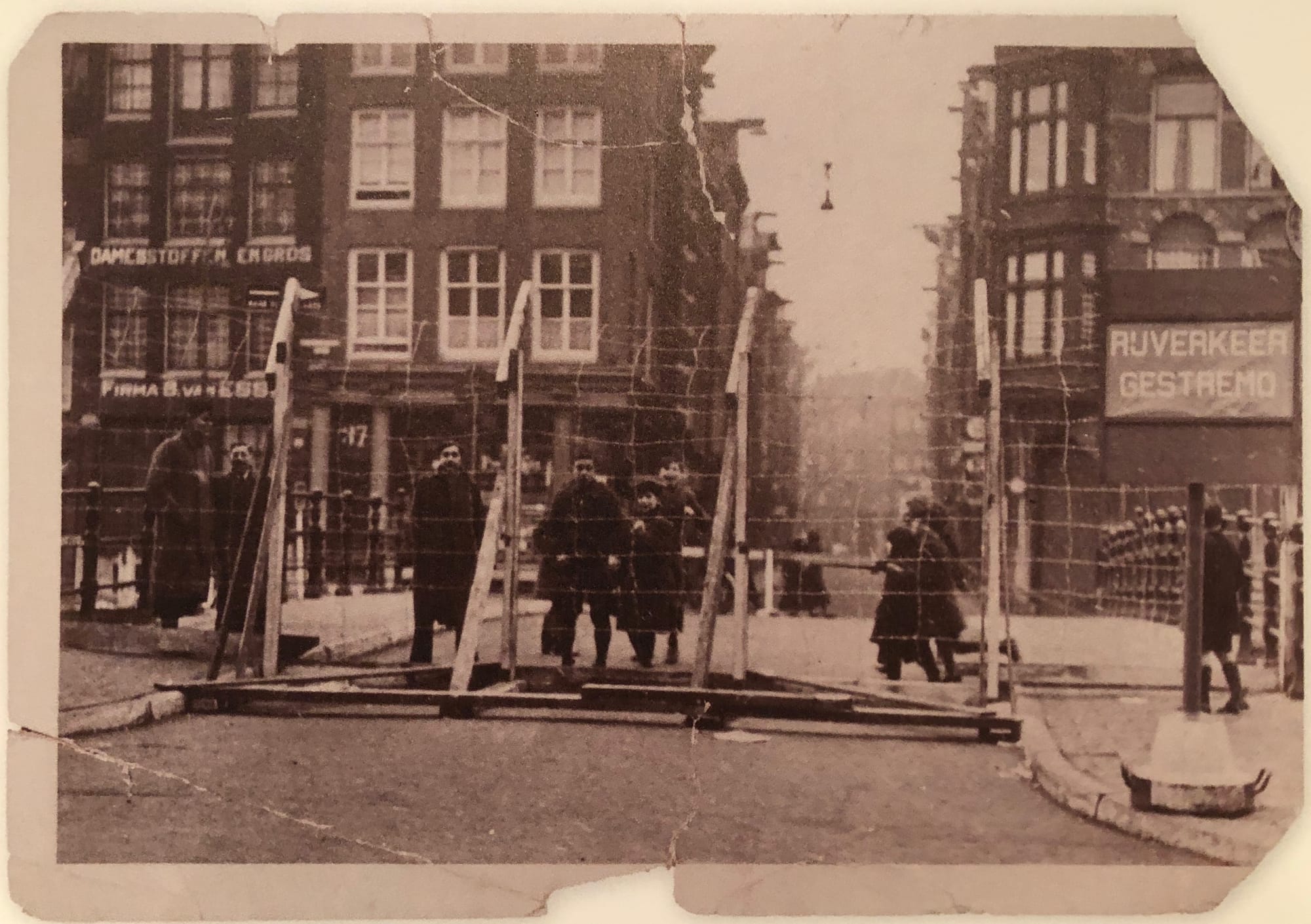
Following clashes and German security operations, occupation forces carried out raids in Amsterdam's Jewish neighbourhood.
On 22 and 23 February 1941, German forces arrested more than 400 Jewish men.
Many were deported to concentration camps, including Buchenwald and Mauthausen.
The raids shocked parts of the Amsterdam population.
They demonstrated that Nazi persecution was moving beyond exclusion from employment and public life toward arrests, detention and lethal violence.
The response would become one of the most significant acts of public protest during the German occupation.
The February Strike of 1941
On 25 February 1941, workers in Amsterdam began a strike in protest against the persecution and arrest of Jewish residents.
The protest, organised through underground communist networks, began among municipal workers and quickly spread to other sectors.
Tram services stopped, factories were affected and thousands of workers joined the action.
The strike extended beyond Amsterdam to several other Dutch towns and cities.
It became known as the February Strike, or Februaristaking.
The strike was an extraordinary public protest against anti-Jewish persecution under Nazi occupation.
Participants risked arrest, dismissal, imprisonment and violence.
German authorities responded with force.
The strike was suppressed, and several people were killed or wounded during the crackdown. Organisers and participants faced arrests and severe punishment.
Although the protest did not stop the persecution of Jews, it remains an important moment in Dutch wartime history.
It demonstrated that opposition to antisemitic policies existed within Dutch society and that some citizens were willing to act publicly in defence of their Jewish neighbours.
The February Strike also illustrates the limits of resistance under occupation.
A powerful act of solidarity could express opposition and temporarily disrupt daily life, but it could not by itself dismantle the system of persecution being established by Nazi Germany.
The Establishment of the Jewish Council
In February 1941, German occupation authorities established the Jewish Council in Amsterdam, known in Dutch as the Joodsche Raad.
Abraham Asscher and David Cohen became its principal leaders.
The council was initially established in the context of tensions and German demands concerning the Jewish community in Amsterdam.
Its responsibilities and reach expanded as the occupation continued.
Eventually, the Jewish Council became an institution through which German authorities communicated orders and imposed requirements on Jewish residents across the Netherlands.
The council was placed in an increasingly impossible position.
Its leaders and employees were members of the very population being persecuted.
They attempted, in different ways, to provide assistance, distribute information, maintain welfare services and protect members of the community.
At the same time, the occupation authorities compelled the council to participate in administrative processes that supported exclusion and deportation.
This created profound moral and practical dilemmas.
Compliance with German demands could sometimes appear to offer opportunities to delay individual deportations or secure temporary exemptions.
Yet the wider system remained under Nazi control.
Historians continue to examine the decisions made by the Jewish Council, the pressures under which its leaders operated and the consequences of its actions.
It is important not to confuse the council's constrained position with the responsibility of the German authorities who designed and directed the persecution.
The Jewish Council did not create Nazi antisemitic policy.
It operated within a coercive system in which the occupiers controlled the conditions and increasingly narrowed the possibilities for meaningful protection.
The Separation of Jewish Children
The persecution reached directly into Dutch schools.
During 1941, Jewish pupils were ordered to leave schools attended by non-Jewish children.
Separate Jewish schools were established or designated.
For thousands of children, the measures disrupted friendships, education and their sense of belonging.
A child who had previously attended lessons alongside neighbourhood friends was suddenly excluded because of Nazi racial classifications.
For Anne Frank, the restrictions meant leaving her Montessori school and transferring to the Jewish Lyceum in Amsterdam.
The change was a personal consequence of a much broader policy.
Jewish teachers were also affected by discriminatory employment measures.
The separation of children was part of the systematic removal of Jews from public life.
Education, which should have provided stability and opportunity, became another instrument through which the occupation authorities enforced exclusion.
The impact extended beyond the classroom.
Children were increasingly prevented from participating in activities that had previously been part of everyday life.
Their social worlds became smaller as restrictions accumulated.
The Yellow Star and the Visibility of Persecution
In May 1942, Jews in the Netherlands were required to wear a yellow Star of David bearing the word Jood, meaning Jew.
The star had to be displayed visibly on outer clothing.
The requirement made people classified as Jewish immediately identifiable in public spaces.
It exposed them to surveillance, humiliation, harassment and arrest.
The yellow star was not simply a symbol of discrimination.
It was part of a wider system intended to separate Jewish residents from the rest of society and facilitate the enforcement of restrictions.
By this time, Jews had already been prohibited from entering numerous public places and participating in ordinary activities.
Restrictions affected public transport, recreational facilities, shops, entertainment venues and freedom of movement.
Jewish residents were subjected to curfews and limitations on where they could travel.
They were also increasingly deprived of economic independence as businesses and property came under German control.
For children such as Anne Frank, the star represented another visible loss of freedom.
It marked them as targets of a government that treated their ancestry as grounds for exclusion.
The requirement also confronted non-Jewish Dutch residents with the increasingly obvious nature of Nazi persecution.
People could see that their Jewish neighbours, classmates and colleagues were being singled out.
How individuals responded varied considerably.
Some expressed sympathy or offered practical assistance.
Others remained silent, accepted the measures or participated in discrimination.
The visible nature of persecution did not guarantee effective opposition.
Economic Dispossession and the Loss of Independence
Anti-Jewish policies also targeted property and economic life.
Jewish business owners faced compulsory registration, restrictions and measures that transferred control of businesses and assets away from their owners.
Bank accounts and financial resources became subject to increasingly severe controls.
Jewish employees lost jobs, while professionals were excluded from occupations in which they had worked for years.
These measures undermined the ability of families to support themselves.
Economic dispossession was not separate from the persecution that later led to deportation.
It was part of the same process.
By depriving Jewish residents of employment, property and financial independence, the occupation authorities made them increasingly vulnerable.
The seizure of Jewish assets also benefited German institutions, collaborating organisations and individuals who acquired property under discriminatory conditions.
For the Frank family, Otto Frank's business arrangements became increasingly complicated.
He relied on trusted colleagues to assume formal responsibilities in the companies as anti-Jewish regulations threatened his ability to remain openly involved.
These colleagues would later play important roles in helping the family while they were in hiding.
The Beginning of Deportations
By the summer of 1942, Nazi persecution in the Netherlands entered a new and devastating phase.
The German authorities began organising systematic deportations of Jews from the country.
Official notices frequently described the transports as labour assignments or work in Germany.
In reality, the deportations formed part of the Nazi programme of persecution and mass murder across occupied Europe.
On 15 July 1942, the first major transport of Jews departed from Westerbork transit camp toward Auschwitz.
Westerbork, located in the province of Drenthe, had originally been established by the Dutch government in 1939 as a refugee camp for Jews fleeing Nazi Germany.
Under German occupation, it was transformed into a central transit camp for deportations.
Jewish residents from across the Netherlands were sent there before being transported to concentration and extermination camps in occupied Poland and elsewhere.
The deportation process involved registration, summonses, arrests, assembly locations, railway transport and the confiscation of belongings.
Many deportees were told they were being sent to work.
Families often had little reliable information about what awaited them.
The authorities used deception, coercion and administrative organisation to facilitate the transports.
A journey presented as relocation could end in forced labour, imprisonment or murder.
The Hollandsche Schouwburg
In Amsterdam, the Hollandsche Schouwburg became one of the most painful symbols of the deportation process.
Before the war, the building had been a theatre.
During the occupation, it was used as an assembly and detention location for Jews awaiting deportation.
Thousands of people passed through the building.
Families were separated, personal belongings were taken away, and individuals faced uncertainty about their destinations.
Across the street, a former childcare facility was used to accommodate young children separated from adults held in the theatre.
The circumstances also created opportunities for courageous rescue efforts.
Members of underground networks, including individuals working with the childcare facility and nearby institutions, helped some children escape deportation.
These efforts involved substantial personal risk.
The Hollandsche Schouwburg therefore represents both the machinery of persecution and the actions of people who attempted to save lives within it.
Today, it forms part of the National Holocaust Museum's wider memorial landscape in Amsterdam.
Dutch Society: Cooperation, Resistance and Difficult Choices
The persecution of Dutch Jews raises difficult questions about the behaviour of institutions and individuals under occupation.
Nazi Germany directed the policies that led to deportation and mass murder.
However, the implementation of those policies also involved local administrative systems, transport infrastructure and police operations.
Some Dutch officials and organisations actively collaborated with the occupation authorities.
Others complied with orders without necessarily supporting Nazi ideology.
Some individuals attempted to obstruct persecution, falsify documents, hide Jewish families or help people escape.
There were also people who profited from the persecution by acquiring confiscated property or accepting positions created through the exclusion of Jewish citizens.
These different behaviours cannot be reduced to a simple division between an entirely resistant population and a small number of collaborators.
Dutch society under occupation was complex.
Fear, antisemitism, opportunism, political conviction, institutional obedience, solidarity and personal courage all influenced decisions.
For Jewish families, the consequences could be immediate.
A neighbour might provide food or shelter.
Another might report a hiding place.
A civil servant might help obtain false papers, while someone else might enforce a regulation that made escape more difficult.
The history of the Holocaust in the Netherlands requires attention to these individual actions without losing sight of the Nazi regime's central responsibility.
The Scale of the Destruction
Before the German occupation, approximately 140,000 Jews lived in the Netherlands.
More than 100,000 were murdered during the Holocaust.
The proportion of Jewish residents who were killed was exceptionally high compared with several other occupied Western European countries.
Historians have examined numerous factors that contributed to this outcome, including the effectiveness of registration systems, the geography of the Netherlands, the structure of the occupation administration, patterns of collaboration and the difficulties of escaping or finding safe hiding places.
No single factor fully explains the scale of the destruction.
The deportations devastated communities throughout the country.
Amsterdam lost much of its Jewish population.
Smaller towns and cities experienced the disappearance of families who had been part of local life for generations.
Businesses closed, homes were emptied and religious institutions lost their congregations.
The consequences continued long after the war.
Survivors returned to communities that had been transformed by absence, destruction and the loss of relatives, friends and neighbours.
The Frank Family Faces an Immediate Threat
For Anne Frank and her family, the summer of 1942 brought the danger of deportation directly to their home.
On 5 July 1942, Margot Frank received a summons ordering her to report for what was officially described as labour in Germany.
Margot was sixteen years old.
Otto and Edith Frank understood that obeying the summons could place their daughter in grave danger.
The family had already prepared a hiding place in the rear section of Otto Frank's business premises at Prinsengracht 263.
The summons accelerated their plans.
On the morning of 6 July 1942, the family left their apartment at Merwedeplein.
They could not openly carry suitcases without attracting attention, so they wore additional layers of clothing and took only what they could carry discreetly.
They travelled to the business premises where a concealed living space had been prepared.
For Anne, who had celebrated her thirteenth birthday less than a month earlier, the transition was sudden and overwhelming.
She left behind her home, school, friends and the ordinary freedoms of childhood.
The family entered hiding without knowing how long they would remain there.
They hoped to survive until the war ended.
From Exclusion to the Threat of Death
The persecution of Dutch Jews developed through identifiable stages.
Registration made people easier to locate.
Discriminatory laws removed rights and employment.
Separate schools and restrictions on public life isolated Jewish residents from their neighbours.
The yellow star made their identity visible.
Property seizures deprived families of financial independence.
Arrests and deportations then placed thousands in the hands of a system designed to exploit and destroy them.
Each stage was connected to the next.
The process illustrates how persecution can be implemented through a combination of ideology, legislation, bureaucracy, intimidation and violence.
For Anne Frank, these developments were not abstract historical events.
They determined where she could study, which places she could visit, how she could move through her city and whether her family could remain together.
By July 1942, the freedom she had known in Amsterdam had almost completely disappeared.
The family had escaped Nazi Germany in search of safety.
Now, in the Netherlands, they had been forced to disappear from public life to avoid arrest.
Behind the walls of the Secret Annex, Anne would continue writing.
Her diary would preserve the thoughts of a young girl living through the consequences of a persecution system that had already transformed the lives of Jewish families throughout the Netherlands.
The next chapter follows Anne and the seven other people who shared the hiding place, exploring the routines, tensions, fears and acts of solidarity that shaped their lives behind the concealed entrance.
Chapter 4 — Life in Hiding: The Secret Annex
A Hidden World Behind an Amsterdam Business
On the morning of 6 July 1942, thirteen-year-old Anne Frank entered a building at Prinsengracht 263 in Amsterdam, unaware that she would spend more than two years living in its concealed rooms.
The building housed the offices and warehouse of businesses associated with her father, Otto Frank. Behind the main premises was a smaller rear section that could not easily be seen from the street.
This rear building would become known around the world as the Secret Annex.
For Anne, her parents and her older sister Margot, the move marked a complete separation from the life they had known.
They could no longer attend school, visit friends, walk through Amsterdam or participate openly in society.
Their survival depended on remaining invisible.
The family had prepared for the possibility of hiding as Nazi persecution intensified. But the summons Margot received on 5 July 1942, ordering her to report for what was described as labour in Germany, forced them to act sooner than originally planned.
The following morning, the family left their apartment at Merwedeplein.
They could not carry ordinary luggage without attracting attention. Instead, they wore additional layers of clothing and brought what they could manage discreetly.
The journey to Prinsengracht 263 was the beginning of a period of confinement that would last 761 days.
The Building at Prinsengracht 263
The Secret Annex was located in the rear part of a building complex connected to Otto Frank's business premises.
The front building contained offices, storage areas and a warehouse where employees continued working during the German occupation.
The rear building contained several rooms spread across multiple levels.
Although it offered a place of concealment, it had never been designed to accommodate eight people living secretly for an extended period.
The available space was limited.
Furniture, bedding, food supplies and personal belongings had to be arranged carefully to make daily life possible.
The windows facing neighbouring properties were covered or concealed to reduce the risk of attracting attention.
During working hours, the people in hiding had to remain extremely quiet.
Warehouse employees and visitors who were unaware of their presence might hear footsteps, voices, running water or other unexpected sounds.
Even ordinary activities could become dangerous.
Walking across a floor, moving furniture or using the toilet could potentially reveal that people were living above and behind the business premises.
The building was both a refuge and a place of constant restriction.
It protected the occupants from immediate arrest, but it also separated them from nearly every aspect of ordinary life.
The Entrance Behind the Bookcase
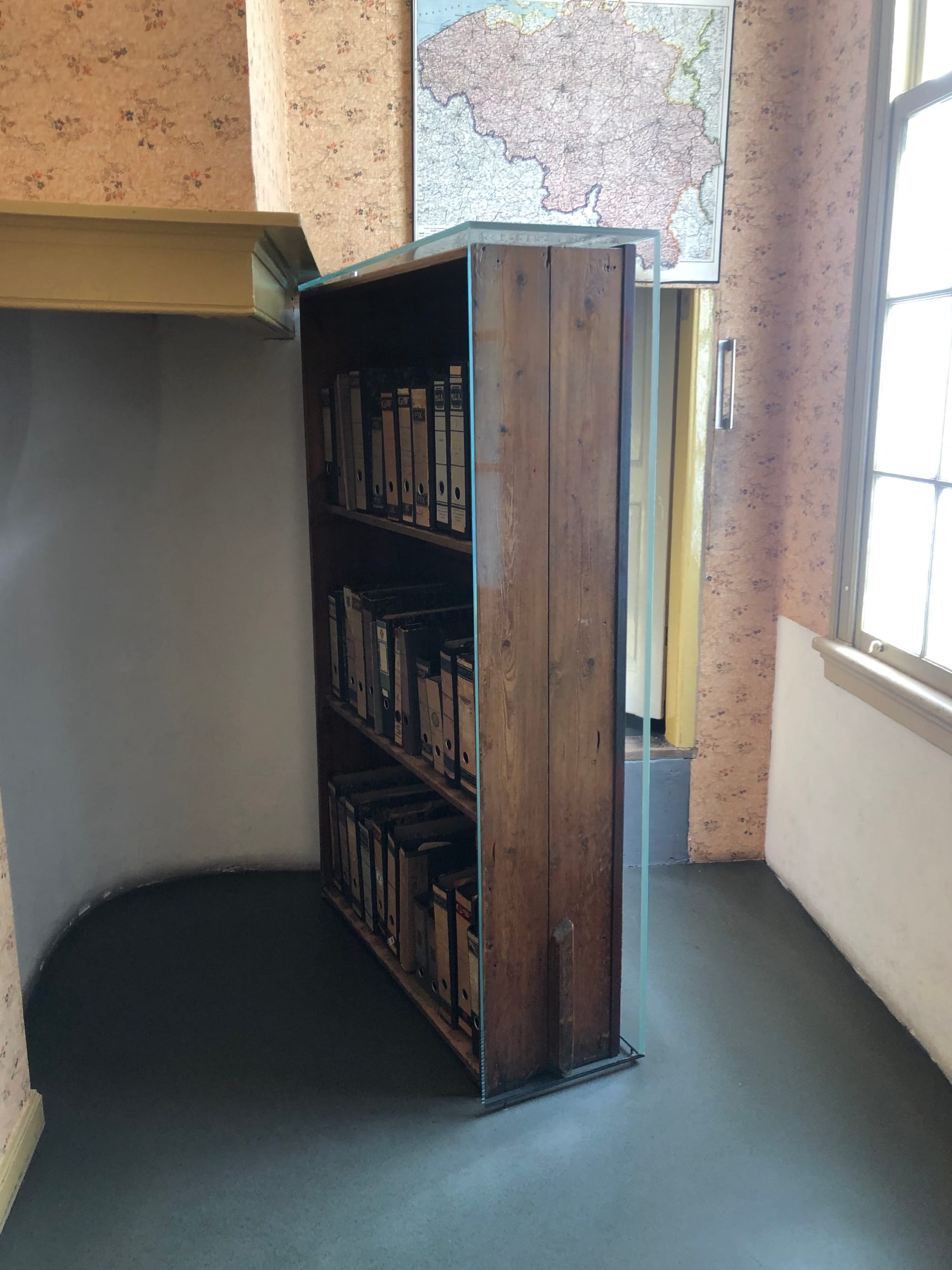
One of the most recognisable features of the Secret Annex is the movable bookcase that concealed its entrance.
The bookcase was installed in August 1942, after the Frank family had already entered hiding.
It helped disguise the doorway leading to the rear building.
Visitors entering the office area would see what appeared to be an ordinary piece of furniture rather than an entrance to concealed living quarters.
The bookcase became an important protective measure, but it did not eliminate the danger of discovery.
The occupants still depended on secrecy, the discretion of their helpers and the ability to avoid attracting attention.
For more than two years, the hidden entrance separated two different worlds.
On one side, business activities continued under German occupation.
On the other, eight people attempted to preserve their lives while remaining entirely outside public view.
The First Four Occupants
The first people to enter the Secret Annex were Otto Frank, Edith Frank and their daughters, Margot and Anne.
Otto, born in 1889, was the oldest member of the family.
He had already experienced the consequences of antisemitism in Germany and had moved his family to Amsterdam in the hope of finding safety.
Inside the Annex, he attempted to maintain routines, encourage learning and provide stability under difficult circumstances.
Edith Frank, born in 1900, faced the challenge of protecting her daughters while coping with the emotional pressures of confinement.
Margot, sixteen years old when the family went into hiding, was a disciplined student who continued studying whenever possible.
Anne, thirteen, was energetic, curious and increasingly interested in writing.
Their family relationships, already shaped by different personalities and expectations, would become more complicated under the pressure of living together in a restricted space.
The Annex offered no real possibility of withdrawing from family tensions.
Disagreements that might once have been resolved through time apart or ordinary outside activities could become more difficult when everyone remained confined.
The Arrival of the Van Pels Family
On 13 July 1942, one week after the Frank family entered hiding, three more people joined them.
They were Hermann van Pels, his wife Auguste and their son Peter.
The Van Pels family had also fled Nazi Germany and settled in the Netherlands.
Hermann van Pels worked with Otto Frank's business and had become involved in the arrangements for hiding.
Peter was sixteen years old when he entered the Annex.
The arrival of the Van Pels family increased the number of occupants to seven.
It also changed the daily dynamics of the hiding place.
Two families now had to share rooms, facilities, food and the constant anxiety of discovery.
The adults had different habits and opinions, while the teenagers were developing their own identities.
Anne's diary later described disagreements over household routines, food distribution, personal behaviour and the limited space available.
These observations provide valuable insight into the emotional strain of confinement.
They also reflect Anne's personal perspective as a teenager.
Her descriptions of other occupants should not automatically be treated as complete or impartial portraits of their personalities.
The people in the Annex were living under extraordinary pressure, and their relationships were shaped by fear, uncertainty and the absence of privacy.
The Eighth Person: Fritz Pfeffer
On 16 November 1942, an eighth person entered the Secret Annex.
His name was Fritz Pfeffer, a German Jewish dentist who had also sought refuge in the Netherlands.
Pfeffer was assigned to share a room with Anne.
The arrangement created additional difficulties.
Anne was accustomed to having some personal space and found it challenging to share a small room with an adult whose routines and expectations differed from her own.
Their disagreements became a recurring subject in her diary.
Pfeffer, meanwhile, was separated from his partner, Charlotte Kaletta, who was not Jewish and remained outside the hiding place.
Like the other occupants, he faced uncertainty about the future and concern for people he could no longer see.
His presence illustrates the difficult choices involved in hiding.
Providing shelter to another person could save a life, but it also increased the demands on food, space, secrecy and the people supplying assistance.
With Pfeffer's arrival, the group reached its final number of eight occupants.
They would remain together until their arrest in August 1944.
The People Who Made Hiding Possible
The survival of the eight occupants depended on a small group of trusted helpers.
Among the best known were Miep Gies, Jan Gies, Bep Voskuijl, Johannes Kleiman, Victor Kugler and Johan Voskuijl.
Their contributions differed, but each played a role in supporting the people in hiding.
Miep Gies worked for Otto Frank's business and helped provide food, supplies and news from the outside world.
Her husband, Jan Gies, also assisted and was involved in resistance-related activities.
Bep Voskuijl, a young office employee, helped obtain supplies and maintain contact with the hidden occupants.
Johannes Kleiman and Victor Kugler, who held important positions in the businesses, helped organise practical arrangements and protect the secrecy of the hiding place.
Johan Voskuijl, Bep's father, worked in the warehouse and constructed the movable bookcase that concealed the entrance.
These helpers were not simply delivering groceries.
They were sustaining an entire hidden household under occupation.
Food was increasingly difficult to obtain, especially as shortages and rationing intensified.
Purchasing unusually large quantities could attract suspicion.
The helpers therefore had to find ways to obtain supplies without revealing that they were supporting eight people who were not officially present.
They also brought books, newspapers, personal items and information.
Their visits connected the occupants to a world they could no longer enter.
The Risks Faced by the Helpers
Helping Jews evade Nazi persecution was dangerous.
Discovery could lead to arrest, imprisonment or other severe consequences.
The people assisting the Frank family had their own families, employment responsibilities and personal concerns.
They were living under occupation themselves.
Yet they continued supporting the hidden occupants for more than two years.
Their actions demonstrate the importance of individual choices during periods of persecution.
The Nazi occupation created conditions in which helping another person could become a punishable act.
The helpers chose to act despite the risks.
At the same time, their courage should not obscure the broader reality that many Jewish people were unable to find safe hiding places.
Successful concealment required access to trustworthy contacts, suitable buildings, food, money and people willing to help.
These resources were not available equally to everyone.
For the eight occupants of the Secret Annex, the existence of a dedicated support network was essential to their survival for as long as it lasted.
A Daily Routine Built Around Silence
Life in the Secret Annex followed a strict routine.
During the hours when employees were working in the warehouse below, the occupants had to remain quiet.
They avoided unnecessary movement and activities that might create noise.
Even the sound of running water or flushing a toilet could be dangerous at certain times.
Meals, cleaning, reading and studying had to be organised around the working day.
When the warehouse employees left, the occupants had somewhat greater freedom to move around and speak normally.
Evenings offered opportunities to prepare food, listen to news and spend time together.
However, the threat of discovery never disappeared.
Unexpected visitors, noises from the building or disturbances outside could cause immediate alarm.
The occupants had to remain constantly aware that their safety depended on secrecy.
This created a form of psychological pressure that was difficult to escape.
Ordinary household routines became matters of survival.
Food, Rationing and Increasing Shortages
Food was one of the most persistent concerns in the Secret Annex.
The Netherlands experienced rationing during the German occupation, and shortages became increasingly severe as the war continued.
The helpers obtained supplies through ration cards, personal contacts and whatever other means were available.
Meals were often repetitive.
Potatoes, beans, vegetables and preserved foods became important parts of the diet.
Fresh products were not always available.
The occupants sometimes received food of poor quality, and shortages caused frustration and disagreement.
Anne's diary records the importance of food in daily conversations.
Discussions about meals could become arguments, particularly when everyone was tired, hungry or anxious.
These difficulties became more pronounced as the war progressed.
By 1944, conditions in occupied Netherlands were deteriorating, and obtaining sufficient food was increasingly challenging.
The eight occupants depended entirely on people outside the Annex to keep them supplied.
Education Behind Closed Doors
Despite the restrictions, Anne and Margot continued their education.
Otto Frank encouraged both daughters to study and maintain intellectual routines.
The girls worked on subjects such as languages, history, mathematics and literature.
Anne read books and pursued her growing interest in writing.
Studying provided structure during days that might otherwise have seemed repetitive and uncertain.
It also offered a connection to the future.
The occupants did not know when the war would end, but they hoped that one day they would return to ordinary life.
Education represented preparation for that possibility.
For Anne, reading and writing became particularly important.
They allowed her to explore ideas, develop her imagination and express emotions that were difficult to communicate within the crowded household.
Anne's Diary as a Private Refuge
Anne had received her diary for her thirteenth birthday on 12 June 1942, less than a month before entering hiding.
She continued writing after the family moved into the Secret Annex.
Her entries gradually developed from descriptions of daily events into more detailed reflections on identity, relationships, fear and the future.
Anne often addressed her diary as if writing to an imaginary friend whom she called Kitty.
This approach gave her writing a personal and conversational quality.
She could express thoughts that she did not always feel comfortable sharing with the adults around her.
Her diary became a place to examine disagreements, frustrations and hopes.
It also allowed her to observe the people with whom she lived.
Anne wrote about household routines, arguments, food shortages, schoolwork and news from the war.
But she also explored deeper questions.
She reflected on the person she wanted to become, the differences between her public behaviour and private feelings, and her desire to be understood.
These passages reveal a young writer developing her voice under extraordinary circumstances.
Growing Up Without Privacy
Anne entered hiding at thirteen and remained there until she was fifteen.
These were important years of adolescence.
During this period, she experienced emotional changes, questioned authority and became increasingly interested in independence and personal identity.
In ordinary circumstances, she might have explored these changes through school, friendships and activities outside the family home.
Inside the Annex, her opportunities were extremely limited.
She lived continuously among seven other people.
Privacy was scarce, and personal disagreements could not easily be escaped.
Anne sometimes felt misunderstood by the adults around her.
Her diary records criticism of her behaviour and her own reactions to those criticisms.
She also reflected on her relationship with her mother, her admiration for her father and her comparisons with Margot.
These experiences were deeply personal, but they also reveal the emotional effects of prolonged confinement.
The people in hiding were not only threatened by external danger.
They also had to manage the psychological strain of living without freedom, independence or certainty about the future.
Anne and Peter: Friendship and First Affection
As the months passed, Anne developed a closer relationship with Peter van Pels.
At first, she did not find him particularly interesting.
Over time, however, their shared circumstances created opportunities for conversation and companionship.
Both were teenagers growing up in confinement.
They experienced the same restrictions, fears and uncertainty.
Anne began spending more time with Peter, particularly in the attic, where they could sometimes speak more privately.
Their relationship developed into a period of emotional closeness and romantic interest.
Anne wrote about her feelings, her expectations and her uncertainty about what the relationship meant.
She also questioned whether Peter could provide the emotional understanding she was seeking.
These reflections are significant because they show Anne experiencing aspects of adolescence despite the conditions of hiding.
Her life was constrained by persecution, but her emotional development did not stop.
She continued to experience curiosity, affection, disappointment and the desire for companionship.
The Attic and the Outside World
The attic became an important space for Anne.
Although the occupants could not go outside, the upper part of the building offered a limited connection to the world beyond the walls.
Anne could sometimes look toward the sky and the chestnut tree visible from the building.
Nature held particular significance for her.
The sight of the sky, changing weather and the tree outside reminded her that a world still existed beyond the restrictions of the Annex.
Her diary contains reflections on the comfort she found in observing nature.
These moments did not remove the danger surrounding her.
But they provided a temporary sense of openness within an otherwise confined environment.
The contrast between the small hidden rooms and the outside world became one of the defining experiences of Anne's life in hiding.
She could see fragments of ordinary existence but could not participate in them.
News from the War
The occupants followed developments in the Second World War as closely as possible.
Radio broadcasts and information brought by the helpers provided news about military operations and political events.
The BBC and Dutch-language broadcasts from London were particularly important sources of information.
Reports about Allied advances created hope that liberation might eventually become possible.
At the same time, news about arrests, deportations and violence reinforced the danger facing Jews throughout occupied Europe.
Anne's diary records her awareness that people outside the Annex were being taken away.
She understood that many Jewish families were suffering under Nazi persecution.
Her reflections reveal the contrast between the relative protection of hiding and the knowledge that others were facing deportation.
The occupants were isolated physically, but they were not unaware of the wider catastrophe.
Their hopes and fears were closely connected to the progress of the war.
The Allied Landings and Renewed Hope
On 6 June 1944, Allied forces landed in Normandy, France.
The operation, known as D-Day, marked the beginning of a major campaign to liberate Western Europe from Nazi occupation.
News of the landings reached the people in the Secret Annex.
For the occupants, the Allied advance offered renewed hope.
They had already spent nearly two years in hiding.
The possibility that German control over Western Europe might eventually collapse became more tangible.
Anne continued writing about the war and her hopes for the future.
She also worked on revising her diary.
In March 1944, she had heard a radio broadcast by Dutch government minister Gerrit Bolkestein, who encouraged people to preserve diaries and other documents about life under occupation.
Anne recognised that her own writing might have historical value.
She began rewriting and organising parts of her diary with the intention of creating a book after the war.
She considered the title Het Achterhuis, meaning The Secret Annex.
This decision reveals that Anne was not merely keeping a private record.
She was beginning to think seriously about becoming a published writer.
The Emotional Weight of Uncertainty
Despite moments of hope, the occupants continued living under constant uncertainty.
They did not know when the war would end.
They could not be certain that the building would remain safe.
Every unexpected noise could suggest danger.
Burglary attempts and disturbances in the building caused particular anxiety.
The occupants feared that someone might discover evidence of their presence.
Their dependence on the helpers also created concern.
If a helper became ill, was arrested or could no longer obtain supplies, the consequences could be serious.
The people in hiding had little control over the political and military events determining their future.
They could study, write, organise routines and attempt to support one another.
But they could not remove the threat that had forced them into hiding.
This prolonged uncertainty shaped every aspect of life in the Annex.
Eight Individuals, Not Just Historical Names
The eight people in the Secret Annex are often remembered collectively.
Yet each had a separate life, personality and history.
Otto Frank was a father and businessman trying to protect his family.
Edith Frank was a mother confronting the possibility of losing her children.
Margot Frank was a young student whose education and future had been interrupted.
Anne Frank was an aspiring writer discovering her voice.
Hermann and Auguste van Pels were parents attempting to protect their son.
Peter van Pels was a teenager facing the loss of freedom during important years of his development.
Fritz Pfeffer was a dentist separated from his partner and living under the same threat of deportation.
Their circumstances brought them together, but they did not become identical because they shared a hiding place.
Their disagreements, habits, fears and hopes reflected their individuality.
Remembering these differences is important.
The Holocaust did not destroy an anonymous population.
It targeted people with distinct identities, relationships, professions and aspirations.
The Final Weeks in Hiding
During the summer of 1944, the occupants followed reports of Allied advances with increasing interest.
The liberation of Europe appeared to be approaching, although the outcome and timing remained uncertain.
Anne continued working on her writing.
Her final diary entry is dated 1 August 1944.
In it, she reflected on the contrast between the different sides of her personality and the difficulty of showing others her deeper feelings.
Three days later, the period of hiding ended.
On 4 August 1944, German security personnel and Dutch police officers entered the building at Prinsengracht 263.
The eight occupants were discovered and arrested.
The exact circumstances that led the authorities to the hiding place remain a subject of historical investigation.
Although several theories have been proposed, no definitive explanation has been established.
The arrest ended 761 days of concealment.
For more than two years, the Secret Annex had provided a fragile form of protection.
Now the occupants faced the deportation system from which they had been trying to escape.
A Place That Preserved a Voice
The Secret Annex became internationally known because Anne Frank's diary survived.
Yet the building's history is larger than the story of one manuscript.
It represents the desperation of families forced to disappear from public life because of Nazi persecution.
It also represents the courage of people who risked their safety to help others.
Inside its walls, eight individuals attempted to preserve ordinary human routines under extraordinary circumstances.
They argued, studied, prepared meals, listened to the radio, formed relationships and imagined a future beyond the war.
Anne's writing captured these experiences with unusual honesty and emotional depth.
Her diary does not provide a complete record of the Holocaust, nor does it represent every Jewish experience during the occupation.
It is the perspective of one young person living in a particular place under specific circumstances.
Its power lies partly in that individuality.
Through Anne's observations, readers encounter the effects of persecution on daily life, family relationships and personal development.
The Secret Annex was not a place where the Holocaust could be escaped permanently.
It was a temporary refuge within a country where Jewish people were being systematically identified, arrested and deported.
The arrest of its occupants demonstrated the vulnerability of even carefully organised hiding arrangements.
But the words Anne wrote there survived.
They would later become an essential part of how the world remembers the persecution of Jews in the Netherlands.
The next chapter examines the diary itself: how Anne developed as a writer, how she used language to explore identity and freedom, and why her words continue to speak to readers across generations.

Chapter 5 — The Diary: Writing, Identity and the Hope for Freedom
More Than a Diary
When Anne Frank received a red-and-white checked diary for her thirteenth birthday on 12 June 1942, she could not have imagined that her words would one day be read by millions of people around the world.
At first, the diary was a personal possession, a place where she could record the events of her everyday life. She wrote about classmates, friendships, family relationships and the experiences of growing up in Amsterdam.
Less than a month later, her circumstances changed dramatically.
On 6 July 1942, Anne entered hiding with her parents and older sister in the concealed rooms behind her father's business premises at Prinsengracht 263.
Her diary became something far more significant than a record of school life.
It became a private space in which she could express emotions, examine her identity and preserve a sense of independence while living under Nazi persecution.
Over the following two years, Anne developed from a young teenager recording daily events into an increasingly thoughtful and ambitious writer.
Her diary documented the pressures of confinement, but it also explored questions that extended beyond the immediate circumstances of the war.
She wrote about friendship, loneliness, family relationships, personal growth, romantic feelings and her hopes for the future.
Her observations were sometimes humorous, sometimes critical and frequently deeply introspective.
The diary's historical importance lies not only in its description of life in hiding, but also in the individuality of the voice it preserves.
Anne Frank was not writing as a historian looking back on the Holocaust.
She was a young person living through events whose outcome she could not know.
Writing to Kitty
Anne began her diary by recording her experiences in a relatively conventional way.
As her writing developed, she increasingly addressed many entries to an imaginary friend named Kitty.
The name was inspired by characters in a series of books by Dutch writer Cissy van Marxveldt, whose work Anne enjoyed.
Writing to Kitty gave the diary the form of a personal correspondence.
Rather than simply listing events, Anne could describe her thoughts as if speaking to someone who would listen without interrupting or judging her.
This approach created an intimate and conversational style.
Inside the Secret Annex, where privacy was extremely limited, the diary provided an emotional refuge.
Anne lived among seven other people in confined rooms, with little opportunity to withdraw from conversations or disagreements.
She sometimes felt misunderstood by the adults around her.
She also struggled with the difference between the lively, outspoken personality others saw and the more reflective person she believed existed within her.
Through Kitty, she could explore these feelings privately.
The diary became a space where Anne could express uncertainty without needing to defend herself.
It also allowed her to examine difficult emotions that were not always easy to communicate within the household.
Her writing reveals the importance of having a personal voice in circumstances where freedom of movement and expression had been severely restricted.
The Diary as a Record of Daily Life
One of the diary's most important historical contributions is its detailed description of everyday life in hiding.
Anne wrote about the practical difficulties of sharing a concealed living space.
She described food shortages, household routines, arguments, schoolwork and the constant need to remain quiet during business hours.
Her entries reveal how ordinary activities became complicated by the danger of discovery.
The occupants could not move freely through the building whenever they wished.
They had to avoid making sounds that might be heard by warehouse employees or visitors who did not know people were hiding above and behind the offices.
Food depended on supplies obtained by their helpers.
News from the outside world arrived through radio broadcasts, newspapers and conversations with trusted visitors.
Anne's writing captures the emotional effects of these restrictions.
Periods of boredom could be interrupted by sudden fear.
Arguments over small matters sometimes reflected much larger anxieties.
The occupants followed military developments with hope, but they could not know whether liberation would arrive before they were discovered.
Through these details, the diary documents a form of persecution that extended beyond formal laws and arrests.
The threat of Nazi violence shaped the smallest aspects of daily existence.
A Young Writer Observing the People Around Her
Anne's diary is particularly notable for the attention she paid to the personalities and behaviour of the people living with her.
She described the adults in the Secret Annex, their habits, their disagreements and the tensions that developed under confinement.
She also wrote extensively about her relationships with her parents and sister.
Her observations were often sharp and sometimes critical.
Anne did not attempt to present every person in a consistently sympathetic way.
She expressed irritation, disappointment and frustration, particularly when she felt that adults failed to understand her.
These passages reveal her developing ability to observe and describe human behaviour.
They also require careful historical interpretation.
Anne's diary represents her personal perspective at particular moments in her adolescence.
It does not provide a complete or impartial account of every person she described.
Her opinions sometimes changed as she matured, and her emotional responses were influenced by the extraordinary pressures of hiding.
Recognising this does not diminish the diary's value.
Instead, it helps readers understand the document for what it is: a personal record written by a young person whose thoughts and relationships were still developing.
Anne and Her Mother
Anne's relationship with her mother, Edith Frank, is one of the more complicated subjects in the diary.
Anne sometimes described feeling emotionally distant from her mother.
She believed that Edith did not always understand her personality or provide the kind of emotional support she wanted.
These feelings became particularly intense during the early period of hiding.
However, the diary also shows Anne reflecting on her own behaviour and gradually developing a more complex understanding of family relationships.
Her criticism should not be interpreted as a definitive assessment of Edith Frank's character.
Edith was living under the same threat of arrest and deportation while attempting to protect her daughters.
She faced the additional emotional burden of motherhood in circumstances where ordinary parental responsibilities had become extraordinarily difficult.
The relationship between Anne and Edith illustrates how confinement could intensify tensions that might otherwise have developed differently.
It also reminds readers that the diary preserves only one side of many conversations.
Edith Frank did not survive the Holocaust and therefore could not later provide her own account of life in the Secret Annex.
Anne's Relationship with Otto Frank
Anne generally described a closer relationship with her father, Otto Frank.
She often regarded him as a source of reassurance and understanding.
Otto encouraged his daughters to continue studying and attempted to maintain a sense of order in the household.
Anne admired his calmness and frequently turned to him for emotional support.
Yet her relationship with her father also changed as she grew older.
As Anne became more independent, she increasingly questioned the expectations placed upon her.
She wanted to be recognised as a developing individual rather than simply treated as a child.
This desire for independence is an important theme throughout the diary.
It shows that Anne's emotional life continued to evolve despite the restrictions of hiding.
The Holocaust threatened her freedom and survival, but it did not prevent her from developing her own opinions, ambitions and sense of identity.
Growing Up in Confinement
Anne entered the Secret Annex at thirteen and was fifteen when she was arrested.
These years represented a significant period of personal development.
During adolescence, young people often begin questioning family expectations, exploring relationships and forming a more independent understanding of themselves.
Anne experienced these changes without the ordinary freedoms available to most teenagers.
She could not attend school, visit friends or participate in activities outside the hiding place.
Her social environment consisted primarily of the seven people living with her and the small group of helpers who visited.
This isolation influenced her emotional development.
She wrote about loneliness, frustration and her desire to be understood.
She also reflected on physical changes, romantic feelings and the challenges of becoming an adult.
These subjects are important because they demonstrate that Anne's diary is not solely a record of persecution.
It is also a coming-of-age narrative written under extraordinary circumstances.
Anne continued to grow intellectually and emotionally even as the world around her attempted to deny her a future.
Anne and Peter van Pels
One of the most personal developments recorded in the diary was Anne's growing relationship with Peter van Pels.
Peter had entered hiding with his parents in July 1942.
Initially, Anne did not consider him especially interesting.
As time passed, however, they began spending more time together.
Their shared experience of confinement created opportunities for conversation and emotional closeness.
They sometimes met in the attic, where they could speak with a degree of privacy.
Anne began to develop romantic feelings for Peter.
She wrote about their conversations, their growing affection and her uncertainty about the relationship.
Yet she also questioned whether Peter understood her deeper thoughts and ambitions.
As her feelings evolved, Anne became increasingly reflective about the difference between romantic attraction and emotional companionship.
These passages provide a rare perspective on adolescence during the Holocaust.
They reveal that young people continued to experience affection, curiosity and personal uncertainty even while living under the threat of deportation.
Anne's developing relationship with Peter was part of her life, not separate from the historical circumstances surrounding it.
The Outside World Through Radio and News
Although Anne was physically isolated from the outside world, she remained interested in political and military developments.
The occupants listened to radio broadcasts and received news from their helpers.
Reports from the BBC and Dutch-language broadcasts from London provided information about the progress of the war.
Anne wrote about Allied military operations, German occupation policies and the possibility of liberation.
She was also aware that Jewish people outside the Annex were being arrested and deported.
Her diary contains references to the suffering of others and the danger faced by those who had no place to hide.
This awareness shaped her understanding of her own circumstances.
She recognised that hiding provided a degree of protection unavailable to many Jewish families.
At the same time, she knew that the safety of the Secret Annex was uncertain.
The occupants could be discovered at any moment.
Her writing therefore moved between hope and fear.
News of Allied advances could create optimism, while reports of arrests and violence reinforced the danger surrounding them.
The Writer Anne Wanted to Become
Anne Frank's literary ambitions became increasingly important during her time in hiding.
She enjoyed reading and was interested in developing her ability to write.
In addition to her diary, she produced short stories, fictional pieces and descriptions of events in the Secret Annex.
She collected some of these writings in a notebook known as Tales from the Secret Annex.
Her work demonstrates that she was experimenting with different forms of storytelling.
Anne did not simply record whatever happened around her.
She began thinking about how experiences could be shaped into narratives that other people might read.
She paid attention to character, dialogue, description and the structure of her writing.
Over time, she became increasingly serious about the possibility of becoming a professional writer.
Her ambition was particularly significant because Nazi persecution had deprived her of ordinary educational and professional opportunities.
Writing allowed her to imagine a future in which her thoughts and experiences might reach an audience beyond the walls of the Annex.
The Radio Broadcast That Changed Her Plans
On 28 March 1944, Anne heard a radio broadcast from London that influenced the direction of her writing.
Gerrit Bolkestein, a minister in the Dutch government in exile, spoke about the importance of preserving personal documents from the occupation.
He suggested that diaries, letters and other records could help future generations understand what people in the Netherlands had experienced during the war.
Anne recognised that her diary might become part of that historical record.
She began considering how her writing could be transformed into a book after the war.
This marked an important development.
Until then, much of her diary had been written primarily for herself.
Now she began revising her material with the possibility of future publication in mind.
She selected, rewrote and reorganised entries.
She also developed the idea of presenting the experiences of the people in hiding as a coherent narrative.
The title she considered was Het Achterhuis, commonly translated into English as The Secret Annex.
The project reveals Anne's growing confidence as a writer.
She was no longer only documenting her circumstances.
She was consciously shaping a literary account of them.
The Different Versions of Anne's Diary
The surviving diary manuscripts are more complex than a single notebook.
Anne's original diary writings are commonly described by researchers as Version A.
These include her original entries in notebooks and on loose sheets, although not every original entry has survived.
After hearing Bolkestein's broadcast, Anne began rewriting her diary for possible publication.
This revised manuscript is commonly called Version B.
In it, she reorganised material, expanded certain passages and changed some names to protect the identities of people she described.
After the war, Otto Frank prepared a publication text using material from both surviving versions.
This edited compilation is commonly known as Version C.
The first Dutch edition appeared in 1947 under the title Het Achterhuis.
Understanding these versions is essential when studying the diary as a historical source.
The published text was not simply a direct reproduction of one uninterrupted manuscript.
It emerged from Anne's original writing, her own revisions and the editorial decisions made after her death.
Later scholarly editions made the different manuscript versions available for comparison.
These editions allow researchers to examine Anne's development as a writer and understand how the published diary relates to the surviving original documents.
Otto Frank's Editorial Decisions
Otto Frank was the only one of the eight people who had hidden in the Secret Annex to survive the Holocaust.
After returning to Amsterdam, he received Anne's preserved writings from Miep Gies.
He eventually decided to pursue publication.
In preparing the text, Otto drew on Anne's original diary and her revised manuscript.
He omitted some passages, including certain personal reflections and comments about family relationships.
Some of these decisions reflected the sensitivities and publishing conventions of the period.
Other editorial choices were connected to the challenge of creating a readable book from the surviving manuscripts.
The existence of edited editions has sometimes been misrepresented by Holocaust deniers.
However, editorial changes do not undermine the authenticity of Anne's writings.
Historical and forensic examinations have established that the diary manuscripts were written by Anne Frank.
The differences between versions are documented and form part of the diary's publication history.
They also demonstrate that Anne herself had already begun revising her work before her arrest.
Authenticity and Historical Evidence
Anne Frank's diary is among the most extensively studied personal documents associated with the Holocaust.
The surviving manuscripts have been examined by historians, handwriting specialists and forensic researchers.
Research conducted by the Netherlands Institute for War Documentation, now known as NIOD, contributed significantly to establishing the diary's authenticity.
The manuscripts, handwriting, paper and writing materials have been investigated.
The evidence supports the conclusion that Anne Frank wrote the surviving diary texts during the period in which she lived.
Claims that the diary was fabricated after the war are false and have been repeatedly disproven.
Some misleading arguments have focused on the presence of ballpoint pen markings in materials associated with the diary.
These claims confuse later annotations and documents with Anne's original handwritten texts.
The authenticity of the diary does not depend solely on one forensic examination.
It is supported by the surviving manuscripts, historical documentation, testimony and extensive scholarly research.
The diary is therefore both a personal literary work and an important historical source.
Its value lies in the combination of these qualities.
The Limits of a Personal Testimony
Although Anne's diary provides extraordinary insight into life in hiding, it does not describe every aspect of the Holocaust.
Anne was not present at the major killing centres while she was writing.
She did not witness the full machinery of deportation and mass murder from inside the Secret Annex.
Her knowledge of events outside came through radio broadcasts, information from helpers and other reports.
Her diary therefore reflects the perspective of a young Jewish girl living in hiding in occupied Amsterdam.
This perspective is invaluable, but it is not comprehensive.
Historians study the diary alongside other sources, including Nazi records, transport lists, survivor testimony, photographs, government documents and postwar investigations.
Together, these materials provide a broader understanding of the persecution of Jews in the Netherlands.
The distinction is important.
Anne Frank's diary should not be expected to explain the entire Holocaust.
Its historical power comes from documenting one individual's experience within that wider catastrophe.
Hope Without Certainty
Hope is one of the most frequently discussed themes in Anne Frank's diary.
She wrote about her desire to return to school, reconnect with friends and build a future beyond the war.
She imagined becoming a journalist or writer.
She wanted her work to have meaning.
At the same time, her diary contains fear, anger, sadness and uncertainty.
Anne was not consistently optimistic.
Her emotional responses changed as the war continued and the pressures of hiding intensified.
Reducing her story to a simple message of hope risks overlooking the conditions in which she lived and the violence that ultimately ended her life.
Her writing is powerful precisely because it contains contradictions.
She could be hopeful and frightened, confident and uncertain, affectionate and critical.
These qualities make her recognisably human.
They also prevent her from being understood only as a symbol.
Anne was an individual whose future remained unknown to her as she wrote.
The Final Diary Entry
Anne Frank's final surviving diary entry is dated 1 August 1944.
In it, she reflected on the different sides of her personality.
She considered the contrast between the cheerful, outspoken person others often saw and the more serious and sensitive individual she felt existed beneath that outward appearance.
The entry reveals a young writer who was still examining her identity.
She was fifteen years old.
She had spent more than two years in hiding.
Her ambitions had grown, and she had begun transforming her private diary into a manuscript intended for publication.
Three days later, on 4 August 1944, the eight occupants of the Secret Annex were arrested.
Anne never had the opportunity to complete her planned book.
She would not live to see the publication of her diary.
A Voice Preserved After Death
After the arrest, the diary papers remained behind in the Secret Annex.
Miep Gies and Bep Voskuijl collected Anne's writings and preserved them.
Miep kept the papers without reading them, hoping that Anne would one day return and receive them herself.
That hope was not fulfilled.
Anne died in Bergen-Belsen concentration camp in early 1945.
After Otto Frank learned that his daughters had died, Miep gave him Anne's writings.
The manuscripts revealed the depth of Anne's thoughts and the seriousness of her literary ambitions.
Otto recognised their importance and eventually worked toward publication.
The diary appeared in Dutch in 1947.
Translations followed, bringing Anne's words to readers far beyond the Netherlands.
Over time, the diary became one of the most widely recognised personal accounts associated with the Holocaust.
Its publication ensured that Anne's experiences would continue to be studied long after the destruction of the world in which she had lived.
The Responsibility of Reading Anne Frank
Reading Anne Frank's diary is an encounter with an individual life.
It offers insight into adolescence, family relationships, fear, creativity and the desire for freedom.
But it also requires historical responsibility.
Anne was persecuted because she was Jewish.
She was forced into hiding by the policies of Nazi Germany and its occupation authorities.
She was arrested, deported and ultimately died as a consequence of the Holocaust.
Her diary cannot be separated from that history.
At the same time, Anne should not be remembered only through the circumstances of her death.
She was a daughter, sister, friend, student and aspiring writer.
She had opinions, ambitions, humour and a developing sense of identity.
The diary preserves these qualities.
It allows readers to encounter a young person whose life was violently interrupted before she could realise her aspirations.
Anne's words survived because others protected them, recognised their importance and made publication possible.
The survival of the manuscript was extraordinary.
The survival of Anne herself was not achieved.
That distinction remains central to understanding her legacy.
Her diary is a testimony to the life she lived, the future she imagined and the history that denied her the opportunity to experience it.
The next chapter follows the events that ended her time in hiding: the arrest at Prinsengracht 263, the journey through Westerbork, deportation to Auschwitz-Birkenau and the final months of Anne and Margot Frank at Bergen-Belsen.
Chapter 6 — Arrest, Deportation and the Final Months of Anne Frank
4 August 1944: The End of 761 Days in Hiding
On the morning of 4 August 1944, the fragile protection of the Secret Annex came to an end.
For 761 days, Anne Frank, her family and four other Jewish people had remained concealed in the rear section of a business building at Prinsengracht 263 in Amsterdam.
They had survived through secrecy, the assistance of trusted helpers and the hope that the Second World War would end before their hiding place was discovered.
That morning, officers entered the building and searched the premises.
The operation involved German security authorities and Dutch police personnel working under the occupation regime. Among those present was SS officer Karl Josef Silberbauer, who later acknowledged his involvement in the arrest.
The eight people in hiding were discovered.
Otto Frank, Edith Frank, Margot Frank, Anne Frank, Hermann van Pels, Auguste van Pels, Peter van Pels and Fritz Pfeffer were taken into custody.
For Anne, who had turned fifteen less than two months earlier, the arrest ended the only life she had known for more than two years.
The rooms that had provided temporary refuge could no longer protect them.
They were now prisoners of the same persecution system from which they had attempted to escape.
What Led to the Arrest?
One of the most frequently asked questions about Anne Frank's history concerns how the authorities discovered the Secret Annex.
Was the hiding place betrayed? Did someone provide information to the German security services? Or did the authorities discover the occupants through another sequence of events?
Despite decades of research, no definitive explanation has been established.
Various individuals have been suspected or named in theories about the arrest. Some investigations have examined possible informants, while others have considered whether the authorities were investigating illegal employment, ration-card offences or other activities connected to the business premises.
These possibilities remain subjects of historical debate.
A widely publicised investigation in 2022 proposed a particular suspect, but its conclusions were challenged by historians and researchers who identified significant weaknesses in the evidence.
The Anne Frank House has emphasised that the precise circumstances leading to the arrest remain unresolved.
It is therefore misleading to present any individual as the proven betrayer of the eight people in hiding.
What is firmly established is that Nazi persecution forced them into hiding and that the German occupation authorities arrested them.
The absence of a definitive answer about the discovery does not create uncertainty about the wider historical responsibility for their persecution.
The Arrest of the Helpers
The arrest also affected people who had helped sustain life in the Secret Annex.
Johannes Kleiman and Victor Kugler were arrested during the operation.
Both had played important roles in protecting the occupants and maintaining the practical arrangements that made hiding possible.
They were subsequently imprisoned.
Kleiman was eventually released because of serious health problems, while Kugler escaped from custody during the final phase of the war.
Miep Gies and Bep Voskuijl were not arrested.
After the authorities had taken the occupants away, the two women entered the hiding place and collected Anne's scattered writings.
They preserved the papers in the hope that Anne would return after the war.
At the time, they could not know that these manuscripts would become one of the world's most widely read personal accounts of the Holocaust.
Their decision to protect the writings would later prove essential to the preservation of Anne's voice.
From the Secret Annex to Detention
Following their arrest, the eight occupants were taken to the headquarters of the German security police and security service in Amsterdam.
They were questioned and detained.
They were subsequently transferred to the Huis van Bewaring, a detention facility on the Weteringschans.
The arrest marked a dramatic transition.
For more than two years, the occupants had lived in hiding, dependent on a small circle of helpers but still able to organise parts of their daily routines.
Now they had lost even that limited control.
Their movements, possessions and futures were determined by the occupation authorities.
The German persecution system treated them not as individuals with rights, but as prisoners subject to administrative classification and deportation.
Within days, they would be sent to Westerbork.
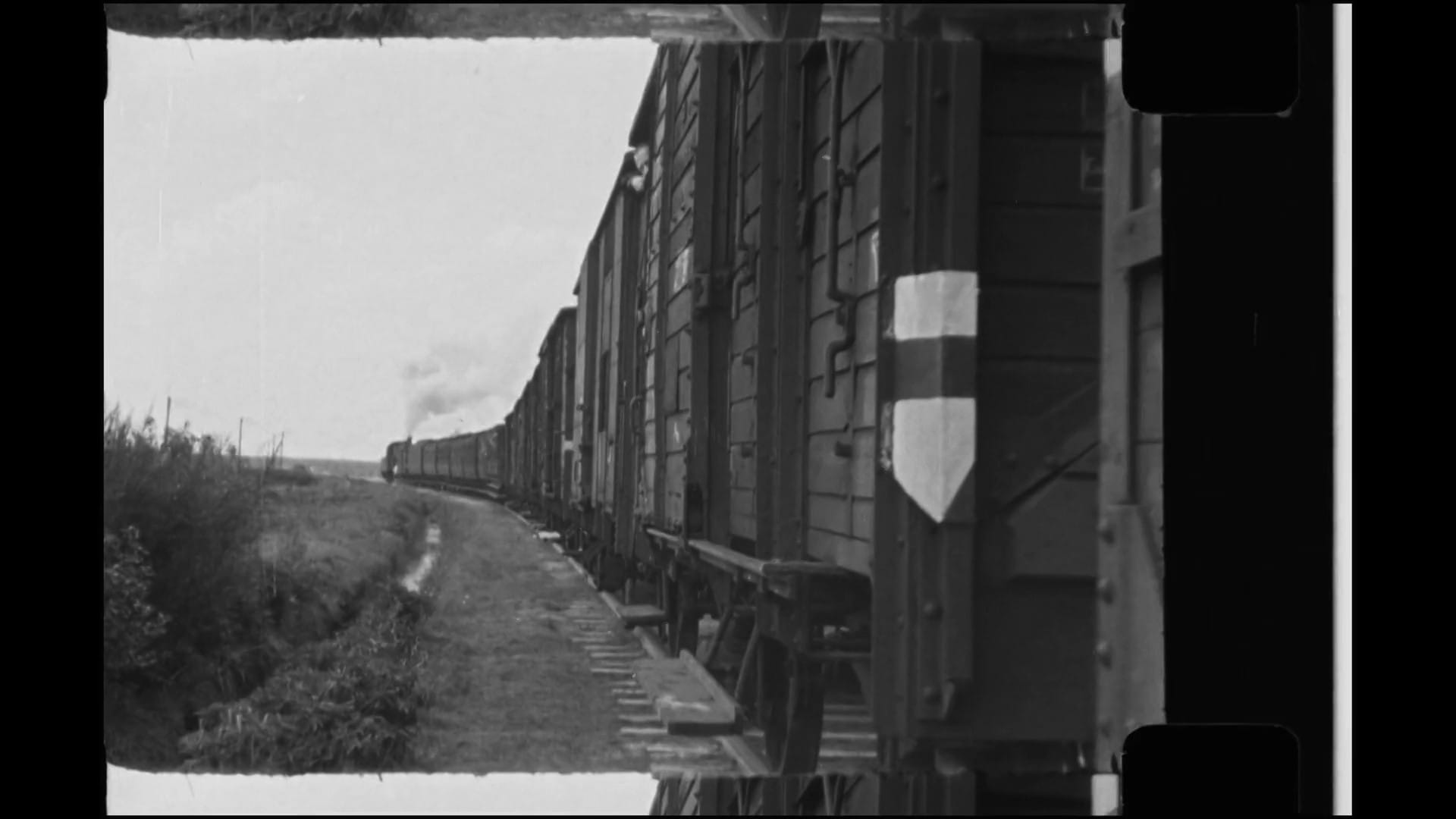
Westerbork: A Transit Camp in the Netherlands
On 8 August 1944, the eight former occupants of the Secret Annex arrived at Westerbork transit camp in the Dutch province of Drenthe.
Westerbork had originally been established by the Dutch government in 1939 to accommodate Jewish refugees from Nazi Germany.
During the German occupation, the camp became a central location in the deportation of Jews from the Netherlands.
From Westerbork, trains transported tens of thousands of people to concentration and extermination camps in occupied Poland and elsewhere.
For many prisoners, Westerbork was the last place they would see in the Netherlands.
The camp had barracks, administrative buildings, work facilities and a railway connection used for deportation transports.
Its organisation could create a misleading appearance of routine.
Prisoners were registered, assigned accommodation and given work.
But behind these administrative procedures was a system that transported people toward forced labour, imprisonment and mass murder.
The Punishment Barracks
Because Anne Frank and the others had been arrested while hiding, they were classified as prisoners who had attempted to evade deportation.
At Westerbork, they were placed in the punishment barracks.
These prisoners faced particularly harsh conditions and demanding work assignments.
Anne, Margot and their mother were assigned work that included dismantling batteries.
Such labour exposed prisoners to difficult and unhealthy conditions.
The experience represented another loss of freedom for the Frank family.
In the Secret Annex, they had lived under constant threat but remained together in a concealed household.
At Westerbork, they were surrounded by large numbers of prisoners and subject to camp regulations.
They were no longer able to control when they worked, where they slept or what would happen next.
The possibility of deportation hung over everyone.
The Deportation System from Westerbork
Deportation trains had been leaving Westerbork since July 1942.
The transports were part of the wider Nazi programme to remove Jewish populations from occupied Europe and send them to camps under German control.
Some destinations, including Auschwitz-Birkenau and Sobibor, were major centres of mass murder.
Others combined imprisonment, forced labour and lethal conditions.
The transports were organised through railway schedules, registration lists and administrative procedures.
Families received little reliable information about their destinations.
Many prisoners were told that they were being sent to labour camps.
The reality was far more dangerous.
By the time Anne Frank arrived at Westerbork, more than two years of deportations had already devastated Jewish communities throughout the Netherlands.
Thousands of families had disappeared from Amsterdam and other Dutch towns and cities.
The camp was not an isolated institution.
It was a central part of a coordinated system of persecution.
3 September 1944: The Final Transport from Westerbork to Auschwitz
On 3 September 1944, Anne Frank, her family and the four other former occupants of the Secret Annex were placed on a transport leaving Westerbork for Auschwitz.
It was the final deportation train from Westerbork to Auschwitz.
The transport carried 1,019 Jewish prisoners.
Among them were Anne and Margot Frank, their parents, the Van Pels family and Fritz Pfeffer.
The journey lasted approximately three days.
Prisoners were transported in overcrowded freight wagons under extremely difficult conditions.
There was little space, inadequate sanitation and limited access to food and water.
The uncertainty was overwhelming.
Most passengers did not know what awaited them at their destination.
For the Frank family, the journey represented the final stage of a process that had begun with exclusion from German society, continued through flight to the Netherlands and culminated in arrest and deportation.
Their attempt to find safety had failed.
Arrival at Auschwitz-Birkenau
The transport arrived at Auschwitz-Birkenau during the night of 5–6 September 1944.
Auschwitz was a complex of concentration and extermination camps established by Nazi Germany in occupied Poland.
Auschwitz I served as the original concentration camp and administrative centre.
Auschwitz II-Birkenau became the principal site of mass murder within the complex.
Auschwitz III-Monowitz and numerous subcamps were associated with forced labour.
At Birkenau, newly arrived prisoners faced selection by SS personnel.
Individuals considered capable of labour were generally separated from those selected for immediate murder.
Children, elderly people and others judged unfit for work were particularly vulnerable.
The selection process was not a legitimate medical assessment.
It was part of a system in which Nazi authorities determined whether prisoners would be exploited through forced labour or killed.
Anne, Margot and Edith Frank were selected for imprisonment and forced labour.
Otto Frank was separated from his wife and daughters.
The family would never be reunited.
The Separation of Families
Family separation was one of the most devastating features of the deportation process.
At Auschwitz-Birkenau, prisoners arriving on transports were divided according to categories imposed by the SS.
Men and women were separated.
Parents were separated from children.
Relatives could disappear from one another's sight without knowing whether they would ever meet again.
For Otto Frank, the arrival at Auschwitz marked the last time he saw his wife and daughters.
For Anne and Margot, the separation from their father added another trauma to the experiences of arrest, deportation and imprisonment.
The family had remained together throughout the years in hiding.
Now that unity was destroyed.
The separation was not an accidental consequence of wartime disruption.
It was part of the organised operation of the Nazi camp system.
Life as Prisoners in Auschwitz
After selection, Anne and Margot were imprisoned in the women's section of Auschwitz-Birkenau.
Prisoners were subjected to degrading procedures, including the removal of personal belongings, forced changes of clothing and the loss of ordinary personal identity.
Camp life was characterised by overcrowding, inadequate food, poor sanitation, disease, exhaustion and violence.
Prisoners were required to follow orders enforced by guards and camp authorities.
Roll calls could last for extended periods, sometimes in severe weather.
Work assignments were physically demanding, and the conditions offered little protection against illness.
For Anne, who had spent more than two years confined in the Secret Annex, imprisonment in Auschwitz represented a different and far more brutal form of captivity.
The restrictions of hiding had been imposed by the need to escape persecution.
The conditions in Auschwitz were deliberately maintained within a system of exploitation, terror and mass murder.
Anne was fifteen years old.
Margot was eighteen.
Their mother, Edith, was forty-four.
All three were struggling to survive in a camp where human life was systematically devalued.
The Wider Reality of Auschwitz-Birkenau
Auschwitz-Birkenau was one of the principal sites of the Holocaust.
Approximately 1.1 million people were murdered in the Auschwitz camp complex, the overwhelming majority of them Jews.
Other victims included Poles, Roma and Sinti, Soviet prisoners of war and people persecuted under various Nazi policies.
Many Jewish deportees were murdered shortly after arrival in gas chambers.
Others were selected for forced labour and faced conditions that caused widespread illness and death.
The camp complex became a central instrument of Nazi Germany's attempt to murder Europe's Jewish population.
Anne Frank's experience formed part of this much larger history.
She was one of hundreds of thousands of Jewish people deported to Auschwitz during 1944.
Her survival of the initial selection did not mean that she was safe.
Prisoners selected for labour continued to face starvation, disease, abuse and the constant threat of death.
Anne and Margot Are Transferred to Bergen-Belsen
In late October or early November 1944, Anne and Margot Frank were transferred from Auschwitz-Birkenau to Bergen-Belsen concentration camp in northern Germany.
Their mother, Edith, remained at Auschwitz.
The sisters were transported without knowing what had happened to their father or what would become of their mother.
Bergen-Belsen had developed into a concentration camp with different prisoner groups and functions during the war.
By late 1944, its conditions were deteriorating rapidly.
The arrival of prisoners transferred from other camps placed increasing pressure on already inadequate facilities.
Overcrowding, food shortages, poor sanitation and disease became severe.
The camp's population continued to increase as Nazi authorities evacuated prisoners from camps threatened by Allied advances.
For Anne and Margot, the transfer did not bring safety.
It placed them in another environment where survival was increasingly difficult.
Bergen-Belsen: Hunger, Disease and Collapse
During the final months of the war, Bergen-Belsen became a place of catastrophic suffering.
Food supplies were insufficient.
Sanitation systems were inadequate, and clean water was scarce.
Prisoners suffered from severe malnutrition, exhaustion and infectious diseases.
Typhus spread through the camp.
The number of deaths rose dramatically.
The camp authorities failed to provide the conditions necessary to protect prisoners from illness and starvation.
The suffering was intensified by the collapse of transport and supply systems as Germany approached military defeat.
Anne and Margot were among the prisoners forced to endure these conditions.
Their health deteriorated.
The exact details of their final weeks are incomplete, but survivor testimony provides important evidence about their circumstances.
Hannah Goslar and a Final Encounter
One of the most moving accounts of Anne's final months comes from Hannah Goslar, a childhood friend from Amsterdam.
Hannah had known Anne before the war.
She was also imprisoned at Bergen-Belsen, although in a different section of the camp.
During the winter of 1944–1945, Hannah learned that Anne was being held nearby.
The two girls managed to communicate across a barrier separating parts of the camp.
They could not see each other clearly, but they were able to speak.
Anne told Hannah about the terrible conditions she was experiencing.
Hannah later recalled attempting to throw a small package containing food and clothing over the barrier.
The first attempt did not succeed in reaching Anne, but Hannah managed to provide another package.
Her testimony offers a rare personal glimpse into Anne's final months.
It also demonstrates how friendship and solidarity could continue even under conditions of extreme deprivation.
The encounter did not change the wider circumstances of the camp.
But it preserved a moment of human connection in a place where prisoners were being deprived of almost everything.
The Death of Margot and Anne Frank
Margot and Anne Frank died at Bergen-Belsen in early 1945.
For many years, their deaths were commonly dated to March 1945.
Research by the Anne Frank House, published in 2015, concluded that they probably died in February 1945, although an exact date cannot be established.
Both sisters are believed to have suffered from typhus amid the camp's catastrophic conditions.
Margot died shortly before Anne, according to survivor accounts.
Anne was fifteen years old.
Margot was nineteen.
Their deaths occurred only weeks before British forces liberated Bergen-Belsen on 15 April 1945.
The sisters were among the tens of thousands of prisoners who died at Bergen-Belsen during the war.
Their bodies were not individually identified, and they have no known individual graves.
The absence of a precise death date or burial location reflects the wider destruction of records and the scale of suffering in the final months of the camp.
Edith Frank's Death at Auschwitz
While Anne and Margot were imprisoned at Bergen-Belsen, their mother remained at Auschwitz-Birkenau.
Edith Frank died there on 6 January 1945.
She was forty-four years old.
Her death occurred shortly before Soviet forces liberated Auschwitz on 27 January 1945.
Edith had survived the family's flight from Germany, the years in Amsterdam, the period of hiding and deportation.
She did not survive the final months of imprisonment.
Her story is sometimes overshadowed by the international recognition of Anne's diary.
Yet Edith Frank was also an individual whose life was destroyed by Nazi persecution.
She was a daughter, wife and mother who had attempted to protect her family through years of escalating danger.
Her death was part of the same history that claimed the lives of her daughters.
Otto Frank: The Only Survivor of the Secret Annex
Otto Frank remained imprisoned at Auschwitz after being separated from his wife and daughters.
During the final phase of the war, he became seriously ill and was unable to participate in the evacuation of prisoners as Soviet forces approached.
On 27 January 1945, Soviet troops liberated Auschwitz.
Otto survived.
He gradually recovered and began the difficult journey back toward the Netherlands.
At the time of liberation, he did not know the full fate of his family.
He hoped that Edith, Margot and Anne might also have survived.
The process of returning home was complicated by the destruction and displacement caused by the war.
Europe's transport systems were severely disrupted.
Millions of people were attempting to locate relatives, return to their countries or find new places to live.
For Holocaust survivors, liberation was often followed by months or years of uncertainty.
Otto Frank's return to Amsterdam would confront him with devastating news.
The Fate of the Other Secret Annex Occupants
Of the eight people who had lived in the Secret Annex, seven died as a consequence of Nazi persecution.
Hermann van Pels was murdered at Auschwitz in 1944.
Fritz Pfeffer was deported from Auschwitz to Neuengamme concentration camp, where he died in December 1944.
Auguste van Pels was transferred between camps and died in 1945. The precise circumstances of her death remain uncertain.
Peter van Pels was transferred to Mauthausen concentration camp and died in May 1945, shortly before or around the period of liberation.
Edith Frank died at Auschwitz in January 1945.
Margot and Anne died at Bergen-Belsen in early 1945.
Only Otto Frank survived.
The deaths of the seven occupants demonstrate the wider consequences of the Nazi deportation and concentration camp system.
The people who had shared the Secret Annex were separated and sent through different parts of that system.
Their experiences after arrest varied, but the persecution that brought them into captivity was the same.
Liberation Came Too Late
On 15 April 1945, British forces liberated Bergen-Belsen.
They discovered a camp overwhelmed by starvation, disease and mass death.
Thousands of prisoners were critically ill.
Many continued to die after liberation because of the severity of their conditions.
Emergency medical care, food distribution and sanitation measures were urgently required.
The liberation of Bergen-Belsen revealed the catastrophic consequences of Nazi imprisonment and the collapse of camp conditions during the final months of the war.
For Anne and Margot Frank, liberation came too late.
Their deaths occurred as the Nazi regime was approaching defeat.
The contrast remains one of the most painful aspects of their story.
After years of persecution, flight, hiding and imprisonment, they died only a short time before the camp was liberated.
Returning to a World Transformed
Otto Frank eventually returned to Amsterdam in June 1945.
The city was no longer the place he had known before the war.
Much of its Jewish population had been murdered.
Families had disappeared, homes had been emptied and businesses had been taken over or destroyed.
Survivors faced the difficult task of rebuilding lives amid profound loss.
Otto initially stayed with Miep and Jan Gies, who had helped his family during the years in hiding.
He learned that Edith had died at Auschwitz.
For a time, he continued hoping that Anne and Margot might have survived.
Eventually, he received confirmation that both daughters had died at Bergen-Belsen.
The news left him as the only surviving member of his immediate family.
His return was therefore not a restoration of the life he had lost.
It was the beginning of an entirely different existence shaped by grief and remembrance.
The Diary That Remained Behind
After Otto learned that Anne and Margot had died, Miep Gies gave him the writings she had preserved following the arrest.
The papers included Anne's diary and other manuscripts.
Otto began reading them.
Through the writings, he discovered aspects of his daughter's thoughts and ambitions that he had not fully understood while they were living together.
Anne had written extensively about her emotions, relationships and desire to become a published writer.
She had also begun revising her diary with the intention of turning it into a book.
Otto recognised that her work deserved to be preserved.
He eventually worked toward publication, using the surviving manuscripts to prepare a text for readers.
The diary was published in Dutch in 1947 under the title Het Achterhuis.
It would later reach an international audience.
What Anne Frank's Death Represents
Anne Frank's story is often told through the extraordinary survival of her diary.
Yet the circumstances of her death must remain central to its historical interpretation.
Anne did not die because she happened to be caught in a war.
She died after being persecuted, arrested and deported because she was Jewish.
Her experiences were shaped by the deliberate policies of Nazi Germany and the institutions that implemented those policies.
The journey from Amsterdam to Westerbork, Auschwitz-Birkenau and Bergen-Belsen illustrates the connection between persecution in occupied countries and the wider concentration and extermination camp system.
The process began with restrictions that removed rights and freedoms.
It continued through registration, isolation, arrest and deportation.
For Anne and millions of others, it ended in death.
Her diary gives her story a uniquely recognisable voice.
But the historical circumstances that destroyed her life were shared by countless Jewish children whose writings did not survive.
Remembering the Seven Who Did Not Return
The history of the Secret Annex should not be reduced to the fate of Anne Frank alone.
Eight people lived there.
Seven did not return.
Each had a life before hiding, relationships beyond the Annex and hopes for a future after the war.
Margot Frank was a gifted student whose ambitions were interrupted.
Edith Frank was a mother who attempted to protect her daughters.
Hermann and Auguste van Pels were parents seeking survival for their family.
Peter van Pels was a young man whose adulthood was taken from him.
Fritz Pfeffer was a dentist separated from the woman he loved.
Their experiences are part of the same history.
Remembering them restores individuality to people who were often reduced to numbers within the Nazi camp system.
It also reminds us that the Holocaust was not only the destruction of lives, but the destruction of relationships, families, communities and possible futures.
A Life Interrupted, a Historical Record Preserved
Anne Frank's final surviving diary entry was written on 1 August 1944.
Three days later, she was arrested.
One month later, she was deported to Auschwitz.
Within several more months, she was dead.
The speed with which these events unfolded stands in sharp contrast to the two years she had spent hoping for liberation.
Anne had imagined returning to school, continuing her education and becoming a writer.
She had begun shaping her diary into a book.
She never had the opportunity to complete it.
The preservation of her manuscripts ensured that her words survived, but it did not change the fate of the young person who wrote them.
Her story illustrates both the importance of historical testimony and the irreversible human losses caused by the Holocaust.
The next chapter broadens the perspective beyond Anne Frank and the Secret Annex.
It examines the persecution of Jews throughout the Netherlands, the destruction of communities, the experiences of other victims and survivors, and the difficult questions surrounding resistance, collaboration and responsibility.
Chapter 7 — The Holocaust in the Netherlands: Beyond Anne Frank
A History Larger Than One Diary
Anne Frank's diary has become one of the most widely recognised personal accounts of the Holocaust. Her words have introduced generations of readers to the persecution of Jews under Nazi rule, the experience of hiding and the destruction of individual lives.
Yet Anne Frank was one of approximately 140,000 Jews living in the Netherlands at the beginning of the German occupation in May 1940.
More than 100,000 Jews from the Netherlands were murdered during the Holocaust.
Among them were children who had never kept diaries, parents who had struggled to protect their families, elderly people who had lived in the same neighbourhoods for decades, and refugees who had already fled persecution elsewhere in Europe.
Many left behind photographs, letters, personal belongings or official records. Others are remembered primarily through their names and the testimony of those who survived.
Their histories reveal the extraordinary scale of the destruction that took place in a country where Jewish communities had existed for centuries.
Understanding the Holocaust in the Netherlands therefore requires looking beyond one family and one hiding place.
It requires examining how persecution spread across an entire society, how deportations were organised, how individuals and institutions responded, and what happened to those who survived.
The Jewish Population Before the German Occupation
Before the Second World War, the Netherlands was home to a diverse Jewish population.
Amsterdam contained the country's largest Jewish community, but Jewish families also lived in Rotterdam, The Hague, Utrecht, Groningen, Arnhem and numerous smaller towns.
Some families had lived in the Netherlands for generations.
Others had arrived more recently, particularly after Adolf Hitler came to power in Germany in 1933.
Jewish residents worked in many different occupations. They were teachers, doctors, lawyers, merchants, diamond workers, factory employees, artists, musicians, civil servants and business owners.
Religious practices varied considerably.
Some families observed Jewish religious traditions closely, while others were secular or participated primarily in Dutch cultural and civic life.
Their experiences were also shaped by differences in wealth, education, political beliefs and family background.
There was no single Jewish way of life in the Netherlands.
What connected these people during the occupation was the Nazi regime's decision to classify them according to racial criteria and subject them to systematic persecution.
The Holocaust transformed this diverse population into a target of state-directed exclusion, dispossession, deportation and murder.
How Persecution Became a National System
Following the German invasion in May 1940, the occupation authorities gradually introduced measures that restricted the rights of Jewish residents.
Jewish civil servants were dismissed from their positions.
Jewish-owned businesses were registered and increasingly subjected to German control.
People classified as Jewish were required to register with the authorities.
Jewish children were excluded from schools attended by non-Jewish pupils.
Public spaces, cultural institutions and recreational facilities became increasingly inaccessible.
In May 1942, Jews were ordered to wear a yellow Star of David marked with the word Jood.
These measures were not isolated acts of discrimination.
Together, they created a system through which Jewish residents could be identified, separated from the wider population and deprived of the resources necessary for independent life.
The persecution relied on German occupation authorities, but it also made use of Dutch administrative structures.
Municipal population records, identity documents, police operations and railway networks became part of the machinery through which orders could be implemented.
The Nazi regime directed the persecution, while the responses of Dutch institutions and individuals varied from active collaboration to reluctant compliance, obstruction and resistance.
The consequences for Jewish families were immediate.
Every new regulation narrowed the possibilities for work, education, movement and safety.
By the summer of 1942, the system of exclusion had developed into organised mass deportation.
Westerbork: The Gateway to Deportation
Westerbork became one of the most important locations in the history of the Holocaust in the Netherlands.
The camp had originally been established by the Dutch government in 1939 to accommodate Jewish refugees who had fled Nazi Germany.
After the German occupation, it was eventually transformed into a transit camp under Nazi control.
From July 1942 onward, deportation trains left Westerbork for concentration and extermination camps.
The destinations included Auschwitz-Birkenau, Sobibor, Bergen-Belsen and Theresienstadt.
More than 100,000 Jews were deported from the Netherlands through the Nazi transport system, the great majority via Westerbork.
For many prisoners, Westerbork was the last place they would see in the country they had considered home.
The camp contained barracks, administrative facilities and a railway connection.
Prisoners were registered, assigned accommodation and sometimes required to work.
These routines could create the appearance of an organised institution, but Westerbork's central function under Nazi rule was to facilitate deportation.
Transport lists determined who would be sent away.
Families waited under conditions of uncertainty, often without reliable information about their destinations.
Some prisoners attempted to obtain temporary exemptions or postponements.
Others tried to escape or relied on contacts who might help them avoid transport.
For most, the power to decide their future rested with the German authorities.
The Trains to Auschwitz and Sobibor
The deportation trains from the Netherlands formed part of a Europe-wide system of mass murder.
Auschwitz-Birkenau, in German-occupied Poland, became the largest Nazi concentration and extermination camp complex.
Sobibor, also in German-occupied Poland, was established primarily as a killing centre.
Between March and July 1943, more than 34,000 Jews were deported from the Netherlands to Sobibor.
Almost all were murdered.
At Auschwitz-Birkenau, many deportees were killed shortly after arrival.
Others were selected for forced labour and subjected to starvation, violence, disease and conditions that caused widespread death.
The journeys themselves were traumatic.
People were transported in overcrowded railway wagons, often with inadequate sanitation, limited water and little opportunity to care for children, elderly relatives or those who were ill.
The transports were organised through administrative procedures and railway schedules.
Behind the paperwork were individual human lives.
Every name on a transport list represented someone with a family, a history and a future that had been placed in the hands of a murderous regime.
The Destruction of Jewish Amsterdam
Amsterdam suffered an immense loss during the Holocaust.
Before the war, the city was home to a large and culturally diverse Jewish population.
Jewish life was visible in neighbourhoods, synagogues, markets, schools, businesses and social organisations.
The area around the Waterlooplein had long been associated with Jewish Amsterdam.
Other neighbourhoods, including the Rivierenbuurt, were home to established Dutch Jewish families and refugees from Germany.
During the occupation, these communities were systematically dismantled.
Jewish residents were excluded from public life, removed from their homes, arrested and deported.
The Hollandsche Schouwburg, once a theatre, became an assembly and detention site for Jews awaiting deportation.
Thousands passed through its doors.
Families were separated, and many of those detained were subsequently transported to Westerbork.
The consequences extended beyond the immediate loss of life.
Homes were emptied.
Businesses disappeared.
Religious institutions lost their congregations.
Streets that had once been filled with Jewish families became places marked by absence.
After the war, Amsterdam's Jewish community was profoundly diminished.
The destruction could be measured in population figures, but its human meaning extended far beyond statistics.
The Children Who Did Not Return
Children were among the most vulnerable victims of Nazi persecution.
Jewish children in the Netherlands experienced exclusion from schools, restrictions on movement, the loss of friendships and the growing fear surrounding their families.
Many were forced into hiding.
Others were arrested and deported with their parents.
At extermination camps, young children were particularly likely to be selected for immediate murder because the SS did not consider them capable of forced labour.
Thousands of Jewish children from the Netherlands were murdered during the Holocaust.
Some were infants.
Others were schoolchildren or teenagers whose education and personal development had been interrupted.
Anne Frank's diary preserves the thoughts of one adolescent girl.
Most Jewish children who were murdered left no comparable written record.
Their experiences are reconstructed through family photographs, school records, transport lists, survivor testimony and memorial archives.
Remembering these children means recognising the individuality behind the numbers.
They had names, friendships, interests and family relationships.
Their deaths represented not only the loss of young lives, but the destruction of possibilities that would never be realised.
Etty Hillesum: Another Voice from the Netherlands
Among the most important surviving personal writings from the Holocaust in the Netherlands are the diaries and letters of Etty Hillesum.
Born in 1914, Hillesum was a Dutch Jewish woman who lived in Amsterdam and wrote extensively during the German occupation.
Her diaries, begun in 1941, explore her emotional life, intellectual interests, relationships and spiritual reflections.
As persecution intensified, her writing increasingly addressed the suffering of Jewish people under Nazi rule.
Hillesum later worked in connection with the Jewish Council and spent periods at Westerbork.
Her letters from the camp describe the experiences of people facing deportation.
Unlike Anne Frank, who wrote while concealed from the authorities, Hillesum documented aspects of persecution from within a transit-camp environment.
Her writings provide a different perspective on the same historical catastrophe.
In September 1943, Hillesum was deported from Westerbork to Auschwitz.
She died there later that year.
She was twenty-nine years old.
Her surviving diaries and letters have become important sources for understanding the emotional and moral experiences of individuals living under persecution.
Together with Anne Frank's diary, they demonstrate the historical value of personal testimony.
Yet their voices were distinct.
Each woman wrote from her own circumstances, with her own interests, beliefs and understanding of the world.
The Hollandsche Schouwburg and the Rescue of Children
The Hollandsche Schouwburg in Amsterdam became a central location in the deportation of Jewish residents.
Across the street, a childcare facility was used for young children whose parents were detained in the theatre.
The proximity of these buildings created opportunities for a remarkable rescue operation.
Several individuals and underground networks helped children escape from the childcare facility.
Among those involved were Walter Süskind, who worked within the Jewish Council's operation at the theatre, Henriëtte Pimentel, who directed the childcare centre, and resistance workers including Johan van Hulst and members of underground groups.
Children were secretly moved away from the building and placed with families or in hiding locations elsewhere in the Netherlands.
The operation required cooperation, secrecy and considerable personal courage.
Those involved risked arrest and severe punishment.
The exact number of children saved through these networks is difficult to establish with complete certainty, but hundreds survived through these efforts.
The rescue operation demonstrates that even within institutions used for persecution, individuals sometimes found ways to resist and protect others.
It also reveals the painful limits of what could be achieved.
Many children could not be saved.
The people who organised rescues were working against a system designed to remove Jewish children from Dutch society and deport them to places where survival was unlikely.
Resistance and the Decision to Help
The Dutch resistance was not a single organisation.
It consisted of different groups and individuals whose activities developed throughout the occupation.
Some produced underground newspapers.
Others gathered intelligence, forged documents, helped people evade forced labour or organised hiding places.
Certain networks specialised in assisting Jewish children and families.
Helping people in hiding required more than providing a room.
Food had to be obtained.
False identity papers or ration cards might be needed.
Communication had to be maintained without attracting attention.
The danger extended to the people providing assistance.
A single discovery could expose an entire network.
Some helpers acted from religious conviction.
Others were motivated by political opposition to Nazism, personal friendship, moral responsibility or a refusal to accept the persecution of their neighbours.
Their motivations varied, but their actions could make the difference between survival and deportation.
The Frank family's helpers were part of this wider history of assistance.
Miep Gies, Bep Voskuijl, Johannes Kleiman, Victor Kugler and others sustained the eight people in the Secret Annex for more than two years.
Their story is well known because Anne's diary survived.
Many other rescuers and hidden families remain less widely recognised.
Corrie ten Boom and the Hiding Networks
Corrie ten Boom and her family in Haarlem became known for helping people threatened by Nazi persecution.
The ten Boom family, whose Christian faith shaped their actions, sheltered Jews and others involved in resistance activities.
Their home became part of a network of assistance.
In February 1944, German authorities raided the house.
Corrie and several family members were arrested.
Six people who were hiding in a concealed space escaped immediate discovery and were later rescued.
Corrie was eventually imprisoned at Ravensbrück concentration camp.
She survived the war.
Her sister Betsie died there in December 1944.
The ten Boom family's experience illustrates the risks faced by people who chose to help those persecuted by the Nazi regime.
It also shows how resistance could emerge from ordinary homes and family networks rather than formal military organisations.
Their story has become an important part of Dutch wartime remembrance.
Collaboration and the Role of Dutch Institutions
Alongside resistance, the history of the Netherlands under occupation includes collaboration.
Some Dutch citizens supported Nazi ideology or joined organisations aligned with the German authorities.
Others assisted the occupiers for financial gain, professional advancement or personal advantage.
Dutch police officers participated in arrests and operations that led to deportations.
Administrative officials sometimes implemented discriminatory orders.
Railway personnel and transport systems were involved in moving deportees.
The degree of responsibility differed according to the actions, authority and circumstances of those involved.
Some individuals actively sought to identify or arrest Jews.
Others carried out orders within institutions operating under occupation.
Still others attempted to obstruct policies or help people escape.
These distinctions matter historically.
However, they do not change the fact that the deportation system depended on practical cooperation at multiple levels.
The persecution of Jews in the Netherlands was directed by Nazi Germany, but its implementation occurred within Dutch society.
Understanding this history requires examining the choices made by institutions and individuals without assuming that everyone acted in the same way.
The Nederlandse Spoorwegen and Deportation Trains
The role of the Dutch railway company, Nederlandse Spoorwegen, has become an important subject of historical examination and public discussion.
During the occupation, railway services were used to transport Jewish deportees and other prisoners.
The company operated within a transport system controlled by the German occupiers and received payment for deportation-related journeys.
For decades after the war, the relationship between Dutch railway operations and the deportation system remained a painful issue.
In 2019, Nederlandse Spoorwegen introduced an individual compensation scheme for certain Holocaust survivors and surviving relatives, following renewed attention to its wartime role.
The scheme did not reverse the consequences of the deportations.
Nor could financial compensation restore the lives that had been lost.
But the acknowledgement reflected a broader effort to examine institutional responsibility.
The railway system demonstrates how mass persecution depended not only on ideological leaders and security forces, but also on ordinary infrastructure.
Trains, stations, timetables and administrative payments became part of a system that transported people toward imprisonment and murder.
Betrayal, Informants and the Vulnerability of Hiding
For Jews who attempted to escape deportation by going into hiding, secrecy was essential.
Some hiding places were discovered through informants.
Others were exposed through police investigations, chance encounters, surveillance or the actions of people who suspected that Jews were being concealed.
The fear of betrayal shaped daily life.
Families often avoided contact with neighbours and acquaintances.
Helpers had to decide whom they could trust.
Even small mistakes could have serious consequences.
Financial incentives sometimes encouraged people to identify Jews in hiding.
Some individuals deliberately assisted the German authorities in locating and arresting Jewish residents.
Others provided information under pressure or through circumstances that remain difficult to reconstruct.
The discovery of the Secret Annex remains one of the best-known unresolved cases.
Although numerous theories have been proposed, no individual has been conclusively established as responsible for the arrest of Anne Frank and the seven other occupants.
This uncertainty should not be used to make unsupported accusations.
The historical evidence is sufficient to establish the responsibility of the Nazi occupation authorities for the arrest and deportation, even where the precise circumstances of discovery remain unknown.
The Difficulty of Finding Safety
Hiding was not equally available to all Jewish residents.
A family needed access to a suitable location and people willing to provide assistance.
They also needed food, money, clothing and ways to avoid official detection.
Children sometimes had to be separated from their parents and placed with non-Jewish families.
Some survived under false identities.
Others moved repeatedly between hiding places.
For elderly people, those with disabilities or families with very young children, concealment could be especially difficult.
The danger increased when supplies became scarce or when helpers were arrested.
The ability to hide was also affected by geography and personal connections.
People with trusted networks might have more opportunities than those who were isolated.
Yet even carefully organised hiding arrangements could fail.
Anne Frank's experience demonstrates both the possibilities and the limitations of concealment.
Her family survived in hiding for more than two years.
They were nevertheless discovered and deported.
The Hunger Winter and the Final Months of Occupation
During the winter of 1944–1945, severe food shortages affected large parts of the western Netherlands.
The period became known as the Hunger Winter.
Military operations, transport disruptions, German restrictions and other wartime conditions contributed to a catastrophic decline in food availability.
Thousands of civilians died from hunger and related causes.
For people still living in hiding, obtaining food became even more difficult.
Helpers faced growing shortages and increased risks when trying to acquire supplies.
The final months of the occupation were therefore especially dangerous.
Although Allied forces had liberated parts of the southern Netherlands in 1944, much of the country remained under German control until May 1945.
The suffering of Jewish survivors and people in hiding continued amid the wider humanitarian crisis.
Liberation eventually brought an end to German occupation, but it could not undo the destruction already inflicted on Jewish communities.
Liberation and the Absence of Families
The Netherlands was liberated in stages during 1944 and 1945, with German forces in the country surrendering in May 1945.
For many Dutch citizens, liberation brought relief, celebration and the possibility of rebuilding ordinary life.
For Jewish survivors, the experience was often profoundly different.
Those who returned from concentration camps or emerged from hiding frequently discovered that their relatives had been murdered.
Homes had been occupied by others.
Businesses had disappeared or changed ownership.
Personal belongings had been confiscated, sold or destroyed.
Communities that had existed before the war were no longer intact.
The return of a survivor could therefore be accompanied by the realisation that almost everyone they had known was gone.
Liberation ended Nazi rule, but it did not end grief, displacement or the struggle to recover what had been lost.
The Challenges of Returning Home
Jewish survivors returning to the Netherlands faced significant practical and emotional difficulties.
Some had no surviving relatives.
Others had lost their homes, employment and financial resources.
Recovering property could involve complicated legal and administrative procedures.
In certain cases, survivors encountered demands for unpaid taxes, municipal charges or other financial obligations associated with property from which they had been forcibly removed.
The treatment of returning survivors has since become an important subject of historical research and public acknowledgement.
The difficulties revealed that the end of occupation did not automatically restore justice.
Survivors had to navigate institutions that had continued operating during the war and were now attempting to return to normal administration.
For people who had endured persecution, imprisonment or hiding, these obstacles could deepen the sense of abandonment.
The process of rebuilding Jewish life required more than reopening buildings or restoring legal rights.
It required confronting the consequences of mass murder and the failures of institutions that had not adequately protected Jewish citizens.
Children Who Survived in Hiding
The liberation also created difficult questions for Jewish children who had survived with foster families or in hiding.
Some had been separated from their parents at very young ages.
They might have lived for years under different names or religious identities.
In many cases, their parents had been murdered.
Questions arose about guardianship, religious upbringing and whether children should remain with the families who had sheltered them.
These decisions could be emotionally painful.
Some foster families had developed deep bonds with the children in their care.
Surviving relatives and Jewish organisations sought to restore connections to the children's families and communities.
The resulting disputes reflected the long-term consequences of persecution.
Even when a child's life had been saved, the destruction of their original family could create lasting uncertainty about identity and belonging.
Survival did not mean that the effects of the Holocaust had ended.
The Destruction of Jewish Communities
The Holocaust permanently changed the demographic and cultural landscape of the Netherlands.
Many smaller Jewish communities were devastated.
Synagogues lost their congregations.
Jewish schools, cultural organisations and businesses disappeared.
In some towns, few Jewish residents returned after the war.
Amsterdam remained an important centre of Jewish life, but its prewar community had been profoundly reduced.
The destruction affected religious traditions, family networks, languages, professions and local history.
It also created gaps in collective memory.
Entire generations had been murdered.
Children who might have continued family traditions never reached adulthood.
Parents and grandparents who carried memories of earlier community life were gone.
The losses extended beyond the Jewish population itself.
Dutch society had lost neighbours, colleagues, artists, teachers, entrepreneurs and citizens who had contributed to its development.
The Holocaust was therefore both a specifically Jewish catastrophe and a profound rupture in the history of the Netherlands.
Rebuilding Jewish Life After 1945
Despite the devastation, Jewish life in the Netherlands did not disappear.
Survivors rebuilt families, congregations, cultural institutions and community organisations.
Some chose to remain in the Netherlands.
Others emigrated, including to Israel, the United States and other countries.
Their decisions reflected personal circumstances, family connections, economic opportunities and the desire to begin again after persecution.
Religious and cultural life gradually resumed.
Synagogues reopened where communities could sustain them.
Jewish organisations supported survivors, preserved historical records and helped maintain traditions.
New generations grew up in families shaped by the memory of the Holocaust.
For many, remembrance became an essential part of identity.
Yet Jewish life after 1945 cannot be understood only through loss.
It also includes renewal, cultural expression, education and the continuing contributions of Jewish citizens to Dutch society.
Recognising this continuity is important.
The Holocaust devastated Jewish communities, but it did not define the entirety of Jewish history or identity in the Netherlands.
Names, Records and the Work of Remembrance
Historical institutions have undertaken extensive efforts to document the Jews who were persecuted and murdered during the Holocaust.
The Jewish Monument in the Netherlands preserves information about victims, including names, dates, family relationships and places associated with their lives.
Archives such as those maintained by NIOD, the National Archives of the Netherlands, the Arolsen Archives and international Holocaust research institutions provide additional documentation.
Transport lists, municipal records, photographs, letters and survivor testimony help reconstruct individual histories.
These records serve several purposes.
They support historical research.
They provide families with information about relatives.
They also challenge the anonymity imposed by the Nazi persecution system.
A person recorded on a deportation list was not simply a number.
They had a name, a home, relationships and a life before arrest.
Documenting those details is part of restoring individuality to victims whose identities the Nazi regime attempted to erase.
The National Holocaust Names Memorial
In September 2021, the National Holocaust Names Memorial was unveiled in Amsterdam.
Designed by architect Daniel Libeskind, the memorial commemorates more than 102,000 Jews, Roma and Sinti who were persecuted from the Netherlands and murdered during the Holocaust and who have no known graves.
Their names are inscribed on individual bricks.
The memorial makes the scale of the destruction visible through the accumulation of individual names.
Each inscription represents a person whose life was taken.
Visitors encounter not only a historical event, but a record of human loss.
The memorial also reflects the continuing importance of remembrance in Dutch society.
More than seventy-five years after the end of the Second World War, the work of identifying, documenting and commemorating victims remains essential.
The passage of time does not diminish the historical significance of their lives.
The Responsibility of Historical Understanding
The Holocaust in the Netherlands raises questions that extend beyond the history of one country.
How can discriminatory policies become embedded in ordinary administrative systems?
What happens when institutions follow unjust orders?
Why do some individuals cooperate with persecution while others resist?
How can societies confront the actions of their own institutions after a period of occupation and mass violence?
These questions require careful historical analysis.
They should not be answered through simplistic assumptions that all people behaved alike or that the outcomes were inevitable.
The Nazi regime created and directed the system of persecution and genocide.
Within occupied Dutch society, individuals and institutions made decisions under different conditions and with different degrees of power.
Some decisions contributed directly to the persecution.
Others helped save lives.
Understanding those distinctions is essential to an accurate account of responsibility.
Beyond Anne Frank
Anne Frank's diary remains one of the most powerful personal documents associated with the Holocaust.
Its survival allows readers to encounter the thoughts of a young girl whose life was destroyed by Nazi persecution.
But her story was not unique in its suffering.
Across the Netherlands, Jewish families experienced the same escalating restrictions, fear of arrest, separation and deportation.
Many were murdered in Auschwitz, Sobibor and other Nazi camps.
Others survived in hiding, through resistance networks or after imprisonment.
Their experiences differed, but together they form the history of the Holocaust in the Netherlands.
Anne's diary provides an entrance into that history.
It should not become its boundary.
Remembering Anne Frank also means remembering the children whose diaries were never found, the parents who never returned, the communities that were destroyed and the survivors who spent the rest of their lives carrying the consequences.
The Holocaust was not the tragedy of one famous family.
It was the systematic persecution and murder of an entire population targeted by Nazi racial ideology.
Its history is preserved through personal testimony, official documentation, historical research and the work of remembrance.
The next chapter returns to Otto Frank, the only survivor of the eight people who lived in the Secret Annex.
It examines his return to Amsterdam, the discovery of Anne's writings, the publication of her diary in 1947 and the decisions that transformed a private manuscript into an internationally recognised work of historical testimony.
Chapter 8 — Otto Frank and the Publication of Anne's Diary
The Father Who Returned Alone
When Soviet forces liberated Auschwitz on 27 January 1945, Otto Frank was among the surviving prisoners.
He was fifty-five years old.
For more than two years, Otto had lived in hiding with his wife, Edith, and their daughters, Margot and Anne. After their arrest in August 1944, the family had been deported from the Netherlands to Auschwitz-Birkenau.
At the camp, Otto was separated from his wife and daughters.
He would never see them again.
By the time Auschwitz was liberated, Otto had endured imprisonment, illness and the uncertainty of not knowing what had happened to his family.
He had survived the Nazi concentration camp system, but survival did not mean that his suffering had ended.
Across Europe, millions of people were displaced, transport networks had been destroyed and information about missing relatives was often incomplete or unavailable.
For Holocaust survivors, liberation frequently marked the beginning of a painful search.
Otto Frank faced that search without knowing whether Edith, Margot or Anne were still alive.
His journey back to Amsterdam would take several months.
The Liberation of Auschwitz
During January 1945, Soviet forces advanced through German-occupied Poland.
As the Red Army approached Auschwitz, the SS began evacuating tens of thousands of prisoners.
Many were forced onto marches in freezing conditions, with inadequate food and clothing. Thousands died during these evacuations.
Otto Frank was seriously ill and remained behind at Auschwitz.
On 27 January 1945, Soviet troops entered the camp complex and liberated approximately 7,000 surviving prisoners.
They encountered people weakened by starvation, disease and prolonged imprisonment.
The liberation exposed further evidence of the crimes committed at Auschwitz, including abandoned prisoners, personal belongings taken from deportees and the physical remains of the camp's machinery of persecution.
For Otto, liberation meant that he was no longer under the control of the SS.
But he still faced a difficult recovery.
His physical condition had been severely weakened, and he had little reliable information about the whereabouts of his family.
The war in Europe would continue for several more months.
The Long Journey Back to Amsterdam
Otto Frank could not immediately return to the Netherlands.
The military situation and destruction of transport infrastructure made travel across Europe extremely difficult.
He travelled through the Soviet Union and eventually reached Odessa, a port city on the Black Sea.
From there, he continued his journey by ship and through Western Europe.
During this period, Otto encountered other survivors and attempted to gather information about people who had been deported.
The uncertainty surrounding his family remained a central concern.
He learned that Edith had died at Auschwitz on 6 January 1945.
The news was devastating.
Yet he continued hoping that Margot and Anne might have survived.
The sisters had been transferred from Auschwitz to Bergen-Belsen in late 1944.
Otto did not initially know what had happened to them after that transfer.
On 3 June 1945, he returned to Amsterdam.
The city was familiar, but the world he had known there had been profoundly changed.
A City Marked by Absence
Amsterdam had been liberated in May 1945.
For many residents, the end of German occupation brought public celebrations and the possibility of rebuilding ordinary life.
For Jewish survivors, returning home often meant confronting an almost unimaginable absence.
Families had been murdered.
Homes had been occupied by others.
Businesses had disappeared or been transferred under discriminatory occupation policies.
Jewish neighbourhoods that had once been filled with community life were devastated.
Otto Frank returned to a city where much of the Jewish population had been deported and murdered.
The apartment at Merwedeplein, where his family had lived before going into hiding, could not simply become the home it had once been.
The business premises at Prinsengracht 263 still existed, but the people who had shared the Secret Annex were gone.
Otto's return was therefore not a return to his former life.
It was the beginning of an uncertain future shaped by loss.
The People Who Welcomed Him Home
After returning to Amsterdam, Otto stayed with Miep and Jan Gies.
Both had helped the Frank family during the years in hiding.
Miep had worked in Otto's business and was one of the people responsible for obtaining food, supplies and information for the occupants of the Secret Annex.
Jan had also supported the family and participated in resistance-related activities.
Their assistance had continued despite the dangers of German occupation.
For Otto, their home offered a place of support at a time when he was physically recovering and searching for information about his daughters.
Other former colleagues and helpers, including Bep Voskuijl, Johannes Kleiman and Victor Kugler, had also survived the war.
These relationships connected Otto to the people who had known his family before their arrest.
They could not restore what had been lost.
But they provided practical and emotional support during the difficult months after liberation.
Searching for Margot and Anne
Otto continued trying to discover what had happened to his daughters.
The search for missing relatives was a common experience among Holocaust survivors.
Information was often passed through personal contacts, relief organisations, returning prisoners and lists of survivors.
Records were incomplete, and many people had died without individual death certificates or identified graves.
For Otto, the uncertainty was especially painful.
He knew that Anne and Margot had been transferred to Bergen-Belsen, but he initially had no definitive information about their fate.
Eventually, he learned from survivors that both girls had died there.
The exact dates of their deaths remain unknown.
Research by the Anne Frank House indicates that they probably died in February 1945.
Anne was fifteen years old.
Margot was nineteen.
The news confirmed that Otto was the only surviving member of his immediate family.
He had lost his wife and both daughters.
Of the eight people who had hidden in the Secret Annex, he was the only one to return.
The Manuscripts Miep Gies Had Preserved
After the arrest on 4 August 1944, the Secret Annex was left in disorder.
The German authorities had taken the occupants away.
Their personal belongings and papers remained behind.
Miep Gies and Bep Voskuijl entered the hiding place and collected Anne's writings, which had been left scattered among other possessions.
Miep kept the papers in a drawer, intending to return them to Anne when she came back.
She did not read the diary.
Her decision was rooted in the hope that Anne would survive.
When Otto learned that his daughters had died, Miep gave him the manuscripts.
They included Anne's original diary writings and material she had revised while in hiding.
For Otto, the papers represented an extraordinary connection to his daughter.
He knew that Anne had enjoyed writing.
But he had not fully understood the depth of her reflections or the seriousness of her literary ambitions.
The manuscripts revealed aspects of her inner life that she had not always shared openly with her family.
Discovering Anne's Voice
Reading Anne's writings was an emotional experience for Otto.
The diary contained descriptions of life in the Secret Annex, but it also revealed Anne's thoughts about identity, relationships, adolescence and the future.
She had written about her desire to become a journalist or professional writer.
She had reflected on her personality, her family relationships and the difficulty of expressing her deeper feelings.
Her observations were often perceptive and sometimes critical.
Otto encountered a daughter who had been developing intellectually and emotionally during the years of hiding.
He also discovered that Anne had begun rewriting her diary with publication in mind.
In March 1944, she had heard a radio broadcast by Dutch government minister Gerrit Bolkestein encouraging people to preserve documents about their experiences during the occupation.
Inspired by the broadcast, Anne had started preparing a revised version of her diary.
She hoped that her account of life in hiding might eventually become a book.
Her proposed title was Het Achterhuis.
Otto now held the unfinished literary project of a daughter who would never have the opportunity to complete it.
From Private Writing to a Published Book
Otto did not immediately publish the diary.
At first, he shared portions of Anne's writing with relatives and trusted acquaintances.
Their responses encouraged him to consider a wider audience.
The manuscripts had both personal and historical significance.
They documented life in hiding under Nazi occupation while preserving the distinctive perspective of a young Jewish girl.
However, preparing the diary for publication was not straightforward.
Anne had left behind different versions of her writing.
Some original entries survived in notebooks and loose sheets.
She had also created a revised manuscript in which she reorganised and rewrote material for a possible future book.
Otto worked with these surviving texts to prepare a publishable version.
He made editorial decisions about which passages to include and how the material should be presented.
These decisions would later become an important part of scholarly research into the diary's publication history.
The Different Manuscript Versions
Researchers generally distinguish three principal textual versions associated with Anne Frank's diary.
Version A refers to Anne's original diary writings.
Version B refers to the revised manuscript she began preparing in 1944, after deciding that her experiences might form the basis of a published book.
Version C refers to the text Otto Frank compiled after the war, drawing from the surviving manuscripts.
The distinctions are important because Anne herself had already begun editing her work.
She was not simply writing a private diary without considering its literary possibilities.
By 1944, she was actively revising passages, developing descriptions and shaping her experiences into a narrative.
Otto's later editorial work built upon this process.
The first published edition did not include every passage found in the surviving manuscripts.
Some material concerning personal relationships, sexuality and family tensions was omitted.
Later scholarly editions made more of the surviving text available, allowing readers and researchers to compare the versions.
These differences are part of the documented history of the manuscript.
They do not undermine its authenticity.
Finding a Publisher
Finding a publisher for Anne's diary initially proved difficult.
Although the war had ended, Dutch society was still recovering from occupation, destruction and severe economic disruption.
Publishing conditions were challenging.
A manuscript written by a teenage girl about life in hiding did not immediately appear to every publisher as a commercially viable project.
An important turning point came when historian Jan Romein read the diary.
He recognised its historical and literary significance.
On 3 April 1946, Romein published an article in the Dutch newspaper Het Parool drawing attention to Anne's writing.
The article helped bring the manuscript to the attention of a wider audience.
It also encouraged interest from publishers.
The Amsterdam publishing house Contact eventually agreed to publish the diary.
For Otto, the decision represented an opportunity to fulfil Anne's ambition of becoming a published writer.
1947: The Publication of Het Achterhuis
On 25 June 1947, Anne Frank's diary was published in the Netherlands under the title Het Achterhuis.
The title refers to the rear section of the building where Anne and seven others had hidden.
The first edition was published by Contact in Amsterdam.
Its initial print run was relatively modest.
At the time, no one could know that the book would eventually become one of the most widely read personal accounts of the Holocaust.
The publication transformed Anne's private writing into a work available to readers beyond her family and friends.
For the first time, people who had never known Anne could encounter her observations about life in hiding.
They could read about the practical difficulties of confinement, her relationships with the other occupants and her developing ambitions.
The book also introduced readers to the experience of persecution through the voice of someone who had lived through it.
Anne did not survive to witness this moment.
Her father had helped bring her unfinished literary project into the world.
The Early Reception of the Diary
The first Dutch readers encountered Anne's diary during a period when the Netherlands was still confronting the consequences of the war.
Many families were grieving.
Survivors were attempting to rebuild their lives.
The full scale of Nazi persecution and mass murder was becoming increasingly documented, although public understanding and discussion continued to develop over subsequent decades.
Anne's writing offered a deeply personal perspective.
Rather than presenting a broad political or military history, it described the experiences of a family attempting to survive under occupation.
Readers encountered Anne as a teenager with humour, opinions, frustrations and hopes.
This individuality became one of the diary's defining qualities.
The book made the consequences of persecution accessible through the experiences of a recognisable person.
Yet its significance was not limited to emotional identification.
It also provided a historical record of life in hiding and the restrictions imposed on Jews in occupied Netherlands.
Translation and International Publication
During the following years, Anne's diary attracted interest beyond the Netherlands.
Translations began appearing in other languages.
French and German editions were published in 1950.
An English-language edition followed in 1952 under the title Anne Frank: The Diary of a Young Girl.
The American edition included an introduction by Eleanor Roosevelt.
Publication in English greatly expanded the diary's international readership.
Readers in countries far removed from the Netherlands could now encounter Anne's account.
The book became particularly influential in schools, libraries and educational institutions.
Its accessibility helped introduce younger generations to the history of Nazi persecution.
Over time, the diary was translated into many dozens of languages and reached millions of readers.
Its international success also brought new questions about how Anne's story should be interpreted and presented.
From Diary to Stage and Screen
The international recognition of Anne Frank's diary led to adaptations for theatre and film.
In 1955, a stage adaptation by Frances Goodrich and Albert Hackett premiered on Broadway.
The production brought the experiences of the Secret Annex to audiences who might not have read the book.
It received major theatrical recognition and contributed to the growing international awareness of Anne's story.
In 1959, a film adaptation directed by George Stevens was released.
These adaptations introduced the diary to wider audiences, but they also involved artistic choices.
A stage production or film cannot reproduce every aspect of a complex historical manuscript.
Scenes may be shortened, dialogue adapted and themes emphasised differently.
Some adaptations placed particular attention on Anne's optimism and the emotional relationships within the hiding place.
While these interpretations helped popularise her story, historians and educators have also questioned whether certain adaptations sufficiently conveyed the specifically Jewish nature of Anne's persecution and the circumstances of her death.
Understanding the difference between Anne's own writings and later dramatic interpretations is essential.
The diary remains the primary source.
Adaptations are interpretations of that source.
Otto Frank and the Responsibility of Remembrance
As the diary became internationally known, Otto Frank increasingly devoted his life to preserving Anne's memory and promoting the educational significance of her writing.
He corresponded with readers, supported historical research and participated in efforts to preserve the building where the family had hidden.
His work was shaped by profound personal loss.
He had survived the Holocaust while his wife and daughters had been murdered.
The diary gave him a way to share Anne's voice with others, but it could not restore the family he had lost.
Otto approached remembrance as a responsibility extending beyond his own experience.
He believed Anne's writings could encourage reflection on prejudice, discrimination and the treatment of others.
At the same time, the historical context of the diary remained essential.
Anne had been persecuted and murdered because she was Jewish.
Her story could speak to universal human concerns, but it could not be separated from the Holocaust.
The Preservation of the Secret Annex
After the war, the building at Prinsengracht 263 continued to be used for business purposes.
Over time, redevelopment plans threatened its future.
As international interest in Anne Frank's story grew, efforts began to preserve the location where she had lived in hiding.
Otto Frank supported these initiatives.
In 1957, the Anne Frank House Foundation was established.
Its purpose included preserving the building and promoting the educational significance of Anne's life and writings.
On 3 May 1960, the Anne Frank House opened to the public as a museum.
The Secret Annex became a place where visitors could encounter the physical environment described in the diary.
The rooms were largely left unfurnished, reflecting Otto Frank's wish to preserve the sense of emptiness left by the people who had not returned.
The museum developed into an internationally recognised institution dedicated to Anne Frank's history, Holocaust education and the examination of antisemitism and discrimination.
Its work continues to connect the personal story of the Frank family with the wider history of persecution in the Netherlands.
The Diary's Authenticity and Historical Research
As Anne Frank's diary became internationally influential, it also became a target of false claims and Holocaust denial.
Some individuals alleged that the diary had been fabricated or written after the war.
These accusations have been thoroughly discredited.
The surviving manuscripts have been examined through historical, handwriting and forensic research.
The Netherlands Institute for War Documentation, now NIOD, conducted extensive investigations into the diary's authenticity.
Researchers examined the paper, ink, handwriting and manuscript history.
Their findings confirmed that the surviving diary texts were written by Anne Frank.
The existence of different manuscript versions and later editorial decisions has sometimes been deliberately misrepresented.
However, Anne's original writing, her own revisions and Otto's publication text are historically documented.
The differences between them are not evidence of fabrication.
They are evidence of a manuscript that developed through writing, revision and postwar publication.
The authenticity of Anne Frank's diary is supported by substantial historical evidence.
The Challenge of Representing Anne Frank
As Anne's story reached a global audience, she became an international symbol of the Holocaust.
Her image appeared in books, exhibitions, educational materials and memorial projects.
For many readers, she became the first individual victim of Nazi persecution whose thoughts they encountered in detail.
This recognition has helped preserve her memory.
However, it has also created challenges.
Anne Frank is sometimes presented primarily as a symbol of hope, courage or the innocence of childhood.
These themes are present in interpretations of her diary, but they do not encompass the full historical reality.
Anne experienced fear, anger, frustration and uncertainty.
She was also an ambitious writer who carefully revised her work.
Most importantly, she was a Jewish girl whose life was destroyed by Nazi persecution.
Remembering her only through an inspirational message risks overlooking the political and historical circumstances that led to her death.
A responsible interpretation must preserve both her individuality and the wider context of the Holocaust.
Otto Frank's Later Life
Otto Frank continued working to preserve Anne's memory for the remainder of his life.
In 1953, he married Elfriede Geiringer, a Holocaust survivor who had also lost family members during the war.
They eventually settled in Switzerland.
Otto remained closely connected to the Anne Frank House and to the international publication of his daughter's diary.
He answered letters, participated in educational initiatives and supported efforts to challenge antisemitism and prejudice.
His work helped establish the diary as a lasting part of Holocaust remembrance.
Otto Frank died on 19 August 1980 in Basel, Switzerland.
He was ninety-one years old.
He had spent more than three decades ensuring that Anne's writings would not be forgotten.
The Survival of a Manuscript
The survival of Anne Frank's diary was the result of several extraordinary circumstances.
Anne had written extensively while in hiding.
She had preserved her observations in notebooks and loose sheets.
She had begun revising her work for possible publication.
After the arrest, Miep Gies and Bep Voskuijl collected the manuscripts rather than allowing them to disappear.
Miep kept the papers safe.
Otto Frank survived Auschwitz and returned to Amsterdam.
He recognised the importance of his daughter's writing and worked to have it published.
Each of these events contributed to the preservation of Anne's voice.
Had the papers been destroyed, lost or discarded, the world might never have known her writing.
Had Otto not survived, the publication history could have been very different.
The diary's survival was therefore not inevitable.
It depended on individual decisions made during and after the war.
A Personal Record Becomes a Historical Legacy
Anne Frank never lived to see her diary published.
She did not know that her words would eventually reach readers across continents and generations.
She had hoped to become a writer.
That ambition was realised only after her death.
The publication of Het Achterhuis in 1947 transformed a private manuscript into an internationally recognised work of testimony.
It allowed readers to encounter the thoughts of a young person whose life had been interrupted by persecution.
But the diary's significance extends beyond its publication history.
It reminds us that historical events are experienced by individuals whose lives cannot be reduced to dates, statistics or political decisions.
Anne's writing preserves the complexity of one young person's identity.
She was a daughter, sister, friend, student and aspiring author.
She was also a Jewish victim of the Holocaust.
The diary connects these realities.
Its survival allows readers to understand something of the life that Nazi persecution attempted to destroy.
The Responsibility of Preserving Her Words
The international recognition of Anne Frank's diary carries an enduring responsibility.
Her words must be presented accurately.
Her life must be understood within the history of the Holocaust.
The experiences of the seven other occupants of the Secret Annex must not be forgotten.
Nor should the diary overshadow the countless Jewish victims whose writings did not survive.
Historical remembrance requires more than repeating familiar stories.
It involves examining original sources, recognising uncertainty where evidence is incomplete and resisting attempts to distort or deny documented crimes.
Otto Frank's decision to publish his daughter's diary helped preserve an individual voice within a history of mass murder.
The work of remembrance did not end with publication.
It continues through museums, archives, schools, research institutions and readers who seek to understand the events that shaped Anne's life.
The next chapter examines the Anne Frank House as a place of historical preservation and education.
It explores how the Secret Annex became a museum, how the original manuscripts are protected and how historical institutions work to ensure that Anne Frank's story remains connected to the broader history of Jewish persecution in the Netherlands.
Chapter 9 — The Anne Frank House and the Preservation of Memory
A Building That Became a Place of Remembrance
At Prinsengracht 263 in Amsterdam stands one of the most internationally recognised historical sites associated with the Holocaust.
From the street, the building resembles many other canal houses in the Dutch capital.
Yet behind its walls, eight Jewish people lived in hiding for more than two years during the German occupation of the Netherlands.
Among them was Anne Frank, whose diary would later become one of the world's most widely read personal accounts of Nazi persecution.
The building is now known as the Anne Frank House.
Every year, visitors from around the world enter the former business premises and pass through the concealed entrance leading to the Secret Annex.
They encounter the physical environment in which Anne wrote about her daily experiences, her relationships and her hopes for the future.
The museum is more than a preserved hiding place.
It is a historical institution dedicated to documenting Anne Frank's life, explaining the persecution of Jews during the Second World War and encouraging reflection on antisemitism, discrimination and human rights.
Its existence reflects decades of work to protect the building, preserve original materials and communicate history accurately.
Prinsengracht 263 Before the War
The building at Prinsengracht 263 was not originally intended to become a memorial.
It was a commercial property in central Amsterdam.
Before the Frank family entered hiding, Otto Frank used the premises for businesses associated with products including pectin, spices and other ingredients.
The building contained offices, warehouse areas and storage facilities.
Behind the main building stood a rear section connected to the front premises.
This architectural arrangement eventually made concealment possible.
The rear building was not readily visible from the street.
It contained rooms that could be adapted into a hidden living space.
As Nazi restrictions against Jews intensified, Otto Frank and trusted colleagues began preparing the location as a possible refuge.
On 6 July 1942, Otto, Edith, Margot and Anne Frank entered hiding.
The Van Pels family joined them one week later.
Fritz Pfeffer arrived in November 1942.
The eight occupants remained concealed until their arrest on 4 August 1944.
During that period, the building served two purposes.
In the front section, employees continued their business activities.
Behind the concealed entrance, eight people attempted to survive persecution without being discovered.
The Secret Annex After the Arrest
Following the arrest of the eight occupants, the hiding place was left behind.
The German authorities removed valuables and personal belongings.
Furniture and other contents were eventually taken away.
The rooms that had been crowded with beds, tables, household items and the possessions of eight people became largely empty.
Anne's diary and other writings survived because Miep Gies and Bep Voskuijl collected them after the arrest.
The building itself remained standing.
After the war, Otto Frank returned to Amsterdam as the only survivor of the eight people who had hidden there.
He resumed contact with former colleagues and helpers.
For him, Prinsengracht 263 was inseparable from the memory of his wife, daughters and the other occupants.
The building had protected them for more than two years.
It was also the place where their attempt to escape Nazi persecution had ended.
Its preservation would eventually become an important part of Anne Frank's legacy.
The Threat of Demolition
During the years following the Second World War, the building at Prinsengracht 263 faced an uncertain future.
Amsterdam was rebuilding and modernising.
Older buildings were frequently considered for redevelopment, and the former business premises were not initially protected as a major historical monument.
By the 1950s, plans for demolition threatened the site.
The possibility that the Secret Annex could disappear prompted growing concern.
Anne Frank's diary had already attracted readers in the Netherlands and abroad.
As the book became more widely known, public interest in the location where it had been written increased.
Journalists, supporters and concerned citizens began advocating for the building's preservation.
The campaign reflected a developing recognition that the physical setting of Anne's diary had historical significance.
The rooms were not simply the background to a published book.
They were part of the evidence of what the occupants had experienced.
Preserving them would allow future generations to encounter a tangible connection to the history of persecution and hiding.
The Establishment of the Anne Frank House Foundation
On 3 May 1957, the Anne Frank House Foundation was established.
Otto Frank was closely involved in the initiative.
The foundation was created to help preserve the building and develop its educational purpose.
Its establishment marked a turning point.
The former commercial property was gradually being transformed into a place of historical remembrance.
The project required financial support, restoration work and decisions about how the building should be presented to visitors.
Preserving a site associated with the Holocaust also raised difficult questions.
Should the rooms be reconstructed as they had appeared during the war?
Should objects be replaced to recreate everyday life in hiding?
Or should the absence of the original occupants remain visible?
Otto Frank had a strong view about the meaning of the empty rooms.
His preference would become one of the museum's defining features.
Why Otto Frank Wanted the Rooms to Remain Empty
When visitors enter the Secret Annex today, they do not encounter a fully furnished reconstruction of the hiding place.
The rooms remain largely empty.
This was a deliberate decision associated with Otto Frank's wishes.
After the arrest, the original furniture and many personal belongings had been removed.
Otto believed that the emptiness itself carried meaning.
It represented the absence of the people who had lived there and had not returned.
The rooms therefore communicate history partly through what is missing.
Visitors can see the limited space available to eight occupants.
They can observe the arrangement of the rooms and the narrow passages connecting them.
But they cannot see the people who once lived there or the ordinary household activities that filled their days.
The absence becomes part of the memorial experience.
The empty rooms do not attempt to recreate every detail of life in hiding.
Instead, they invite visitors to consider the lives that were interrupted and the consequences of persecution.
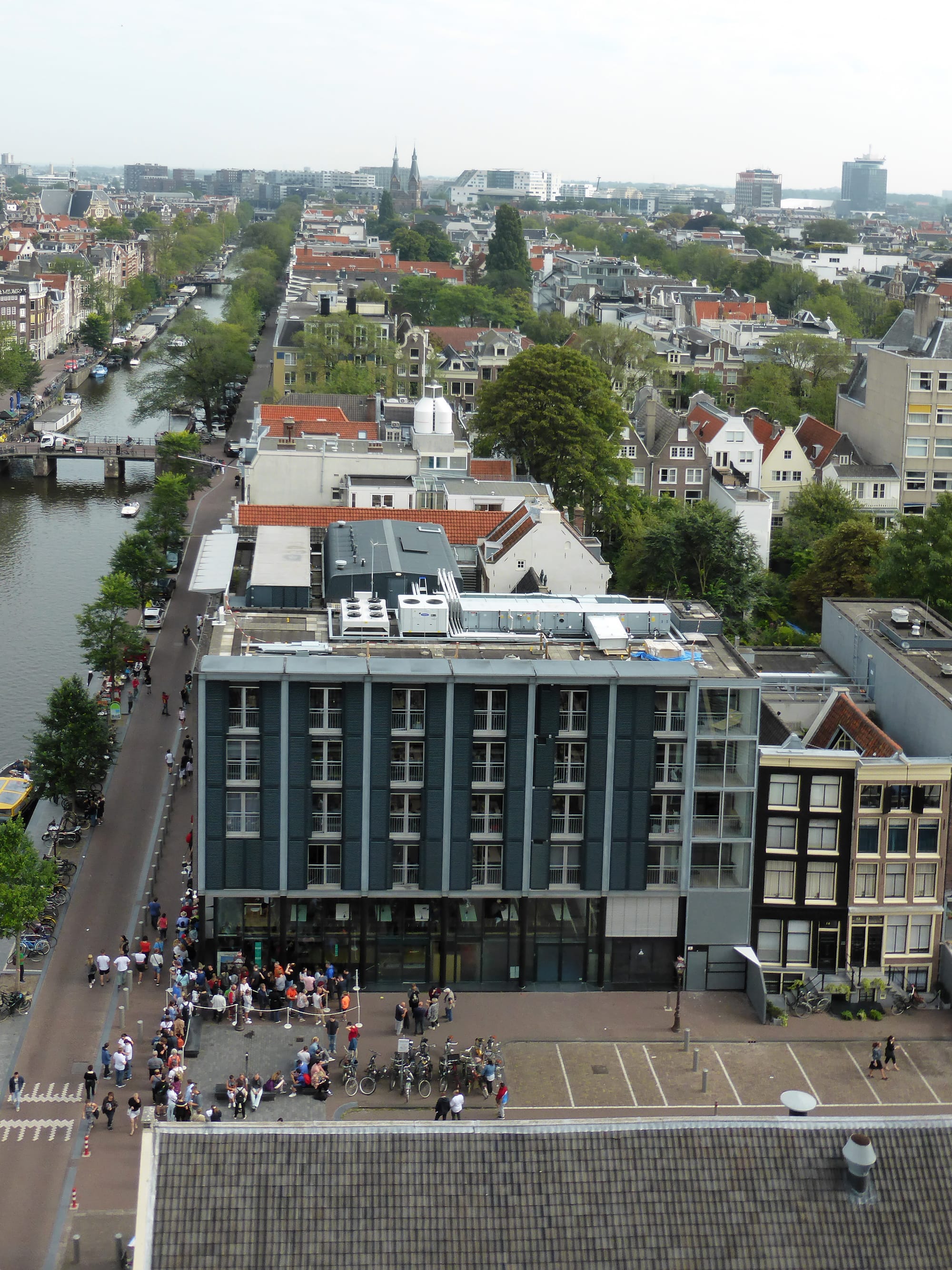
The Opening of the Museum in 1960
On 3 May 1960, the Anne Frank House officially opened to the public.
The museum allowed visitors to enter the building where Anne Frank had lived in hiding.
Its opening represented the culmination of years of preservation efforts.
By then, Anne's diary had already been translated into several languages and adapted for theatre and film.
International interest in her story was growing.
The museum provided a physical connection to the events described in her writing.
Visitors could move through the former business premises, see the concealed entrance and enter the rooms where the eight occupants had lived.
The experience differed from reading the diary.
The physical dimensions of the Annex made the restrictions of hiding more tangible.
The narrow spaces, limited rooms and separation from the outside world helped visitors understand the practical conditions of confinement.
The museum also connected Anne's individual story to the wider history of Nazi occupation and the persecution of Jews in the Netherlands.
The Movable Bookcase
One of the most recognisable features of the Anne Frank House is the movable bookcase concealing the entrance to the Secret Annex.
The bookcase was constructed in 1942 by Johan Voskuijl, the father of helper Bep Voskuijl.
It was installed after the Frank family had already entered hiding.
The structure concealed the doorway leading to the rear building.
For people unfamiliar with the premises, it appeared to be an ordinary piece of office furniture.
For the occupants, it represented a barrier between their hidden existence and the danger outside.
The bookcase could reduce the likelihood of casual discovery, but it could not guarantee safety.
The occupants still depended on silence, secrecy and the cooperation of trusted helpers.
Today, the bookcase remains one of the most powerful physical reminders of the circumstances in which the eight people lived.
It demonstrates how ordinary objects could acquire extraordinary significance under persecution.
A piece of furniture became part of an attempt to preserve human life.
Anne's Room and the Pictures on the Wall
Among the most personal features preserved in the Secret Annex are the pictures Anne placed on the walls of her room.
During her time in hiding, Anne decorated the walls with photographs, postcards and images of people she admired.
These included film stars, members of royal families and other pictures that interested her.
The decorations helped make the small room feel more personal.
They also reflected Anne's identity as a teenager.
Although she was living under extraordinary restrictions, she continued to express her interests and preferences.
The pictures connected her to a world of popular culture, imagination and ordinary adolescent life.
Their preservation is historically significant.
They are not simply decorative details.
They provide direct evidence of Anne's presence in the room.
They also remind visitors that the person whose diary became internationally famous was a young girl with interests beyond the war.
Her life included curiosity, humour, ambitions and personal attachments.
The wall decorations help preserve that individuality.
The Original Diary Manuscripts
Anne Frank's original diary writings are among the most important historical materials associated with the museum.
They include the red-and-white checked diary she received for her thirteenth birthday in June 1942, along with later notebooks and loose sheets.
The surviving manuscripts document Anne's development as a writer.
They also reveal how she revised her work after deciding that her experiences might eventually become a published book.
The Anne Frank House is closely involved in the preservation and presentation of these materials.
The original manuscripts are part of the Dutch national heritage collection and are held in the care of the Netherlands Institute for War, Holocaust and Genocide Studies, known as NIOD.
They are made available for display at the Anne Frank House under controlled conditions.
Preserving historical manuscripts requires careful attention to light, temperature, humidity and handling.
Paper and ink can deteriorate over time.
Conservation measures are therefore essential to ensure that future generations can continue studying the original documents.
The diary is not only a literary work.
It is also a physical historical object that survived the arrest of its author and the destruction of her family.
The Importance of Original Documents
Historical remembrance depends on reliable evidence.
Anne Frank's diary is supported by a substantial body of documentation, including original manuscripts, photographs, correspondence, official records and testimony.
The preservation of these materials allows researchers to examine the circumstances in which Anne lived and wrote.
It also helps distinguish historical facts from later interpretations.
For example, the different versions of Anne's diary demonstrate that she was actively revising her writing before her arrest.
Her original entries and revised manuscript can be compared with the text prepared for publication by Otto Frank.
This makes it possible to study Anne not only as a historical witness but also as a developing author.
Original documents are especially important when confronting attempts to distort or deny Holocaust history.
The authenticity of Anne Frank's writings has been established through extensive historical and forensic research.
Preserving the manuscripts ensures that this evidence remains available for future examination.
Historical Research and New Discoveries
The history of Anne Frank continues to be studied.
Researchers investigate the lives of the eight occupants, the people who helped them, the circumstances of their arrest and the broader context of Jewish persecution in the Netherlands.
New archival material and historical methods can deepen understanding of events that occurred more than eighty years ago.
Research has helped clarify details about Anne's childhood, the development of her writing and the experiences of the Frank family after deportation.
It has also corrected assumptions that were once widely repeated.
One example concerns the deaths of Anne and Margot Frank.
For many years, their deaths were commonly dated to March 1945.
Research published by the Anne Frank House in 2015 indicated that they probably died in February 1945.
The precise dates remain unknown.
This distinction illustrates an important principle of historical research.
Responsible institutions must be willing to revise conclusions when stronger evidence becomes available.
Historical accuracy requires recognising both what is known and what remains uncertain.
The Unresolved Question of the Arrest
The discovery of the Secret Annex has been the subject of numerous investigations.
Researchers have examined possible informants, police activities, economic offences and other circumstances that might have led the authorities to Prinsengracht 263.
Several theories have attracted public attention.
However, no definitive explanation has been established.
The Anne Frank House has continued to distinguish between documented evidence and speculation.
This is particularly important because accusations of betrayal can affect the reputations of individuals and families.
A theory should not be presented as historical fact without sufficient evidence.
The uncertainty surrounding the arrest does not diminish what is known about the persecution of the occupants.
They were Jewish people forced into hiding by Nazi policies.
They were arrested by authorities operating under the German occupation.
They were deported into a system of imprisonment and mass murder.
Seven of the eight did not survive.
These established facts remain central regardless of whether the precise circumstances of discovery are ever fully resolved.
The Museum as a Place of Holocaust Education
The Anne Frank House has developed into an internationally recognised institution for Holocaust education.
Its educational work extends beyond the physical building in Amsterdam.
The organisation produces learning materials, exhibitions and resources for schools and other audiences.
These initiatives explore Anne Frank's life, the German occupation of the Netherlands, antisemitism and the consequences of discrimination.
A central educational challenge is connecting Anne's personal experiences to the wider history of the Holocaust.
Her diary is accessible to young readers because it describes familiar aspects of adolescence.
She wrote about friendships, family disagreements, identity and hopes for the future.
These themes can help students connect emotionally with her story.
However, that connection must be accompanied by historical understanding.
Anne was not simply a teenager experiencing difficult circumstances.
She was a Jewish girl persecuted by a regime committed to excluding and murdering Jews.
Educational programmes must therefore explain the ideology, institutions and decisions that made her persecution possible.
Teaching History Without Simplifying It
Anne Frank's story is sometimes presented primarily as a lesson about kindness or tolerance.
These themes can be meaningful, but they are not sufficient on their own.
The Holocaust was not caused merely by individual unkindness.
It resulted from Nazi antisemitic ideology, state-directed persecution, administrative cooperation, organised deportation and systematic mass murder.
Understanding this history requires examining political decisions and institutional responsibility.
It also requires recognising the different experiences of victims, perpetrators, collaborators, bystanders and rescuers.
The Anne Frank House provides an opportunity to introduce these distinctions through a personal story.
Visitors can learn about the eight people in hiding while also considering the thousands of Jews deported from Amsterdam and other parts of the Netherlands.
The challenge is to preserve the emotional power of Anne's diary without reducing the historical events to a simple moral message.
A meaningful encounter with history should encourage questions as well as sympathy.
Antisemitism Then and Now
The Anne Frank House also addresses antisemitism as a historical and contemporary issue.
Antisemitism existed in Europe long before the rise of Nazi Germany.
The Nazi regime transformed antisemitic prejudice and conspiracy theories into state policy, exclusion and genocide.
The Holocaust demonstrates the catastrophic consequences of a political system built around racial persecution.
Studying this history also requires attention to the ways antisemitism can appear in contemporary society.
It may take the form of harassment, threats, conspiracy theories, vandalism, discrimination or violence directed at Jewish people and institutions.
Holocaust distortion and denial are additional concerns.
Educational institutions have a responsibility to explain historical evidence clearly and challenge false claims.
At the same time, contemporary political disagreements should be examined with precision.
Criticism of a government or its policies is not automatically antisemitic. Whether a statement or action is antisemitic depends on its content and context, including whether it targets Jews as Jews or invokes antisemitic stereotypes.
Historical education is most effective when it encourages careful distinctions rather than broad assumptions.
The Experience of Visiting the Secret Annex
A visit to the Anne Frank House differs from reading the diary or watching a documentary.
The physical environment communicates information that written descriptions cannot fully convey.
Visitors move through the former business premises and encounter the entrance concealed behind the movable bookcase.
They enter rooms that once accommodated eight people.
The limited space becomes immediately apparent.
The absence of furniture draws attention to the people who are no longer there.
The preserved photographs on Anne's wall provide a personal connection to her life.
Exhibitions and historical materials explain the broader context of Nazi persecution.
The experience can be emotionally powerful.
However, the museum is not intended simply to produce an emotional response.
Its historical value lies in combining the original location with documented information about the occupants, their helpers and the events that led to their arrest and deportation.
The Importance of Preserving Difficult History
Preserving a site associated with persecution requires ongoing care.
Buildings deteriorate.
Historical materials are vulnerable to damage.
Visitor demand can create pressure on fragile spaces.
Museums must balance public access with conservation.
The Anne Frank House has undertaken restoration and preservation work over the decades to protect the building and its historical features.
The institution has also expanded and updated its exhibitions to accommodate visitors and present historical information.
Such work involves difficult decisions.
A museum must remain accessible while protecting the authenticity of the site.
It must explain the past without turning suffering into spectacle.
It must also respond to new historical research while maintaining respect for victims and survivors.
These responsibilities are not unique to the Anne Frank House.
They are shared by Holocaust museums, memorials and former camp sites throughout Europe.
Beyond the Building: Digital Preservation
Historical education increasingly extends beyond physical museum visits.
Digital archives, virtual educational resources and online exhibitions allow people to study Anne Frank's history without travelling to Amsterdam.
These resources can make original documents, photographs and historical explanations accessible to international audiences.
They are particularly valuable for schools and researchers.
Digital preservation also helps protect fragile materials by reducing the need for repeated physical handling.
However, digital presentations must maintain the same standards of historical accuracy as traditional exhibitions.
Images and documents require clear descriptions.
Sources should be identified.
Interpretations should distinguish established facts from unresolved questions.
Technology can expand access to history, but it cannot replace the need for reliable evidence and responsible scholarship.
The Wider Landscape of Holocaust Remembrance in Amsterdam
The Anne Frank House is one of several important locations connected to the history of Jewish persecution in Amsterdam.
The Hollandsche Schouwburg commemorates people who were detained there before deportation.
The National Holocaust Museum presents the broader history of the persecution and murder of Jews in the Netherlands.
The National Holocaust Names Memorial preserves the names of more than 102,000 Jewish, Roma and Sinti victims from the Netherlands who have no known graves.
Jewish cultural institutions and historical archives also document centuries of Jewish life before the war.
Together, these sites provide a more complete historical perspective.
Anne Frank's story is internationally familiar, but the Holocaust in the Netherlands affected entire communities.
Understanding that history requires recognising both the individual experiences preserved through diaries and the larger patterns documented through archives, memorials and historical research.
The Anne Frank House forms one part of this wider landscape of remembrance.
The Voices That Were Never Published
Anne Frank's diary survived because she wrote it, because helpers preserved the manuscripts and because Otto Frank lived to arrange their publication.
Many other Jewish victims left no comparable written testimony.
Some never had the opportunity to write.
Others lost their papers during arrest, deportation or imprisonment.
Entire families were murdered, leaving no survivors to preserve their belongings.
This absence is one of the most difficult challenges in Holocaust history.
The surviving documents provide essential evidence, but they cannot represent every experience.
Historians therefore rely on a wide range of sources.
Transport records, photographs, municipal documents, letters, testimony and material objects help reconstruct lives that might otherwise remain unknown.
Remembering Anne Frank responsibly also means acknowledging the people whose voices were not preserved.
Their lives were no less significant because their stories did not become internationally famous.
A Memorial to Eight People
Although the museum bears Anne Frank's name, the Secret Annex was home to eight individuals.
Otto Frank, Edith Frank, Margot Frank, Anne Frank, Hermann van Pels, Auguste van Pels, Peter van Pels and Fritz Pfeffer shared the hidden rooms.
Each had a separate life before entering hiding.
Each experienced the restrictions, uncertainty and tensions of confinement.
After their arrest, they were deported through the Nazi camp system.
Only Otto survived.
The museum preserves the history of all eight occupants.
It also acknowledges the helpers who made their concealment possible.
Miep Gies, Bep Voskuijl, Johannes Kleiman, Victor Kugler, Jan Gies and Johan Voskuijl are part of the history of the building.
Their decisions demonstrate how individuals responded differently to persecution.
Some people assisted the Nazi occupation authorities.
Others risked their safety to protect those being targeted.
The Secret Annex offers a concrete setting in which to examine these choices.
Memory and Historical Responsibility
The preservation of the Anne Frank House raises a broader question: what does it mean to remember history responsibly?
Remembrance is more than maintaining a building or displaying original documents.
It requires explaining the circumstances that gave those objects their meaning.
The Secret Annex existed because Jewish people were being systematically persecuted.
The eight occupants entered hiding because remaining visible in Dutch society had become dangerous.
Their arrest led to deportation, imprisonment and the deaths of seven people.
The museum's responsibility is therefore not only to preserve Anne's room or display her diary.
It is to communicate the historical reality that shaped her life and death.
That responsibility includes confronting antisemitism, examining the actions of institutions and individuals, and recognising the wider destruction of Jewish communities.
It also requires avoiding historical distortion and unsupported claims.
Accurate remembrance depends on evidence, context and a willingness to acknowledge uncertainty.
The Lasting Significance of the Anne Frank House
More than eight decades after Anne Frank entered hiding, the building at Prinsengracht 263 remains a place where personal history and the wider Holocaust intersect.
The rooms are small.
The entrance is concealed.
The photographs on Anne's wall remain visible.
The original diary manuscripts are preserved for future generations.
These physical traces connect visitors to a young girl who wanted to become a writer and to the seven other people who shared her attempt to survive.
The museum cannot restore their lives.
It cannot recreate the world that existed before the German occupation.
But it can preserve evidence, communicate history and encourage people to confront the consequences of persecution.
Anne Frank's diary allows readers to hear her voice.
The Anne Frank House allows them to encounter the place where much of that voice was formed.
Together, they provide an enduring connection between individual testimony and historical remembrance.
The final chapter examines Anne Frank's legacy in the twenty-first century: how her story is taught, how it is sometimes misunderstood, and what it can contribute to informed discussions about antisemitism, human rights and the responsibility to remember.
Chapter 10 — Anne Frank's Legacy: Antisemitism, Human Rights and Remembrance
A Young Girl Whose Words Reached the World
Anne Frank was fifteen years old when she died at Bergen-Belsen concentration camp in early 1945.
She never saw the publication of her diary.
She never returned to school, pursued a career in journalism or experienced the adulthood she had imagined while living in hiding.
Yet the words she wrote in the Secret Annex survived.
Since the first publication of Het Achterhuis in 1947, her diary has reached millions of readers across the world.
It has been translated into numerous languages, studied in classrooms, adapted for theatre and film, and examined by historians and literary scholars.
Anne's story has become one of the most internationally recognised personal accounts of the Holocaust.
For many people, her diary provides their first encounter with the persecution of Jews under Nazi rule.
Its influence is extraordinary.
But the international recognition of Anne Frank also creates an important responsibility.
Her life must be remembered accurately, within the historical circumstances that led to her persecution and death.
She was not simply a young girl whose dreams were interrupted by war.
She was a Jewish child targeted by a regime that systematically excluded, deported and murdered Jews.
Her legacy begins with that historical reality.
The Danger of Remembering Only the Symbol
Over time, Anne Frank has become a symbol of hope, innocence, courage and the human desire for freedom.
These interpretations reflect important aspects of her writing.
She expressed hopes for the future, questioned the world around her and continued developing her identity despite the restrictions of hiding.
However, reducing Anne to a universal symbol can unintentionally obscure the specific history of her persecution.
Anne was forced into hiding because she was Jewish.
She was arrested under the German occupation of the Netherlands.
She was deported through Westerbork to Auschwitz-Birkenau and later transferred to Bergen-Belsen.
She died as a consequence of the conditions created by Nazi persecution and imprisonment.
These facts cannot be separated from the diary's meaning.
Her story is not simply about overcoming adversity.
It is about a young person whose life was destroyed by antisemitism and genocide.
Remembering her responsibly means recognising both her individuality and the historical forces that denied her a future.
Anne Frank Was More Than a Victim
Anne Frank is often introduced to readers through the circumstances of her death.
Yet her diary reveals a person whose identity extended far beyond victimhood.
She was curious, outspoken, observant and ambitious.
She enjoyed reading and writing.
She reflected on family relationships, friendships, romantic feelings and her own personality.
She could be humorous, critical, uncertain and deeply thoughtful.
She wanted to become a journalist or professional writer.
In 1944, she began revising her diary because she believed her experiences might one day become a published book.
This literary ambition deserves recognition in its own right.
Anne was not merely recording events without considering their meaning.
She was developing her ability to tell stories, describe people and communicate complex emotions.
Her writings reveal an emerging author whose work was interrupted before it could reach maturity.
Recognising her talent does not diminish the tragedy of her death.
It makes the loss more visible.
The Holocaust did not only take lives.
It destroyed possibilities, careers, relationships and futures that could never be realised.
The Meaning of Antisemitism
To understand Anne Frank's legacy, it is necessary to understand the antisemitism that shaped her life.
Antisemitism refers to prejudice, hostility or discrimination directed against Jews because they are Jewish.
It has appeared in different forms across history.
Religious hostility toward Jewish communities existed in Europe for centuries.
During the nineteenth and twentieth centuries, racial theories and nationalist movements contributed to new forms of antisemitic ideology.
Nazi Germany combined antisemitism with an extreme racial worldview.
The regime portrayed Jews as enemies of German society and falsely blamed them for political, economic and social problems.
These claims were not based on evidence.
They were part of a propaganda system designed to justify exclusion, persecution and ultimately mass murder.
Under Nazi rule, antisemitism became embedded in legislation, education, government administration and state violence.
The Holocaust demonstrates the catastrophic consequences of this process.
Anne Frank's experience reveals how such policies affected an individual child.
She lost access to ordinary education, public spaces and freedom of movement before being forced into hiding.
Her persecution was not caused by anything she had done.
It was imposed because of her Jewish identity.
From Prejudice to State Persecution
The Holocaust did not begin with the construction of extermination camps.
It developed through political decisions, discriminatory laws, propaganda, administrative measures and escalating violence.
In Germany, Jews were progressively excluded from public employment, education, professional life and citizenship rights.
After the German occupation of the Netherlands, similar policies were introduced there.
Jewish residents were registered.
Their businesses and property were targeted.
Children were separated from non-Jewish classmates.
Restrictions limited movement and participation in public life.
The yellow Star of David made Jewish people visibly identifiable.
Deportations followed.
These stages demonstrate how a state can transform prejudice into systematic persecution.
They also reveal the importance of institutions.
Government offices, police organisations, transport systems and administrative records became instruments through which Nazi policies were implemented.
Understanding this process is essential to Holocaust education.
The genocide was not an isolated outbreak of violence.
It was organised and carried out through decisions, structures and actions involving many people.
The Responsibility of Institutions
Anne Frank's history raises difficult questions about institutional responsibility.
The Nazi regime directed the persecution and murder of European Jews.
But the implementation of its policies in occupied countries involved local administrative systems and organisations.
In the Netherlands, municipal records, identity documents, police operations and railway infrastructure were used in the persecution and deportation of Jews.
The behaviour of individuals within these institutions varied.
Some actively collaborated.
Others complied with occupation orders.
Some attempted to obstruct persecution or help those being targeted.
These distinctions are important.
Historical responsibility should be examined through evidence rather than assumptions about entire populations.
At the same time, the involvement of ordinary institutions demonstrates that serious human rights violations can become embedded in routine procedures.
Administrative decisions may appear distant from violence, but they can have devastating consequences when used to identify, isolate or remove vulnerable populations.
The Holocaust therefore requires examination not only of political leaders and perpetrators, but also of the institutions through which persecution became possible.
The Courage of Those Who Helped
The history of Anne Frank also includes the actions of people who refused to abandon those facing persecution.
Miep Gies, Jan Gies, Bep Voskuijl, Johannes Kleiman, Victor Kugler and Johan Voskuijl helped sustain the eight occupants of the Secret Annex.
Their assistance included providing food, maintaining secrecy, organising practical arrangements and bringing news from the outside world.
They acted under German occupation, when helping Jews evade arrest carried serious risks.
Their decisions did not guarantee the survival of the people they protected.
The eight occupants were eventually discovered and deported.
Seven died.
Yet the helpers' actions remain historically significant.
They demonstrate that individuals could make choices within a system of persecution, even when those choices involved danger.
Across the Netherlands, other people also helped Jews obtain false documents, find hiding places or escape arrest.
Their experiences remind us that resistance was not limited to armed action.
Providing shelter, food, information or protection could also become acts of opposition.
These examples should not be romanticised.
Many people were unable to find help, and rescue efforts often failed.
But the choices made by helpers remain an important part of the historical record.
The Voices of Those Who Did Not Survive
Anne Frank's diary is exceptional because it survived.
Most Jewish children murdered during the Holocaust did not leave behind a comparable written account.
Some were too young to write.
Others lost their papers during arrest, deportation or imprisonment.
Entire families were murdered, leaving no relatives to preserve photographs, letters or personal belongings.
This creates an important challenge for remembrance.
The stories most widely known are not necessarily representative of every experience.
Anne lived in hiding for more than two years with the assistance of a trusted support network.
Many Jewish families had no access to such protection.
Others were deported much earlier.
Some survived under false identities or through underground networks.
Some experienced ghettos, forced labour or different concentration camps.
The Holocaust affected Jewish communities across Europe in ways that varied according to location, occupation policies, available resources and individual circumstances.
Anne's diary provides one deeply personal perspective.
It should encourage readers to learn about the lives of others rather than replace their stories.
The Importance of Names and Individual Histories
The Holocaust is often described through numbers.
Approximately six million Jews were murdered by Nazi Germany and its collaborators.
More than 100,000 Jews from the Netherlands were among the victims.
These figures are essential for understanding the scale of the genocide.
But numbers alone cannot communicate the individuality of the people who died.
Each victim had a name, a family, a personal history and relationships with others.
Some were infants.
Others were elderly.
They came from different social backgrounds and held different religious, political and cultural beliefs.
Memorial projects, archives and historical institutions work to recover and preserve these individual identities.
In the Netherlands, the National Holocaust Names Memorial in Amsterdam commemorates more than 102,000 Jewish, Roma and Sinti victims who have no known graves.
The names are inscribed individually.
This approach challenges the anonymity imposed by the Nazi persecution system.
It reminds visitors that the Holocaust was not only a historical event measured through statistics.
It was the destruction of individual human lives.
Holocaust Education for New Generations
As the number of living Holocaust survivors continues to decline, education becomes increasingly important.
Future generations will have fewer opportunities to hear direct testimony from people who experienced Nazi persecution.
Historical institutions therefore face the responsibility of preserving survivor accounts, documents and physical evidence.
Anne Frank's diary remains an important educational resource.
Its personal style makes it accessible to younger readers.
Students can recognise familiar experiences of adolescence while learning about the extraordinary circumstances in which Anne lived.
However, effective Holocaust education must extend beyond emotional identification.
It should explain the historical development of Nazi antisemitism, the persecution of Jewish communities, the organisation of deportations and the system of mass murder.
It should also examine the experiences of other victim groups and the different forms of Nazi persecution, while preserving the historical specificity of the genocide of the Jews.
Education should encourage students to distinguish evidence from speculation.
It should introduce primary sources and explain how historians establish facts.
Anne Frank's diary can provide a starting point for this work.
It cannot replace the wider historical record.
The Challenge of Holocaust Denial and Distortion
Despite extensive historical evidence, the Holocaust remains a target of denial and distortion.
Some individuals falsely claim that the genocide did not occur or attempt to minimise the number of victims.
Others misrepresent historical documents, manipulate photographs or promote conspiracy theories.
Anne Frank's diary has repeatedly been targeted by such claims.
Accusations that the diary was fabricated have been disproven through historical and forensic research.
The surviving manuscripts have been examined by specialists, and their authenticity is firmly established.
The existence of different diary versions reflects Anne's own revisions and later editorial decisions.
It is not evidence that the diary was invented.
Holocaust denial is not a legitimate alternative interpretation of the historical record.
It rejects or manipulates extensive evidence, including Nazi documents, transport lists, camp records, photographs, physical remains and survivor testimony.
Historical debate is essential when evidence is incomplete or interpretations differ.
But responsible debate must remain grounded in verifiable sources.
The distinction between legitimate historical inquiry and deliberate distortion is fundamental to preserving accurate public understanding.
Antisemitism in the Twenty-First Century
Antisemitism did not disappear with the defeat of Nazi Germany.
Jewish communities continue to experience prejudice, harassment, threats and violence in different parts of the world.
Contemporary antisemitism can appear through conspiracy theories, stereotypes, vandalism, online abuse and attacks against Jewish people or institutions.
Historical narratives about Jewish power, collective responsibility or supposed disloyalty may reappear in modern language.
Digital platforms can accelerate the spread of such ideas.
False information can reach large audiences quickly, particularly when emotionally charged events are presented without context.
The history of Anne Frank provides a reason to take antisemitism seriously.
It demonstrates what happened when a state embraced antisemitic ideology and transformed it into systematic persecution.
However, historical comparisons must be made carefully.
Not every contemporary incident is equivalent to Nazi persecution, and the Holocaust should not be used as a casual metaphor for unrelated political disagreements.
Accurate comparisons require attention to context, evidence and the specific nature of the events being discussed.
Jewish Identity and Contemporary Political Debate
Discussions about antisemitism frequently intersect with debates concerning Israel, the Middle East and international politics.
These subjects can generate strong disagreements.
It is important to distinguish criticism of a government or its policies from hostility directed toward Jewish people as a group.
Criticism of Israeli government decisions is not automatically antisemitic.
At the same time, political arguments can become antisemitic when they invoke anti-Jewish stereotypes, hold Jews collectively responsible for the actions of a state or target Jewish individuals and institutions because they are Jewish.
The context and content of particular statements matter.
Jewish people have diverse political opinions, national identities, religious practices and relationships with Israel.
They should not be treated as a single political group.
The same principle of individual responsibility applies to all populations.
Historical understanding requires resisting collective blame and examining actions, institutions and policies with precision.
Anne Frank's story reminds us of the consequences of a worldview that denied individuals their humanity because of an identity assigned to them.
Human Rights and the Lessons of History
The Holocaust had a profound influence on postwar discussions about international law and human rights.
In 1948, the United Nations General Assembly adopted the Universal Declaration of Human Rights.
That same year, the Convention on the Prevention and Punishment of the Crime of Genocide was adopted.
These developments emerged in a world confronting the consequences of the Second World War, Nazi atrocities and other forms of mass violence.
The Universal Declaration affirmed fundamental rights and freedoms belonging to all human beings.
The Genocide Convention established genocide as a crime under international law.
Neither document can be understood solely as a response to Anne Frank's story.
They reflected broader efforts to create international standards after catastrophic violations of human dignity.
Nevertheless, Anne's experience illustrates why such protections matter.
She was deprived of education, freedom of movement, personal security and ultimately her life because she belonged to a targeted population.
Her story connects abstract principles of human rights to the experience of an individual child.
The Role of Journalism in Preserving Historical Truth
Journalism has an important responsibility in reporting on the Holocaust and its legacy.
Historical subjects require the same commitment to verification, accuracy and context as contemporary events.
Journalists must distinguish established facts from interpretations and unresolved questions.
They should identify reliable sources and avoid repeating unsupported allegations.
The question of how the Secret Annex was discovered provides one example.
Various theories have been proposed over the decades.
Yet no definitive explanation has been established.
Responsible reporting should communicate that uncertainty rather than presenting speculation as fact.
The same principle applies to the circumstances of Anne and Margot Frank's deaths.
Their exact death dates are unknown, although historical research indicates that they probably died in February 1945.
Accurate journalism acknowledges these limits.
It does not weaken a story to explain what remains uncertain.
On the contrary, transparency strengthens public trust.
The Responsibility to Avoid Sensationalism
The Holocaust is a subject of immense human suffering.
Its history includes persecution, forced displacement, starvation, torture and mass murder.
Reporting on these events requires sensitivity toward victims and survivors.
Sensational language or unnecessarily graphic descriptions can distract from historical understanding.
Images should be selected carefully and presented with accurate captions.
Archival photographs should not be used merely for emotional impact.
Their dates, locations and subjects should be verified wherever possible.
A photograph from one concentration camp should not be presented as evidence of events at another.
Similarly, quotations attributed to victims should be checked against reliable editions of original documents.
Anne Frank's words are frequently shared online, sometimes without context or with incorrect attribution.
Responsible journalism should avoid repeating quotations that cannot be verified.
The purpose of historical reporting is not simply to provoke emotion.
It is to help readers understand what happened, why it happened and what the evidence reveals.
The Danger of Simplifying the Holocaust
The Holocaust is sometimes presented through a narrow set of familiar images and stories.
Anne Frank's diary, Auschwitz and the liberation of concentration camps are among the most widely recognised subjects.
These are essential parts of Holocaust history.
But they do not tell the entire story.
The genocide involved ghettos, mass shootings, forced labour, starvation, deportations, extermination camps and persecution across numerous occupied territories.
It affected Jewish communities with different languages, traditions and social backgrounds.
It also involved a wide range of perpetrators, collaborators, bystanders, rescuers and survivors.
Simplifying this history can obscure the mechanisms through which persecution developed.
It can also create the misleading impression that the Holocaust was inevitable or that everyone involved behaved in the same way.
Historical understanding requires attention to complexity.
The decisions made by governments, institutions and individuals mattered.
So did the opportunities for resistance, the limitations faced by victims and the changing circumstances of the war.
The Anne Frank House and the Preservation of Memory
The Anne Frank House continues to play a central role in preserving Anne's history.
The museum protects the building at Prinsengracht 263 and presents the experiences of the eight people who lived in hiding.
It also develops educational resources and supports historical research.
The physical site offers a direct connection to the events described in the diary.
Visitors can enter the Secret Annex, see the concealed entrance and observe the photographs Anne placed on the walls of her room.
The rooms remain largely unfurnished, reflecting Otto Frank's wish to preserve the sense of absence left by those who did not return.
This emptiness is part of the museum's historical message.
It reminds visitors that the people who once occupied those rooms were arrested and deported.
The building is therefore both a place of remembrance and a source of historical evidence.
Its preservation ensures that future generations can encounter the setting in which Anne's writing developed.
The Limits of Hope as a Historical Message
Anne Frank is often associated with hope.
Her diary contains reflections on the future, personal growth and the possibility of a better world.
These passages have inspired readers across generations.
Yet hope should not become the only message drawn from her life.
Anne hoped to survive.
She hoped to return to school.
She hoped to become a writer.
She hoped to experience a future beyond the war.
Those hopes were not fulfilled during her lifetime.
She died at Bergen-Belsen before the camp was liberated.
Her story therefore contains a painful distinction between the survival of her words and the destruction of her life.
Remembering Anne only as an inspirational figure can unintentionally soften the historical reality.
Her diary should inspire reflection, but it should also confront readers with the consequences of persecution.
The tragedy is not diminished by the beauty of her writing.
It becomes more apparent because readers can recognise the person whose future was taken away.
Remembering the Other Seven Occupants
Anne Frank's international recognition should not overshadow the seven people who shared the Secret Annex with her.
Otto Frank survived Auschwitz and devoted much of his later life to preserving Anne's writings.
Edith Frank died at Auschwitz in January 1945.
Margot Frank died at Bergen-Belsen in early 1945.
Hermann van Pels was murdered at Auschwitz.
Auguste van Pels died after transfers through the Nazi camp system.
Peter van Pels died at Mauthausen in May 1945.
Fritz Pfeffer died at Neuengamme in December 1944.
Each person had a separate history.
They were parents, children, professionals and individuals with their own relationships and ambitions.
Their lives did not begin when they entered hiding.
Nor should they be remembered only through their connection to Anne.
The history of the Secret Annex is the history of eight people who attempted to survive.
Seven did not return.
The Legacy of Otto Frank
Otto Frank's role in preserving Anne's diary was essential.
He survived Auschwitz and returned to Amsterdam, where he learned that his wife and daughters had died.
Miep Gies gave him Anne's writings after the fate of the girls became known.
Otto recognised the importance of the manuscripts and worked to have them published.
The first Dutch edition appeared in 1947.
He later supported the preservation of the Secret Annex and the development of the Anne Frank House.
For decades, he corresponded with readers and participated in educational initiatives.
His work helped ensure that Anne's writings reached an international audience.
But Otto's legacy also reflects the experience of a Holocaust survivor.
He lived with the loss of his family while attempting to preserve their memory.
His actions demonstrate the importance of those who safeguard personal testimony after mass violence.
Without such efforts, many historical voices might disappear.
Why Anne Frank Still Matters
Anne Frank's story continues to matter because it connects individual experience with one of the most extensively documented crimes in modern history.
Her diary reveals the effects of persecution on daily life.
It shows how discriminatory policies could force a family to abandon ordinary freedoms and disappear from public view.
It records the emotional development of a young person living under constant uncertainty.
It also demonstrates the importance of personal testimony.
Through her writing, Anne preserved experiences that might otherwise have remained unknown to future generations.
Yet the diary's significance depends on understanding its historical context.
Anne was one of millions of Jewish people targeted by Nazi Germany.
Her experiences were individual, but the persecution that shaped them was systematic.
The survival of her diary does not make her suffering more important than that of victims whose words were lost.
Instead, it provides an opportunity to recognise the humanity of people whose lives were destroyed.
Remembrance as an Ongoing Responsibility
Remembrance is not a task completed by building memorials or publishing books.
It requires continued research, education and public engagement.
Historical institutions must preserve documents and physical evidence.
Educators must explain the events accurately.
Journalists must verify claims and provide context.
Governments and societies must confront the histories of institutions that participated in persecution.
Individuals also have a role in recognising prejudice and rejecting the dehumanisation of others.
These responsibilities do not mean that every contemporary conflict should be compared directly with the Holocaust.
Historical events must be understood within their own circumstances.
But studying the Holocaust can strengthen awareness of the consequences of state-directed discrimination, propaganda and the removal of fundamental rights.
The purpose of remembrance is not to claim that history always repeats itself.
It is to understand how particular decisions and systems produced catastrophic outcomes, and why that knowledge remains important.
A Life That Cannot Be Reduced to Its Ending
Anne Frank's life ended at fifteen.
Her ambitions remained unfinished.
She never experienced the freedom she imagined during her years in hiding.
But her surviving writings reveal more than the circumstances of her death.
They preserve her humour, curiosity, intelligence, frustrations and hopes.
They show a young person attempting to understand herself and the world around her.
Her diary allows readers to encounter Anne as an individual rather than only as a victim.
That distinction is essential.
The Holocaust was an attempt to destroy people because of their Jewish identity.
Remembering their individuality is one way of confronting the dehumanisation that made the genocide possible.
Anne Frank was not merely a historical symbol.
She was a person whose life mattered independently of the fame her diary later achieved.
Final Reflection — Beyond the Diary
The story of Anne Frank begins long before the Secret Annex.
It begins with a Jewish family living in Germany, the rise of Nazi persecution and the search for safety in the Netherlands.
It continues through the German occupation, the loss of civil rights, the decision to go into hiding and the daily struggle to remain undiscovered.
It ends with arrest, deportation and the deaths of Anne, Margot, Edith and four other occupants of the Secret Annex.
Only Otto Frank survived.
Yet the history did not end in 1945.
The preservation of Anne's diary, its publication in 1947 and the establishment of the Anne Frank House transformed her personal writings into an enduring historical legacy.
Her story continues to be studied because it connects the enormous scale of the Holocaust to the experiences of one recognisable human being.
But responsible remembrance must look beyond the diary.
It must include the more than 100,000 Jews from the Netherlands who were murdered, the communities that were destroyed, the people who resisted persecution and the institutions whose actions helped make deportation possible.
It must also recognise the survivors who returned to a world transformed by loss.
Anne Frank's diary cannot tell every story of the Holocaust.
No single testimony can.
What it can do is preserve one voice with extraordinary clarity.
A voice that belonged to a young girl who wanted to live, learn, write and become someone in the world.
The responsibility of future generations is not simply to admire her words.
It is to understand the history that made those words necessary, preserve the evidence of what happened and remember the millions of individuals whose futures were taken away.
Anne Frank did not survive the Holocaust.
Her writings did.
And through them, the world can continue to encounter the life behind one of history's most recognised names.
Sources and Further Reading
This article draws on historical research, archival documentation and educational resources published by institutions specialising in Anne Frank's life, the Holocaust and the persecution of Jews in the Netherlands.
Anne Frank House
Anne Frank House — Timeline of Anne Frank's Life
A detailed historical chronology covering Anne Frank's childhood, the German occupation, the Secret Annex, arrest, deportation and death.
https://www.annefrank.org/en/anne-frank/the-timeline/timeline-anne-frank/
Anne Frank House — The Complete Works of Anne Frank
Information about Anne's original diary manuscripts, her rewritten texts, surviving documents and the development of the published diary.
https://www.annefrank.org/en/anne-frank/diary/complete-works-anne-frank/
Anne Frank House — The Publication of the Diary
The history of Otto Frank's decision to publish Anne's writings and the preparation of the first edition.
https://www.annefrank.org/en/anne-frank/diary/publication-diary/
Anne Frank House — Conserving the Anne Frank Collection
Information about the conservation of the original manuscripts, the diary's display and the preservation of historical objects.
Anne Frank House — The Diary of Anne Frank on UNESCO's Documentary Heritage Register
Information about the international recognition of Anne Frank's manuscripts and arrangements for their preservation.
United States Holocaust Memorial Museum
Holocaust Encyclopedia — The Netherlands
Historical background on the German occupation, anti-Jewish measures, deportations, hiding and the destruction of Jewish communities in the Netherlands.
https://encyclopedia.ushmm.org/content/en/article/the-netherlands
Holocaust Encyclopedia — Westerbork
The history of Westerbork transit camp and its role in the deportation of Jews from the Netherlands.
https://encyclopedia.ushmm.org/content/en/article/westerbork
Holocaust Encyclopedia — Mass Deportation of Jews from the Netherlands Begins
Historical information about the systematic deportations beginning in July 1942.
Anne Frank House Research Database
Het Achterhuis Is Published — 25 June 1947
Archival research documenting the first publication of Anne Frank's diary, including publication records and historical references.
https://research.annefrank.org/en/gebeurtenissen/4fea69ad-a50b-45d1-89ef-b68428864012/
Otto Frank and the Typescript of Anne's Diary
Research into the preparation of Otto Frank's typescripts and their role in the first published edition.
https://research.annefrank.org/en/onderwerpen/e68d042f-25ad-4f2b-acfd-2ecbce09290d/
Primary Historical Testimony
Anne Frank — The Diary of a Young Girl / Het Achterhuis
Anne Frank's surviving diary writings, originally composed between 1942 and 1944. Readers should distinguish the original manuscripts, Anne's revised manuscript and later published editions.
For historical research, a scholarly edition that identifies the different manuscript versions is preferable.
Editorial note: This article distinguishes established historical facts from interpretations and unresolved questions. In particular, the circumstances leading to the arrest of the Secret Annex occupants and the exact dates of Anne and Margot Frank's deaths remain matters where the surviving evidence has limitations.